

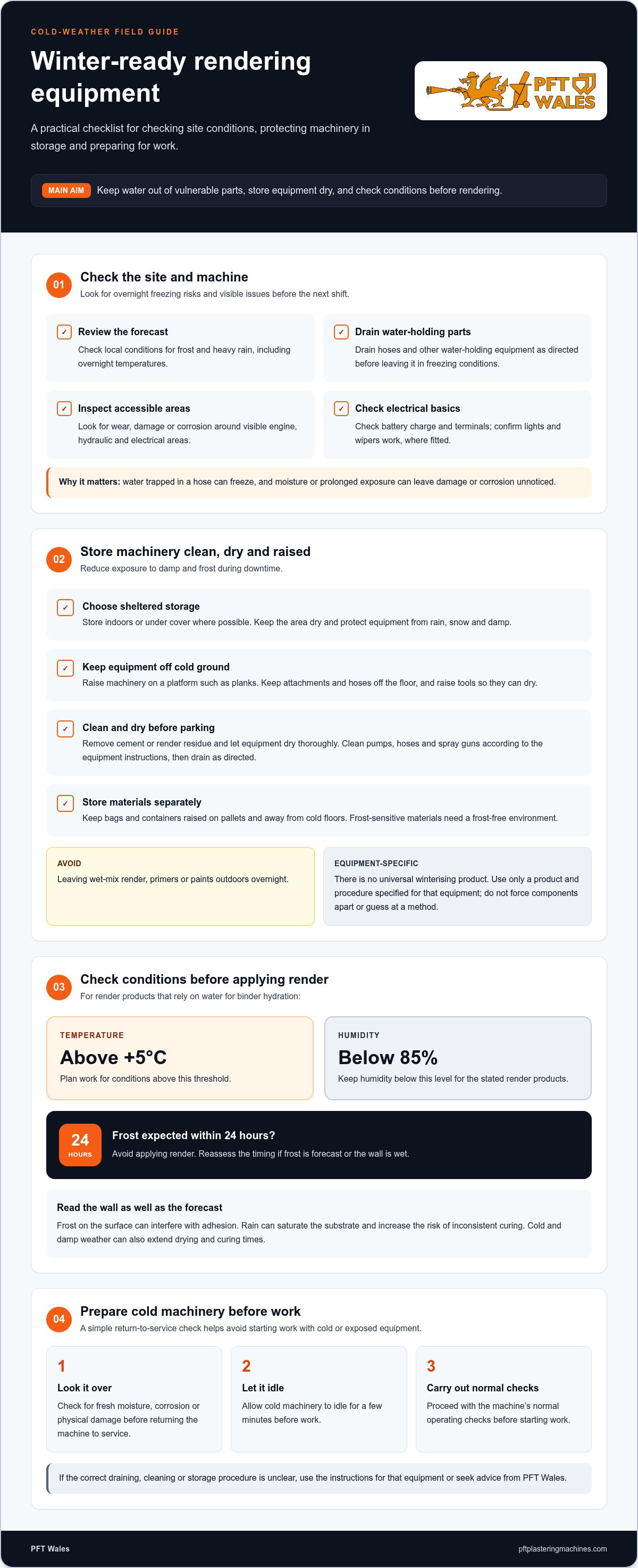
A dry machine is easier to bring back into service than one left with water in its lines. Good winter care for rendering equipment means draining water-holding parts, storing machinery clean and protected from frost, and allowing cold equipment to warm before work. For render products that rely on water for binder hydration, conditions need to be above +5°C with humidity below 85%.
Winter work brings familiar pressures: overnight frost, damp storage and slower curing can disrupt the day. A few practical checks before storage and start-up can help identify freezing risks and prevent machinery being put to work while it is still cold.
This guide explains how to assess conditions, store equipment, manage temperature and humidity, and prepare machinery before starting. It also covers practical cleaning and drying steps for winter storage, and when cold or damp conditions mean it is better to pause rendering.
Key Takeaways
- Check the forecast for frost and heavy rain, and drain water-holding equipment before temperatures drop.
- Where possible, store machinery under cover and raise it off cold, damp ground.
- For render products that rely on water for binder hydration, plan work for conditions above +5°C and below 85% humidity; avoid applying render if frost is expected within 24 hours.
- Clean and dry equipment thoroughly before storage so water left on tools or in components cannot freeze.
- Let cold machinery idle for a few minutes before work, then proceed with its normal operating checks.
1. Checking for freezing conditions
Start with the weather forecast, then compare it with conditions on site. Frost or heavy rain can make a planned shift unsuitable, even if the earlier forecast looked workable. Check overnight temperatures too: water left in hoses or other water-holding parts can freeze after work. Drain those parts as directed before leaving equipment in the cold.
What winter maintenance checks should be carried out on rendering equipment? Inspect visible components for wear, damage and corrosion, including engine areas, hydraulic systems and electrical connections. Check the battery charge and terminals, then make sure lights and wipers work, where fitted. These checks can reveal obvious issues before the machine is needed on site.
- Review the local forecast for frost and heavy rain before planning work.
- Drain water-holding equipment, including hoses, before overnight freezing conditions.
- Look over accessible engine, hydraulic and electrical areas for wear, damage or corrosion.
- Check battery charge and inspect terminals for debris or rust.
- Check that lights and wipers work before setting out, where those components are fitted.
Cold temperatures can affect battery performance, so a machine that started reliably in mild weather may struggle after standing in the cold. Monitor its charge during winter use. If machinery will be idle for an extended period, include the battery and exposed connections in the storage inspection rather than assuming they will be ready at the next start-up. Effective winter care for rendering equipment starts with checks suited to the machine and its working conditions.
What are the risks of leaving rendering equipment unused or exposed over winter? Moisture and freezing temperatures can affect machinery and water-filled parts, while prolonged exposure may leave damage or corrosion unnoticed until the next job. Water trapped in a hose can freeze, and a weakened or damaged connection may then cause problems when work resumes.
Check the machine again before returning it to service. Look for fresh signs of moisture, corrosion or physical damage, and note whether any component appears different from its last inspection. Don’t guess at repairs or change lubricants without the correct machine information. Cold-weather lubricants may be needed for some construction machinery, but the suitable type depends on the equipment.
Freezing conditions affect the wall as well as the machine. Frost on the surface can interfere with render adhesion, while rain can saturate the substrate and increase the risk of inconsistent curing. If frost is expected or the wall is wet, reassess the timing rather than relying on equipment checks alone. Include the site forecast and substrate condition in your winter care for rendering equipment routine.
2. Indoor and raised equipment storage
How do you protect rendering machines and tools from frost and freezing temperatures? Store equipment indoors or under cover where possible, on a raised platform such as planks rather than directly on cold ground. Keep tools dry and raise attachments off the ground during winter storage.
Choose a sheltered space that limits exposure to rain, snow and damp. A covered structure can reduce moisture reaching the machine, but the storage area still needs to be dry. Avoid places where water can collect around the base or settle on exposed parts. If indoor storage is unavailable, use weather-resistant protection and keep machinery raised above the ground.
Before parking the machine, remove cement or render residue and allow the equipment to dry. Any remaining water can freeze, so pay particular attention to water-holding parts. For pumps, hoses and spray guns, follow the equipment’s cleaning instructions, then drain components as directed. Store them dry and protected from frost. Don’t assume that blowing through a hose, dismantling a pump or applying a product is suitable for every machine.
How should render pumps, hoses and spray guns be drained and stored over winter? Clean them according to the machine instructions, drain water-holding parts as directed, and keep them dry under cover. The correct process depends on the equipment, so don’t force components apart or use an unapproved method.
What antifreeze or winterising products are safe for rendering equipment? There is no universal product suitable for every pump, hose or spray gun. Use only a product and procedure specified for that equipment, as an unsuitable additive may affect materials or components.
Store render materials separately from machinery. Keep bags and containers raised on pallets and away from cold floors, where damp can affect the contents. Frost-sensitive materials should be kept in a frost-free environment. Storage requirements depend on the product, particularly for materials used with cement or other binders.
When space is tight, organise the storage area before colder weather arrives. Keep hoses off the floor, avoid tight bends that could trap water, and put small tools somewhere they can dry fully after cleaning. Leave room around the machine so you can inspect it without moving stacked materials. Don’t leave wet-mix render, primers or paints outdoors overnight.
Make the final winter-care check practical: confirm the machine and attachments are clean, water-holding parts have been drained as directed, and everything is stored dry and raised. Keep the product instructions with the equipment so the correct procedure is clear when it returns to use.
3. Temperature and humidity requirements
How can cold weather affect render application equipment and materials? Water freezes at 0°C, and freezing conditions can affect water added to pre-bagged plaster. Cold and damp weather can also extend render drying and curing times, so a workable application temperature alone doesn’t ensure suitable conditions afterwards.
For render products that rely on water for binder hydration, UK conditions need to be above +5°C and humidity below 85%. Monocouche render requires at least +5°C throughout application. Silicone and acrylic renders need temperatures above +5°C and humidity below 85% for at least 48 hours after application to cure properly.
Check both the forecast and the wall before starting. Avoid applying render if frost is expected within 24 hours. A north-facing external wall can retain moisture for weeks after prolonged exposure, slowing curing even when the air feels warmer. If the substrate is saturated, the bond may be reduced and lime bloom can occur.
How should render mixers and electric motors be protected from damp and corrosion? Keep them under cover in a dry storage area, and dry equipment after cleaning before putting it away. Before use, inspect accessible electrical connections and metal surfaces for moisture or corrosion. Don’t apply unapproved coatings or treatments.
Humidity matters as well as air temperature. In cold, damp conditions, higher humidity prolongs drying, while rain can make render inconsistent, weaken it or wash it off. A wet substrate may also have reduced suction and bond. Check that external walls are dry, then assess whether the forecast allows enough suitable curing time.
Render systems don’t all share the same application conditions. Some thin-coat renders can be applied at temperatures as low as 1°C, but that figure shouldn’t be treated as a general minimum for other products. Thin-coat systems also dry more quickly than conventional sand-and-cement render because the finished layer is thinner. Follow the requirements for the specific system being applied.
Protect the wall if temporary heating or coverings are used to help maintain curing conditions. Don’t point heaters directly at the rendered surface. Protective sheeting should hang clear of the wall; if it forms a tunnel, wind can increase evaporation from the render. A scaffold covering or tin roof can shield fresh work from rain, but should not create another drying problem.
Record the forecast, temperature and humidity when planning each application. If there is no suitable warm curing window, postpone the work rather than relying on a summer drying pattern. Cold conditions change the timing: a surface that appears dry may still need longer to cure.
Cold temperatures affect render drying and curing, so check product drying times and monitor forecasts for overnight temperature drops. Some render products include additives intended to help them cure more consistently in cooler temperatures. Brush a small amount of water onto an external wall; if it freezes, stop application for the day.
Protect construction plant machinery from freezing temperatures and moisture to help prevent potential damage. Don’t leave silicone or acrylic wet-mix renders on scaffolding or materials outdoors overnight.
4. Warming machinery before use
A rendering machine that has stood in a cold store needs a careful start, not an immediate workload. Follow the operating instructions for the correct start-up procedure, then allow heavy equipment to idle for a few minutes before work. This gives the machine time to run before you ask it to handle a full application.
Begin with a visual check. Look for moisture, visible damage or corrosion, and make sure the machine’s controls and connections appear as expected. If it has been brought in from cold storage, allow it to stand in the sheltered work area before starting, where practical. Don’t use an external heat source on machine components unless the instructions specify this method.
After starting, let the machine idle for a few minutes, as advised for heavy equipment. Don’t treat that as a fixed warm-up time for every rendering machine. The correct start-up process depends on the model and its operating instructions. If it sounds or behaves differently from normal, stop and consult the machine guidance rather than forcing the work.
Prepare the application area while the machine warms up. Check that the working surface and materials are ready, and review the weather and curing conditions before mixing or pumping render. Machinery may be ready to operate while the wall remains too cold or damp for application. Keeping these decisions separate prevents a warm machine from creating pressure to start unsuitable work.
If temporary heaters are being used to help maintain conditions around fresh render, don’t point them directly at the wall. Direct heat can affect drying across the rendered surface. Position heat to support the surrounding conditions, and keep the machine’s start-up procedure separate from any wall-heating plan.
- Check the machine’s instructions before starting after cold storage.
- Inspect visible areas for moisture or damage, then allow the machine to idle for a few minutes.
- Prepare the surface and materials while it warms, but assess application conditions independently.
- Keep temporary heaters from directing heat straight at fresh render.
Warming up is not a substitute for maintenance or repair. If the machine shows damage, corrosion or unusual behaviour during start-up, don’t press on with the job. Consult the technical guidance for that machine before putting it back to work. Base the start-up routine on the equipment’s design, not a one-size-fits-all sequence.
Make warming up part of the day’s set-up, alongside preparing the work area and materials. A few minutes of idling gives heavy machinery time to run before work begins, but suitable application conditions still matter. The aim is to have equipment ready without using direct heat or rushing a cold start.
5. How should rendering equipment be cleaned and dried before winter storage?
Clean rendering equipment after the job, before residue hardens on working surfaces or inside components. Use the cleaning method specified for that machine and tool. Don’t assume one method suits every pump, hose, spray gun or mixer. Remove render residue carefully, then manage water according to the equipment’s instructions. The aim is to avoid leaving wet areas before storage.
Drying matters as much as cleaning. Water left on tools or inside water-holding parts can freeze when temperatures fall, so allow cleaned equipment enough time to dry. Store it somewhere warm and dry rather than putting damp tools back in a cold vehicle or exposed work area. Arrange parts so air can reach surfaces, and check recesses where water may remain after washing.
For a pump, hose or spray gun, follow the relevant drainage and cleaning instructions rather than improvising. Drain water from parts designed to hold it, and don’t dismantle assemblies or use compressed air unless the machine instructions permit it. These precautions prevent routine cleaning from becoming an unverified maintenance procedure. If a component remains wet, leave it in a suitable dry place until it has dried.
- Clean each machine and tool using its own instructions.
- Remove residue before it hardens, without using an unapproved cleaning method.
- Drain water-holding parts as directed, then allow them to dry fully.
- Keep cleaned tools somewhere warm and dry before winter storage.
Separate equipment drying from render curing. For newly applied render, allow at least 48 hours of drying time at about 5°C. That figure concerns the render after application, not a set drying period for machinery or tools. Equipment drying depends on whether water remains on its surfaces or inside components, so check those areas directly before putting everything away.
Before storage, inspect the machine and tools in good light. Look for damp patches, residue around connections or water sitting in low points. Wipe accessible surfaces dry, then arrange components to finish drying. Don’t seal damp equipment beneath a cover, as trapped moisture can remain against the surface. Once dry, store machinery and attachments in a protected place, raised from the floor where possible.
A clear routine helps: clean, drain as instructed, dry, inspect, then store. If you’re unsure how to clean or drain a particular machine, ask for equipment-specific advice before trying a different method. That keeps winter preparation practical without risking damage through guesswork.
Make the final check part of putting equipment away: after cleaning, confirm the tools have dried sufficiently rather than assuming washing alone completes preparation. Winter storage requires warmth and adequate drying; both matter because water left on tools can freeze. Choose a warm place for cleaned tools and allow them enough time to dry before putting them away. If they are still damp, leave them there to continue drying.
PFT Wales: PFT Plastering & Rendering Machines
PFT Wales supplies PFT Plastering & Rendering Machines for professional plastering and rendering work. If winter checks reveal worn or damaged parts, PFT Wales also supplies PFT machine parts, spares, rotors and stators to help you find the right next step for your equipment.
PFT Wales also supplies Refina professional plastering and rendering tools and Skimflex professional plastering tools to support winter site work. Machine-specific storage and start-up procedures matter: don’t choose parts or winterising products by guesswork, as compatibility and care instructions vary by equipment.
Contact PFT Wales to discuss your equipment and the parts or machinery you need.
Make winter preparation part of your site routine
Build winter care for rendering equipment into regular site planning rather than leaving it until machinery is needed again. Keep equipment records and machine instructions accessible so operators can follow the right procedures when machinery changes hands or moves between jobs.
At the end of each shift, note equipment issues that need attention before the next job. If a machine behaves differently after storage, or you need guidance on suitable parts, seek advice before putting it back into service. Planning ahead helps avoid rushed decisions on site.
For help with an equipment question, contact PFT Wales. A considered routine can help you start the next job prepared and ready to work.
Frequently Asked Questions
How should rendering equipment be stored on a UK building site during winter?
Choose the driest sheltered area available on site, away from places where rainwater collects or runs off. Keep the machine, attachments and cleaned tools together, but leave enough space to inspect them without shifting stacked equipment. If indoor storage isn’t possible, use a weather-resistant cover and raise the machinery on a platform. Store render materials separately from damp tools, and label stored components so the correct parts stay with their machine.