

A continuous render mixer earns its place when a job needs steady output rather than separate batches. It feeds material into the mixing chamber as mixed material leaves, making it a practical option for sustained work. That does not mean it suits every render or mix.
Continuous mixing can keep work moving and produce a consistent mix when ingredients are fed correctly. But feed rate, mixer speed and machine design affect how long material stays in the chamber, so output alone cannot show whether a mix is suitable. This guide explains how continuous mixers handle different materials, where they work well, how they compare with batch mixing and what their limitations mean on site. It also covers practical safety considerations, including following the manufacturer’s instructions and using a stable, flat surface. The aim is to help you match the mixing method to the material, required output and workflow.
Key Takeaways
- Continuous mixing feeds material in and discharges the mix as it travels through the machine; the material’s time in the mixer can vary with feed rate, speed and design.
- Match the mixing method to the job: continuous operation favours sustained output, while batch mixing gives more control over each mix and recipe.
- Dense mixes and coarse aggregates need careful consideration of the material and machine; don’t assume every mixer is suited to every mix.
- Continuous mixers are used across varied industries and large-scale projects, but the right application depends on the process and the required level of control.
- Work to the manufacturer’s instructions, use a stable, flat surface and switch off and unplug the mixer before cleaning.
Benefits and limitations of continuous mixers
A continuous render mixer feeds ingredients into the machine as mixed material leaves it. That flow suits work where output needs to continue, rather than stop for each batch. Material moves through the mixing chamber, undergoing axial and radial mixing. The finished mix can be consistent when ingredients are added properly, but consistency depends on how the machine is fed.
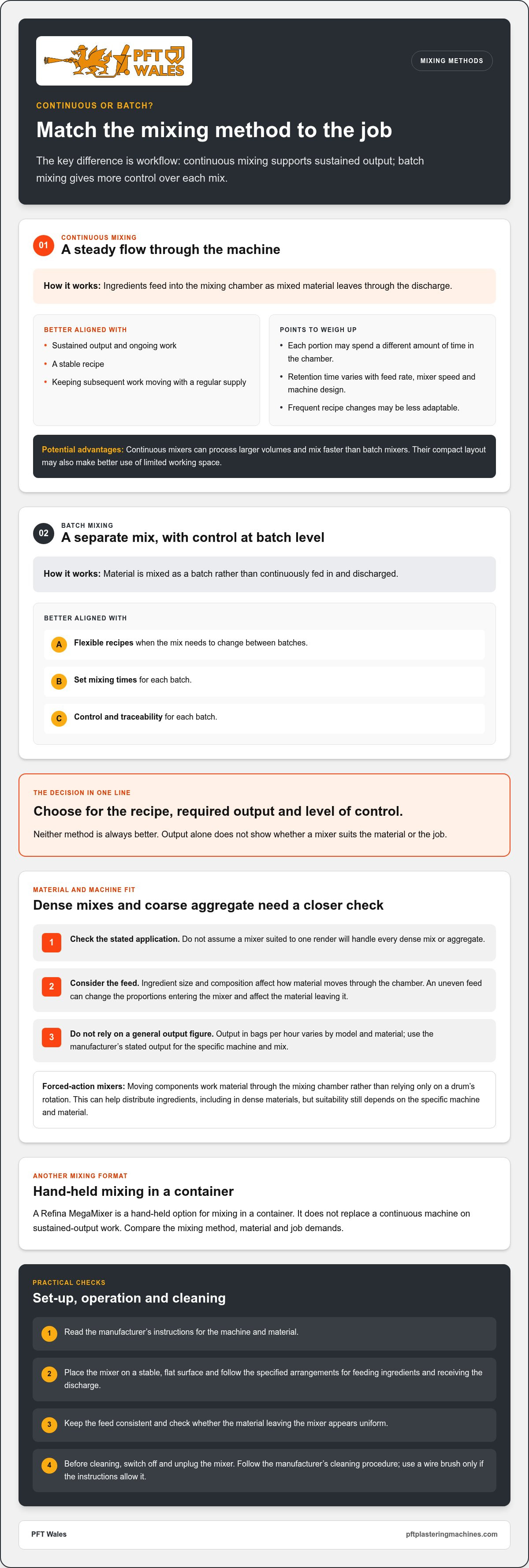
Continuous mixers can process larger volumes and mix faster than batch mixers. Their compact layout may also make better use of limited working space. These benefits matter on sustained jobs, where a regular supply helps keep subsequent work moving. However, output alone does not determine whether a mixer is suitable. The material, feed rate and degree of control required all matter.
Retention time depends on feed rate, mixer speed and machine design. Unlike a batch process with a set mixing time, each portion may spend a different amount of time in the chamber. That can be a limitation when a recipe requires precise proportions or tightly controlled mixing. Continuous systems may also be less adaptable when recipes need frequent changes.
Continuous render mixer vs batch mixer: which is better? Neither is always better. Choose continuous mixing for sustained output and a stable recipe. Choose batch mixing when flexible recipes, set mixing times or control and traceability for each batch matter more.
Forced-action mixers use moving components to work material through the mixing chamber, rather than relying only on a drum’s rotation. This can help distribute ingredients, including in dense materials, but suitability still depends on the specific machine and material. For example, render containing coarse aggregate needs a mixer designed for that mix, not simply one labelled “forced action”. Check the manufacturer’s stated applications before matching equipment to the job.
Which power supply, water supply and hoses does a continuous render mixer need? Power, water and hose requirements vary by model. Follow the machine’s instructions for connections and match hoses and couplings to the equipment and task. Do not assume fittings or specifications are interchangeable.
For a different mixing format, a Refina MegaMixer is a hand-held option to consider where the task calls for mixing in a container rather than continuous feed. It doesn’t replace a continuous machine on sustained output work. Compare the mixing method, material and job demands first, then select equipment built for that application.
In brief, continuous mixing favours steady production, while batch and forced-action approaches offer different kinds of control. Feed behaviour, recipe tolerance and machine design are key selection factors.
Mixing dense materials and coarse aggregates
Dense mixes and coarse aggregate place different demands on material flow through a continuous mixer. Match the material and feed method to the machine’s stated application.
Continuous Feeding and Discharge
In continuous mixing, ingredients enter as mixed material leaves through the discharge outlet. This steady movement can support ongoing work, but the feed must suit both the mix and the machine.
With dense material or coarse aggregate, ingredient size and composition affect how the feed moves into and through the mixing chamber. An uneven feed can change the proportions entering the mixer and affect the material leaving it. Follow the manufacturer’s guidance on suitable materials and feeding arrangements. Do not assume a mixer suitable for one render will handle every aggregate or dense mix.
A continuous render mixer processes material according to its design and feed rate. Output in bags per hour therefore varies by model and material. Use the manufacturer’s stated output for the specific machine and mix, rather than relying on a general figure.
Mixer Setup, Operation and Cleaning
Setup, operation and cleaning involve preparing the machine for the intended mix, running it according to its instructions and cleaning it safely. Each stage matters because dense material and aggregate can affect feeding and leave residue in the mixing chamber.
Before starting, read the manufacturer’s instructions for the machine and material. Place the mixer on a stable, flat surface, then follow the specified arrangements for feeding ingredients and receiving the discharge. During operation, keep the feed consistent and check whether the material leaving the mixer appears uniform. Do not change settings or connections based on assumptions about another model.
Before cleaning, switch off and unplug the mixer. Follow the manufacturer’s cleaning procedure, including any instructions for removing residual material. A wire brush can help loosen stubborn mortar, but use it only if the machine’s instructions allow it. Letting dense mix harden inside the chamber makes cleaning more difficult.
Output expectations depend on the machine and material, so production planning should account for both the mix’s feed requirements and its discharge. For a dense render containing coarse aggregate, check the stated application and arrange the material supply to match the machine’s operating method. If the mix or machine presents a technical question, discuss the material and machine requirements with a specialist before planning the run.
Continuous mixer applications
Continuous mixers are used in processes that need material to move through mixing and discharge without stopping for separate batches. Applications range from industrial production to large construction projects, where a sustained supply can support the pace of work.
The food, chemical and plastics industries use continuous mixers for different materials and production processes. The shared principle is continuous processing, not one universal machine or recipe. A machine suited to one process should not automatically be assumed suitable for another. Material behaviour, the mix required and how ingredients enter the system all affect the choice.
- Food production: continuous mixing can form part of processes handling food products.
- Chemical production: mixers can serve processes where chemical ingredients are combined continuously.
- Plastics: continuous mixing can support production involving plastic materials.
Scale can also favour continuous mixing. Major roads, high-rise buildings, dams and bridges are examples of large projects where it may be suitable. These jobs can require an ongoing supply to support successive construction stages; for extensive structural works requiring high-volume output, manufacturers like GPE Group provide industrial concrete batching plants and cement systems to match the pace of development. The right application still depends on the material and process: project size alone does not establish that a particular mixer will suit the mix.
For render work, consider the production pattern as well as the material. A continuous render mixer may suit a job requiring sustained output and the same mix throughout. For example, a large façade project may involve repeated application across extensive elevations. The key question is whether the machine’s intended application matches the render and working method, not simply whether continuous mixing sounds faster.
Some continuous mixers use gravity-based gentle mixing. This approach can homogenise delicate products without degradation, heat build-up or hot spots. Gentle mixing is relevant when the product needs to be preserved during processing. It is distinct from construction mixing, where materials and processes have different requirements. “Continuous mixer” covers a range of equipment and methods, so identify the mixing mechanism before comparing applications.
To assess a proposed use, start with the material or product, then consider the required production pattern. A delicate food product, a plastics production line and a render job are different applications. Each has its own requirements for ingredients, mixing action and output. Match the machine to the process and use its stated application to guide selection.
Continuous mixing is most relevant when a process benefits from ongoing material movement and output. Batch mixing remains useful when a project needs separate mixes or greater recipe flexibility. For a render application, decide whether continuous operation fits the material and job sequence. This helps avoid choosing equipment based on project scale alone.
Mixer safety precautions
In the UK, follow the manufacturer’s instructions and workplace safety controls for the specific mixer and task. The machine’s design and operating arrangement determine which precautions apply.
Before operating a continuous mixer, read its instructions and learn the correct controls, operating sequence and cleaning procedure. Do not rely on experience with a different machine, as layouts and instructions vary. If several people are working around the mixer, make sure everyone knows how to operate it and when it must be stopped.
Wear the protective equipment specified for the task. Safety guidance identifies gloves, goggles and ear protection for mixer operators. Each has a different purpose, so one item is not a substitute for another. Goggles protect the eyes, while ear protection addresses noise exposure. Follow the manufacturer’s instructions for the requirements of the specific mixer.
Place the mixer on a stable, flat surface before use. A level base helps keep the equipment in its intended working position as material enters and leaves. Consider the surrounding work area, too: keep feeding and discharge arrangements accessible, and avoid placing the mixer where site activity could disrupt operation. Follow the manufacturer’s positioning instructions for that model.
Stop the mixer before bringing hands or tools near the mixing area. Switch it off and unplug it before cleaning to reduce the risk of accidental operation. Then follow the machine’s cleaning instructions. A wire brush can help loosen stubborn mortar, but use it in line with the manufacturer’s directions. Never clean the mixer while it is running or connected to its power supply.
- Before mixing: read the machine instructions, wear gloves, goggles and ear protection, and use a stable, flat surface.
- During operation: use the controls and operating sequence described for that mixer, rather than assuming another model works identically.
- Before cleaning: switch off and unplug the machine, then follow its cleaning instructions.
These precautions apply whether the mixer is producing render or another material. Continuous feeding can keep material moving through the machine, so operators need to understand the controls before starting work. Keep the instructions accessible to everyone operating or cleaning the mixer, and refer to them if the machine, task or working arrangement changes. This gives the team a consistent reference instead of relying on guesswork.
Safety procedures must suit the machine and site. The instructions, working position, operator PPE and cleaning procedure all matter when using a continuous render mixer. Follow the specified method rather than adopting a routine from another machine.
Follow the manufacturer’s instructions and workplace safety controls for the specific mixer and task. The precautions required depend on the machine’s design and operating arrangement.
What are the main types and models of continuous render mixers?
Compare continuous render mixers by how they feed, mix and deliver material, rather than by a universal model category. A machine’s name alone cannot tell you whether its arrangement suits your render or site workflow.
First, distinguish the mixing process from the wider machine setup. One arrangement mixes material continuously and discharges it for handling elsewhere. Another combines mixing with further material-delivery equipment. These are ways to compare system layouts, not guarantees that a particular machine suits every product. Check the manufacturer’s stated application for the exact model and mix.
The feed method is another practical distinction. Some systems feed ingredients continuously and discharge the mixed material. For a site using bagged render, consider how the product will be introduced and kept flowing. The feed arrangement must follow the machine’s instructions, not assumptions based on another model.
Mixing action matters, too. Continuous mixers move material through a chamber, where it undergoes axial and radial mixing. Some applications use forced action, with moving components working the material inside the chamber. The question is not which action sounds more powerful, but whether the machine’s stated application covers the render and aggregate you plan to use.
Compare models against the work, not just their labels. A useful selection check includes:
- Material: identify the render and whether it contains coarse aggregate.
- Process: establish how ingredients enter and how mixed material leaves.
- Mix control: consider whether continuous operation suits the recipe and required consistency.
- Site workflow: assess whether the discharge arrangement suits the next stage of application.
These points help distinguish continuous from batch mixing, and a mixer-only arrangement from a combined setup. A job needing an uninterrupted supply, for example, may call for a different configuration from one requiring frequent recipe changes. Neither job size nor model name settles the choice. The material, intended process and manufacturer’s application guidance must all align.
For UK renderers, avoid choosing on an assumed capacity, power supply or hose arrangement. Those details vary by machine, and cannot safely be inferred from a general type description. Use the model’s instructions and stated specifications to assess the setup. If you’re comparing options for a particular render or site process, contact the team to discuss the machine requirements.
PFT Wales: PFT Plastering & Rendering Machines
PFT Wales supplies PFT plastering and rendering machines for professional work. If you are choosing a machine for a particular mix or workflow, start with the material, required output and the manufacturer’s stated applications.
PFT Wales also supplies PFT machine parts, spares, rotors and stators, alongside plastering and rendering tools such as trowels, spatulas and floats. The Skimflex range offers professional finishing tools. Match equipment and tools to the job, and check that parts and accessories suit the specific machine.
For advice on selecting a machine or finding parts and tools for your work, contact PFT Wales or visit pftplasteringmachines.com.
Make the next machine decision with confidence
Before choosing a continuous render mixer, write a clear equipment brief. Note the render and aggregate, how material will be supplied, the output pattern your team needs and where the mix must go next. Then compare these requirements with each machine’s stated application and operating instructions. This gives you a practical basis for assessing suitability instead of relying on a model name or broad capacity claim.
Consider more than the mixing chamber. The machine needs to fit the work sequence, available site space and how your crew handles the finished mix. A setup that works for one project may not suit another, particularly when materials or recipe requirements change. Discussing the actual job can help narrow the options without guessing at specifications.
Gather the material details and intended workflow before discussing your next step. For help relating those requirements to your work, contact PFT Wales about your mixer. A clear brief is a sound place to start.
Frequently Asked Questions
What is a continuous render mixer and how does it work?
A continuous render mixer combines ingredients through an ongoing mixing process, rather than treating each load as a separate batch. “Continuous” describes how production is organised, not a guaranteed finish or output. The specific model determines its controls and intended use, so identify the make and model before comparing operating details. This distinguishes the general machine type from an individual unit’s capabilities.
What materials can it mix and spray?
There is no universal material list for every machine. Suitability depends on the materials included in the manufacturer’s stated application for that model. Mixing and spraying are also separate functions: a mixer’s ability to prepare a material does not establish that the equipment can spray it. Treat the mixer and spray setup as distinct parts of the process, and match each to its intended task.
What are common problems and safety risks during use?
Common concerns include an inconsistent feed or choosing a material or application outside the model’s intended use. These can affect the process and result. Safety risks depend on the machine’s design and operating method, so follow its instructions for controls and precautions. If the machine behaves unexpectedly, follow the manufacturer’s guidance rather than guessing at settings, dismantling components or attempting an unapproved repair.
Where can you buy or hire one in the UK?
UK buyers can purchase through specialist plastering and rendering machinery suppliers; the machine section above points to PFT Wales’s range. Hiring is a separate option, so do not mistake a purchase listing for a hire offer. When comparing purchase options for a continuous render mixer, consider how often it will be used and whether its intended application fits the work. Do not infer hire terms, stock or technical specifications from a product description.