

The broadest blade isn’t always the quickest route to a clean skim. Plasterers use a finishing spatula in the final stages to spread a thin, even layer across walls and ceilings. Its flat, flexible blade helps control each pass, and careful finishing can reduce sanding after the plaster has dried.
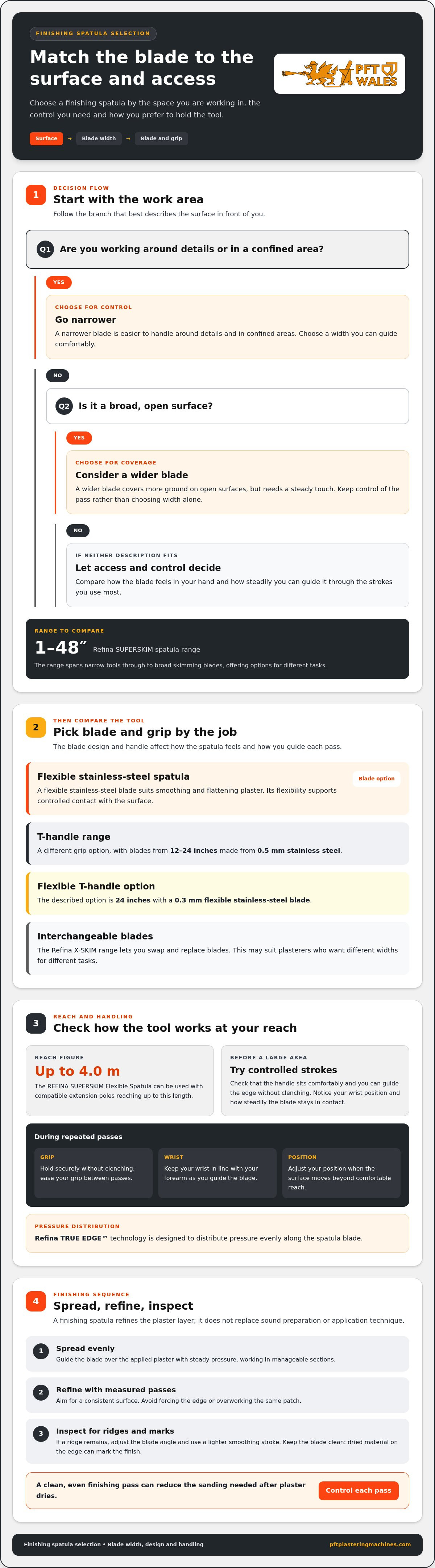
Choosing a finishing spatula comes down to the surface, access and control you need. A narrower blade is easier to handle around details and confined areas; a wider one covers more ground on open surfaces but needs a steady touch. The Refina SUPERSKIM range runs from 1 to 48 inches, offering options for different tasks.
This guide explains what skimming spatulas do, how their main types differ and which sizes suit different jobs. It also covers when to use one and how grip and blade design affect handling over a long day. Use these points to choose a finishing spatula that suits your work and helps you control each pass.
Key Takeaways
- Choose blade width around the surface and access: narrower tools help with control in confined areas, while wider blades cover open surfaces more efficiently.
- Flexible broad blades help spread a thin, even layer across walls and ceilings, and a good pass can reduce the sanding needed after drying.
- Compare flexible, stainless-steel and T-handle designs by the control and reach the task calls for, rather than choosing on width alone.
- Grip and pressure distribution matter during repeated passes; Refina’s TRUE EDGE™ technology is designed to distribute pressure evenly along the blade.
- Know when a broad finishing tool is the right choice, and when a plastering trowel or smaller palette knife gives better control for the task.
Ergonomic grip and fatigue reduction
Repeated skimming passes require the hand, wrist and forearm to guide a broad blade across the surface. A finishing spatula that feels balanced can make it easier to apply controlled pressure, especially across a ceiling or long wall. Comfort depends on the handle, blade width, working angle and grip. Since one tool won’t feel the same to every plasterer, consider how it handles during the strokes you use most.
Refina’s TRUE EDGE™ technology is designed to distribute pressure evenly along the spatula blade. When assessing a finishing spatula, check whether the handle sits comfortably in your palm and whether you can guide the edge without clenching. Try a few controlled strokes before starting a large area. Notice your wrist position and how steadily you can keep the blade in contact with the surface.
For a practical look at drywall skimming blades, watch this introduction from LEVEL5 Tools.
As you work across a wall, adjust your stance to follow the pass instead of twisting from one fixed position. Keep your shoulders relaxed and avoid locking your elbow. On a ceiling, lower your arms when pausing between sections. These adjustments affect how the tool feels over repeated strokes and help you maintain a consistent working posture.
Reach also affects how the blade feels in use. The REFINA SUPERSKIM Flexible Spatula can be used with compatible extension poles reaching up to 4.0 m. Consider whether the pole and blade combination lets you guide a steady pass at your working reach. Practise the movement before tackling a full section, and choose a blade size you can control comfortably rather than defaulting to the widest option.
- Hold the handle securely without clenching; ease your grip between passes.
- Keep your wrist in line with your forearm as you guide the blade.
- Adjust your position when the surface moves beyond comfortable reach.
What safety considerations matter? Make sure your grip and reach let you control the blade throughout each pass. These factors also affect your posture and the effort needed to guide the tool.
Handle shape and balance are personal, so assess them through the movements you use on site. The range of plastering spatulas includes tools for different finishing tasks, helping you compare options by blade and grip before choosing.
Why Do Plasterers Use Skimming Spatulas?
During finishing, a skimming spatula spreads a thin, even layer across plaster. Its broad, flat, flexible blade helps plasterers control application on walls and ceilings.
Using skimming spatulas in plastering
The tool spreads and smooths plaster across a surface, rather than simply shifting material from one spot to another. On a broad wall, guide the blade over the applied plaster with steady pressure and watch how its edge moves across the surface. The flexible blade supports controlled contact, while its width covers more area with each pass.
Work in manageable sections and keep the blade clean: dried material caught on the edge can mark the finish. Check the surface after each pass, adjusting your angle and pressure where ridges remain. A finishing spatula refines the plaster layer; it cannot replace sound preparation or application technique.
Finishing and skimming plaster
Skimming creates a smooth surface layer, and the spatula helps flatten and refine it during finishing. Use controlled strokes to even plaster on a wall, and guide the blade carefully across each ceiling section. Aim for a consistent surface rather than applying excessive pressure. Forcing the edge can shift the plaster instead of smoothing it.
Assess the surface as you work. If a pass leaves a ridge, adjust the blade angle and make a lighter smoothing stroke. Check the surrounding area before repeating a pass over the same patch, as overworking can leave an uneven finish. A flexible blade follows the surface while giving you control over the edge.
An effective finishing pass with a skimming spatula can reduce the sanding needed after plaster dries. The result depends on the application and the surface left by the blade. Aim for a clean, even finish while the plaster is workable, rather than relying on sanding to remove marks later.
These tools suit walls and ceilings where a broad blade can smooth a thin coat across open areas. Around corners, edges and tight details, use a narrower tool or adjust your approach to stay in control. A finishing spatula works best on the main surface, while careful handling helps manage transitions into restricted areas.
Use the tool in a controlled sequence: spread the plaster evenly, refine the surface with measured passes, then inspect for ridges or marks. Keep the blade in clean contact with the plaster throughout. A steady pass can reduce remedial sanding and leave a more uniform base for decorating.
Recommended spatula types and sizes
Blade type and width affect how a tool handles plaster on different surfaces. Match both to the work area, access and level of control required.
Recommended spatula types
A flexible stainless-steel spatula suits smoothing and flattening plaster, with blade widths ranging from narrow detail tools to broad skimming blades. T-handle versions offer a different grip, and the skimming spatula T-handle range includes blades from 12 to 24 inches, made from 0.5 mm stainless steel. A flexible T-handle option measures 24 inches and has a 0.3 mm flexible stainless-steel blade.
Interchangeable-blade designs offer another practical option: the Refina X-SKIM range lets you swap and replace blades. This may suit plasterers who want different widths for different tasks. Compare how you hold each handle and guide its edge rather than choosing by design name alone.
Choosing a spatula size
For detailed work, the SUPERSKIM range includes a 1-inch spatula measuring 20 × 100 × 0.3 mm. Other narrow options include 1½-inch, 3-inch, 4-inch, 5-inch and 6-inch blades. These smaller widths give more control around edges and restricted sections than a broad blade.
For open areas, the same range includes 10-inch, 18-inch, 24-inch, 32-inch and 40-inch sizes, with a 48-inch option at the widest end. The range uses 0.3 mm stainless-steel blades. Choose a width you can guide evenly across the surface; a broad blade covers more ground, but needs room to move and steady control.
A five-piece kit contains 18-inch, 24-inch, 32-inch and 40-inch spatulas, plus an extension pole. That spread gives a plasterer several widths for varying surface access. For higher areas, compatible extension poles for the flexible spatula can reach up to 4.0 m.
Comparing spatulas, palette knives and trowels
A skimming spatula has a broad, flat blade for smoothing plaster over larger areas. A palette knife is narrower, making it better suited to small patches or precise material handling than continuous wall finishing. A plastering trowel is a separate tool with a different feel in use, so choose according to the finish and control required.
For an open wall, a wider spatula can smooth a larger section per pass. Around a small repair, a narrow spatula or palette knife gives closer control. A plastering trowel remains useful for tasks that call for a trowel rather than a broad finishing blade. Compare the plastering spatula range by blade width and design, then choose according to the surface you regularly finish.
When to use a skimming spatula
Use a skimming spatula when a plastered surface needs a controlled smoothing pass, particularly across broad walls or ceilings. It’s a finishing tool: its role is to refine the coat, not replace preparation or correct every defect beneath it. For example, after spreading plaster across a wall, use the blade to even the surface and assess the finish as you go.
Timing matters. Make smoothing passes while the plaster is still workable, rather than returning after it has dried. Let the condition of the coat guide your approach: move steadily, watch how the blade meets the plaster and don’t force the edge. If a pass leaves a ridge, adjust your movement and reassess the surrounding area before continuing.
A skimming spatula is useful when the next stage calls for a smooth surface. Preparing a wall for painting or wallpapering is one example: marks can affect the final appearance, so use controlled passes to flatten the skim. Work across the area in a consistent sequence, checking the result from different angles as you go.
Choose a finishing spatula for open surfaces where its blade can travel without catching on nearby details. On a ceiling, work from a stable position and keep the tool under control. Around sockets, corners or narrow returns, switch to a smaller tool or work carefully into the restricted area. A wider blade suits the main surface better than tight detailing.
- Fresh skim: refine the coat with measured strokes while it remains workable.
- Wall preparation: smooth the surface before painting or wallpapering.
- Broad ceiling areas: use controlled passes where there’s room to guide the blade.
- Restricted details: switch to a narrower tool when the broad blade limits access.
Don’t treat every uneven background as a skimming-spatula problem. If a wall has a pronounced hollow or damaged area, the blade can only work the material applied over it; it won’t correct the underlying surface. Check the area before skimming, then decide whether you’re finishing the coat or dealing with a separate defect.
Inspect the surface after a finishing pass and before moving on. Look for raised lines, missed patches and marks that stand out across the wall or ceiling. Correcting them while the plaster remains workable can help create a smoother base for decoration. Use the tool to refine the surface, matching each stroke to the area rather than pressing harder to chase every mark.
A finishing spatula earns its place when a job calls for an even skim and a clean surface ready for the next stage. On a large, uninterrupted wall, a broad blade can cover the main area; at edges and details, precise control matters more than coverage. Assess the task first, then choose a suitable tool and working approach.
How does a finishing spatula compare with a palette knife or plastering trowel?
Each tool has a different role in plastering. A finishing spatula smooths skim across a surface, while a palette knife gives closer control over a small patch. A plastering trowel handles plaster with a different blade and grip. Choose according to the area and the movement needed to achieve the finish.
On a broad wall, a finishing spatula lets you make longer, continuous smoothing passes. Its wide blade helps refine an applied skim across open areas, where a palette knife would require many short strokes. Work the surface, then check for raised lines or missed patches. A spatula is for finishing, not a substitute for applying plaster or preparing the background.
A palette knife is more suitable for a small repair, tight edge or restricted detail. Its narrower blade gives precise control over a small amount of material. Around a narrow return, for example, a broad spatula may be awkward to position. Use the smaller tool for the detail, then return to the wider blade for the main wall.
A plastering trowel is commonly used to apply and work plaster. Its handling differs from that of a broad skimming blade, so don’t assume either tool replaces the other throughout the job. Use the trowel where its form suits the application, then choose a spatula for a finishing pass when you need to smooth the skim across a larger area.
- Broad skimming spatula: smooths larger areas with longer passes, such as an open wall.
- Palette knife: handles smaller patches and tight details, such as a narrow corner.
- Plastering trowel: supports plaster application and working, with a different handling feel.
Consider the sequence as well as the tool. A plasterer might apply material with a trowel, use a palette knife for an awkward edge, then finish the open skim with a broad spatula. This avoids forcing a wide blade into a confined space or using a small knife across an entire wall. Match the blade to each task.
Grip and blade control also distinguish these tools in practice. A palette knife suits short, precise movements; a broad spatula needs room for a steady sweep. A trowel’s handle and blade call for a different action. Try the movement required for the job before choosing a tool, especially where limited access or an uneven edge restricts your stroke.
For a wall that needs an even skim, use the spatula to refine the surface, not to chase every defect in the substrate. Keep a trowel or palette knife available for the tasks they suit. If you’re weighing up tools for your finishing work, talk to the team about choosing suitable plastering tools.
PFT Wales: PFT Plastering & Rendering Machines
PFT Wales supplies PFT Plastering & Rendering Machines and professional plastering tools for skimming and finishing work. If you need a hand tool, its range of Plastering & Rendering Tools includes trowels, spatulas and floats. Skimflex Professional Plastering Tools offer another option for regular site use.
Turn to PFT Wales when comparing hand tools or considering a plastering machine for your work. The company also supplies PFT Machine Parts, Spares, Rotors & Stators. Choose parts using the exact machine details, rather than assuming compatibility.
For advice on suitable tools or equipment, contact PFT Wales or visit pftplasteringmachines.com.
Choose your next tool with the job in mind
Let your next skimming job guide your choice. Before adding a tool to your kit, note the surfaces you’ll work on and where access changes, such as around returns or ceiling edges. These details will help you judge whether your current blade provides the control the task needs.
On your next job, notice how the tool handles through a complete pass. Pay attention to where you adjust your grip or change direction, then use those observations to decide what might complement your existing kit. A considered choice starts with the work in front of you.
Frequently Asked Questions
What types of finishing spatulas are available?
Common options include flexible broad-blade spatulas, stainless-steel spatulas, T-handle designs and models with interchangeable blades. For example, the Refina SUPERSKIM has a 0.3 mm stainless-steel blade, while the Refina X-SKIM has interchangeable blades. T-handle spatulas offer a different grip for flattening and smoothing. Consider how the handle feels in your hand and whether you need one blade width or the flexibility to change blades.
What size finishing spatula is best for different tasks?
Match the blade to the working area and the control the task needs. A 1-inch spatula can help with narrow details, while a 24-inch blade covers more surface in a pass. For larger open areas, 32-inch or 40-inch options may suit your working style, provided you can guide the blade evenly. For a useful all-round choice, weigh access and handling alongside coverage, rather than choosing by width alone.
Which finishing spatulas are recommended by UK buyers and professionals?
There isn't one best choice for every plasterer; the job and preferred handling make the difference. For a flexible stainless-steel option, compare the Refina SUPERSKIM range, available from 1 to 48 inches. The Refina X-SKIM offers interchangeable blades in sizes from 7 to 44 inches. A T-handle model may suit workers who prefer that grip style. Consider the blade design, size range and how the tool fits your finishing routine.
How do you use a finishing spatula for a smooth finish?
Start with an even application of plaster, then guide the blade across the surface in controlled, consistent strokes. Keep the edge clean, as material caught along it can leave marks. Work in manageable sections and inspect each area before moving on. If a line remains, adjust your angle and make a light corrective pass. Avoid pressing hard to chase a mark, as this can move the plaster unevenly.
How much does a finishing spatula cost in the UK?
Prices for a quality finishing spatula in the UK generally range from around £20 for smaller, standard blades up to £80 or more for professional, wide-format systems or interchangeable blade kits available from suppliers like PFT Wales. Premium brands and larger sizes sit at the higher end of the scale, whilst standard everyday blades offer a more budget-friendly entry point.
How to clean and maintain a finishing spatula?
Keep the blade clean as you work: dried plaster caught on its edge can mark the finish. Wash the blade thoroughly with water after use to remove all plaster residue, dry it properly to prevent corrosion on steel components, and store it flat or protected in a case to avoid damaging or bending the precision edge.