

The tool doing the hardest work may not be the first thing to change. Repeated hand and arm movements can make a long plastering shift demanding, but there’s no single piece of kit that suits every job. Choosing tools to reduce plasterer fatigue starts with identifying the task that feels most demanding, then matching the equipment and workflow to it.
Look beyond broad claims about lightweight or ergonomic design. A hand tool that feels right for one task may not suit another, while powered equipment can change how material is mixed, moved or applied without removing the need for setup, cleaning or manual finishing. The work itself matters.
This guide compares practical options for common plastering tasks, from manual trowels and finishing tools to plastering machinery. It looks at the trade-offs involved and the workflow choices that can help you make a more informed equipment decision. If you need advice about machine suitability or specifications, PFT Wales offers technical support.
Key Takeaways
- Pinpoint whether repetition, awkward reach or long sessions make a task demanding before comparing equipment.
- Compare trowels, spatulas, knives and floats by task, handling and trade-offs, not by generic ergonomic claims.
- When considering tools to reduce plasterer fatigue, weigh manual work against mechanised application and the finishing work that remains.
- Assess handling, reach and task duration, then consider how the equipment fits into the full job.
- Match Skimflex or Refina hand tools, PFT machinery or spray equipment to the work, and use PFT Wales technical advice for machine suitability questions.
Tools to reduce plasterer fatigue: identify where the work feels demanding
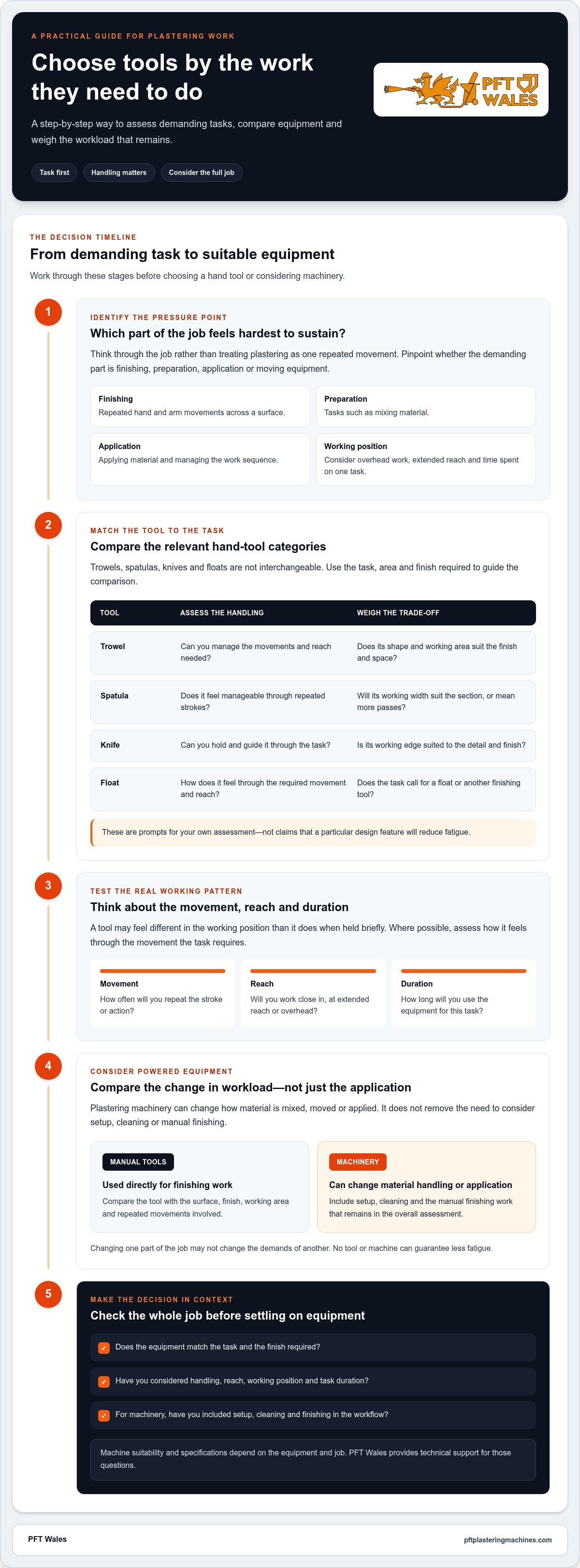
A long day involves different tasks, each with its own demands. Repeated passes over a wall, reaching above shoulder height, preparing material and moving equipment are not the same type of work. Before comparing tools to reduce plasterer fatigue, identify which task is taking the most effort. That gives you a more useful basis for choosing equipment than a general claim about comfort.
Separate hand finishing from preparation and application. A trowel or spatula is used directly in finishing work; mixing, pumping and spraying involve different equipment and steps. Changing one part of the job may not change the demands of another, and no tool or machine can guarantee less fatigue. Match equipment to the task before judging its comfort.
For a general overview of the trade and its tools, see Plasterer. The video below also introduces common plastering tools and when they’re used.
Which parts of a plastering job can feel most demanding?
Think through a typical job rather than treating plastering as one repeated movement. Finishing can involve repeated hand and arm movements across a surface. Preparation may involve mixing material, while application can include moving equipment and managing the work sequence. These tasks call for different equipment, so identify the stage that feels most demanding before comparing options.
Notice the working position and duration, too. Overhead work, extended reach and prolonged periods on one task are useful factors to assess when deciding what equipment to compare. They don’t point to one universal solution; the right choice depends on the job and the person using the tool. Ask yourself: which task, position or stage of the shift is hardest to sustain?
Why one tool is unlikely to suit every job
A tool that suits detailed finishing may not address the demands of mixing or moving material. A machine may change how material is applied, but the finishing work still needs to be considered. Look at the task, your working position and how long you’ll use the equipment. Those details help narrow the options without assuming that one trowel, machine or accessory suits every plasterer.
Handling is personal, too. Where possible, consider how a tool feels in the working position you’ll actually use, not only when you hold it briefly or view it online. PFT Wales supplies Skimflex professional plastering tools alongside machinery and spray equipment. Compare the relevant categories against the work involved, then weigh the practical differences between manual tools and powered options.
Manual plastering tools to compare for repetitive finishing work
Once you’ve identified the task, compare tools by what they help you do and how they feel during the movements the job requires. A trowel, spatula, knife and float aren’t interchangeable. Choosing by category alone won’t tell you whether a tool suits the surface, finish or working pattern. The aim is to narrow down useful options, not assume one tool will make every job easier.
Use the table as a starting point. The handling questions are prompts for your own assessment, not claims that a particular design feature will reduce fatigue.
| Tool | Task to consider | Handling question | Trade-off to weigh |
|---|---|---|---|
| Trowel | Working and finishing plaster across a surface | Can you manage the movements and reach needed for the area? | Does its shape and working area suit the finish and space? |
| Spatula | Finishing work where a narrower tool may be useful | Does it feel manageable through the repeated strokes involved? | Will its working width suit the section, or mean more passes? |
| Knife | Working material in areas where a knife is appropriate | Can you hold and guide it comfortably through the task? | Is its working edge suited to the detail and finish required? |
| Float | Working a surface where a float is appropriate | How does it feel through the motion and reach required? | Does the task call for a float, or a different finishing tool? |
Trowels and spatulas for finishing tasks
Trowels and spatulas both feature in finishing work, but the right comparison depends on the area and the finish you need. Consider where each will be used, how often you’ll repeat the movement, and whether you’ll work close in or at extended reach. If possible, assess the tool in hand and through the movement it needs to make, rather than judging it from appearance alone.
PFT Wales supplies Skimflex trowels and knives. Compare the range of Skimflex professional plastering tools against the tasks you regularly carry out. The best fit will depend on the work and your own handling preferences.
Knives, floats and edges for task-specific work
Knives, floats and straight edges belong in a comparison for different reasons. Consider whether you’re working a local area, finishing a surface, or checking and working across a wider section. The finish required, access and movement involved help determine which category is relevant. Tools that don’t match the job won’t make the choice clearer.
For a broader view across hand-tool categories, browse the professional plastering tools guide. If you’re weighing up which tool category suits your regular work, you can also contact PFT Wales for tool advice. Start with the task rather than relying on unverified claims about comfort or fatigue.
Manual tools versus plastering machines: compare the workload trade-offs
Manual tools and machinery support different parts of a plastering job. A trowel keeps finishing in the plasterer’s hands; mixing and pumping equipment changes how material is prepared and moved, while spray equipment is another option for application work. The comparison isn’t simply manual versus powered. Consider the task each option supports, the work involved in setting it up, and what still needs to be completed by hand.
Mechanised equipment changes task allocation, not every finishing requirement. A machine may alter how material reaches the work area, but it doesn’t establish how much finishing remains. That depends on the job. When weighing tools to reduce plasterer fatigue, look at the whole sequence, including setup, application, access and hand finishing.
- Hand tools: suited to tasks carried out directly on the surface, with the working movements and reach remaining manual.
- Mixing and pumping equipment: supports material preparation or transfer, but brings its own setup and operation tasks to assess.
- Spray equipment: an option for relevant application work; consider the surrounding workflow and finishing that follows.
When mixing and pumping equipment is worth considering
Machine-assisted mixing and pumping may be worth assessing where those stages make up a substantial part of the work. Start with the job and the task you want the equipment to support, then account for setup and the work around its use. Don’t assume a machine suits every application. PFT Wales supplies PFT mixing and pumping machines and offers advice on machine suitability and specifications.
Where spray equipment fits, and where hand tools remain relevant
Spray equipment is an option to consider for appropriate application work, not a universal replacement for hand application. The choice depends on the project and the equipment’s intended application. Factor in what happens after spraying: areas may still need working or finishing by hand, so include those movements in your comparison rather than judging the application stage alone.
Take a typical job and map out the stages: preparation, moving or applying material, and finishing. Which part is the main concern? If repeated surface work is the issue, a machine for material handling may not address it. If material preparation is the demanding stage, compare relevant mixing equipment while considering the added setup and operation. This keeps the decision tied to the workload, rather than the general idea that powered equipment must be easier.
PFT Wales supplies PFT plastering machinery and spray equipment, and provides technical support on machine suitability and specifications. If you’re comparing options for a particular job, contact PFT Wales for equipment advice. Aim for a workable match between the equipment, the task and the hand finishing still required.
Choosing tools to reduce plasterer fatigue for your job
A useful choice starts with the work, not a broad claim that a tool is light, comfortable or easier to use. Make the comparison practical: note the task that feels demanding, narrow down the equipment that supports it, then assess how well each option fits the job. This helps distinguish a hand-finishing issue from a preparation or application requirement.
- Identify the demanding task. Record what you’re doing, the surface, your working position and the equipment already in use. Is the challenge repeated finishing movements, working at reach, mixing, moving material or applying it? Be specific. “Finishing this ceiling” gives you a clearer starting point than “the whole job is hard”. Note how long you spend on that task as part of the normal work sequence.
- Compare relevant equipment categories. For repeated surface work, compare manual tools intended for that type of task. If preparation is the focus, consider mixing equipment; if application is the focus, assess suitable pumping or spray equipment. Keep the comparison to options that address the demanding task. A machine won’t necessarily change the hand-finishing work that follows, so include those remaining movements in your assessment.
- Assess practical fit. Consider how you handle the tool, the reach and movements required, the time spent using it, and any setup or work that comes with machine use. If possible, assess handling in a way that reflects the task rather than relying on a brief impression. Comfort is a personal judgement, not proof of a product feature or a guaranteed outcome.
Assess the job before selecting equipment
Keep manual finishing separate from mixing, pumping or spraying requirements. A task note can be simple: surface and finish, working position, current method, equipment used and the stage that feels most demanding. For machine options, don’t assume suitability for a particular material. Product documentation and reliable manufacturer guidance matter. If machine suitability or specifications need clarification, use PFT Wales technical advice rather than guesswork.
Compare tools in a practical, consistent way
Compare like with like. For each relevant option, note the task it supports, how it feels during the movements involved, any reach constraints and what work remains afterwards. Don’t turn a subjective impression into a verified claim about weight, balance or ergonomic design. Product-specific features and compatibility need reliable manufacturer information, not assumptions based on a product category or appearance.
That process gives you a reasoned shortlist, not a promise that one item will suit every plasterer or remove fatigue. PFT Wales supplies professional hand tools, PFT machinery and spray equipment, with technical support for machine suitability and specifications. Discuss a tool or machine requirement with the team when you need advice for a particular application.
Choosing professional plastering tools with PFT Wales
Use the demands of your work to narrow down the equipment category, then consider products within it. PFT Wales supplies professional plastering and rendering tools, machinery and spray equipment. These options serve different parts of the trade, so a finishing tool, mixing or pumping machine and spray setup shouldn’t be treated as substitutes.
Match the product category to the work
For hand finishing, PFT Wales supplies Skimflex tools, including trowels and knives, as well as Refina tools. The professional plastering tools guide covers hand-tool categories to help you browse by the type of work involved. If your requirement is mechanised mixing or pumping, consider PFT machinery; spray equipment is a separate category for relevant application work.
Get support when technical details matter
PFT Wales is an authorised PFT dealer and provides telephone technical advice and machine training. The company also services and repairs plastering machinery. These services are useful when your enquiry concerns a machine or its technical details, while hand-tool choices can be considered against the finishing work you carry out.
For a focused discussion about the tools or equipment relevant to your work, contact PFT Wales about professional tools and machinery.
Make your next equipment choice a considered one
Before your next job, note which part of the work you want your equipment choice to address. A clear starting point helps you compare options with purpose, rather than changing tools on the strength of a general claim. Keep the decision grounded in the work ahead.
The most useful tools to reduce plasterer fatigue are the ones you assess against your own tasks and working pattern. There’s no universal fix, but a considered choice can help you build a setup that makes sense for the job.
Ready to discuss your options? Talk through your next equipment choice with PFT Wales and take a practical approach to your next job.
Frequently Asked Questions
Can the wrong plastering trowel make a job feel more tiring?
It can. A trowel that’s difficult to control for the finish you’re aiming for may make repeated work feel less straightforward. To judge whether the tool is contributing, pay attention to the result as well as the effort: are you repeatedly correcting marks or changing your technique? That observation can help distinguish a tool choice from other factors, such as the surface condition or the stage of the work.
Are lighter plastering tools always better?
No. A lighter tool isn’t automatically the best option for your work. Look at the working edge and size alongside the finish you need, then consider whether it allows you to work accurately. When comparing product information, use the manufacturer’s stated details rather than assuming how a feature will feel in use. Your own assessment during the task remains relevant, but it isn’t a verified product specification.
Can plastering machines remove all manual work?
No. A machine can perform specific functions, but it doesn’t operate a whole job independently. The operator still has to manage the work around the equipment, and the exact duties depend on the machine and application. Before adopting a machine-based process, map the full sequence from preparing the equipment through application to the finished surface. That makes it easier to understand where hands-on work remains.
How can I tell whether a tool is making a task harder?
Keep a brief job note rather than relying on memory at the end of a long shift. Record the tool used, the particular stage of work and what you noticed about the result or technique. Comparing similar tasks over time may help reveal a pattern, such as repeated corrections with one tool. This is a practical observation, not a diagnosis or proof that the tool has a specific design issue.
Should I use the same plastering tools for every job?
No. Building a kit around the work you regularly carry out is more useful than assuming one set covers every situation. Before a job, check which tools you’ll need for its distinct stages and whether a specialist item is required for the finish. For one-off projects or heavy-duty site demands, sourcing equipment from suppliers like Pahrump Rentals & Hardware offers access to industrial machinery and tools without the expense of outright ownership. This can also help avoid reaching for an unsuitable tool simply because it’s already to hand. The right selection depends on the work planned.
Is spray equipment suitable for every rendering project?
No. A rendering project’s requirements and the intended application both matter. Before planning around spray equipment, establish whether the relevant equipment is specified for that use, and consider the practical arrangements for the work sequence. Don’t infer material compatibility from a general product description. PFT Wales provides technical advice on PFT machinery and spray equipment when project requirements or product information need clarification.