

The label on a trowel matters less than the job you need it to do. A plasterboard trowel is generally used to work plaster or another suitable finishing material over plasterboard, but the term can mean different things in practice. That makes it easy to choose a tool that doesn’t suit the task or stage of the work.
If you’re deciding between a plastering trowel, a finishing trowel or a smaller spatula, start by identifying the action you need the tool to perform. Working material across a broad area is different from refining a surface or dealing with a local detail. The right choice depends on the task, the finish required and how the tool handles for you.
This guide explains what a plasterboard trowel does, how it compares with finishing trowels, spatulas and jointing tools, and what to consider before choosing one. It also shows how to use product descriptions and the work in front of you to narrow your options, including professional tools from Skimflex and Refina.
Key Takeaways
- A plasterboard trowel is a general term for a trowel used on plasterboard, so the label alone may not tell you whether it suits the task.
- Match the tool category to the work, whether you’re working material, refining a surface or dealing with joints.
- Before choosing, consider the working area, the finish required and how the tool feels to handle.
- Compare trowels, spatulas and jointing tools by their intended roles, rather than assuming one can replace another.
- Explore professional tool ranges from Skimflex and Refina, and use practical advice to help guide your selection.
What Is a Plasterboard Trowel and What Is It Used For?
A plasterboard trowel is a hand tool used to work plaster or another suitable finishing material over plasterboard. The term describes the job more than one precisely defined tool. On site, one person might use it to mean a trowel for working material across the board, whilst another might mean one used to refine the surface.
That distinction matters when choosing equipment. Plasterboard is the substrate, the board fixed to form an internal lining. Plaster or compound is the material applied over it. A useful definition is: a plasterboard trowel is a trowel selected for the task being carried out on a plasterboard surface, not a tool identified by the board itself.
For background on the board as a building material, the Drywall (Plasterboard) Overview explains its composition and uses. For tool selection, keep the roles distinct: the board provides the surface, the specified material is what you work, and the trowel is one of the hand tools used to handle it.
What does “plasterboard trowel” mean on site?
The label needs context. A request for a plasterboard trowel could mean a tool for working material across the board, or one chosen for refining the surface at a later stage. It doesn’t, by itself, specify a blade shape, size or construction. When comparing tools, describe the job instead: are you working material across a broad area, smoothing a treated surface or dealing with a smaller section? That gives you a more useful basis for choosing than the label alone.
Where does a trowel fit in plasterboard work?
Internal-lining work brings together the board, the material applied to it and the tools used to work that material. A trowel may be used at different points, but the task affects what you need from it. The phrase “for plasterboard” doesn’t prescribe a coat thickness, timing or application method. Those details depend on the work and the relevant product guidance.
Think about the action required rather than assuming one tool suits every stage. Are you working material across the surface, or refining an area that has already been treated? Those are different tasks and may call for different tool categories. PFT Wales supplies professional plastering tools from Skimflex and Refina, alongside a range of plastering trowels. Start with the task, then compare the stated purpose of the tools that could suit it.
How a Plasterboard Trowel Fits into Internal-Lining Work
Internal-lining work involves more than choosing a hand tool. While contractors regularly order plasterboard and drylining from trade suppliers such as Insulation Warehouse Direct, the board itself simply forms the surface. The specified plaster or compound is worked over it, and the work progresses towards the finish required for the job. A trowel may be used at different points, but the task changes what you need from it.
Let the working task, not the board name alone, guide your choice of trowel. A tool chosen for working material across a broad area may not be the one you prefer for an edge or transition. The label “plasterboard trowel” doesn’t describe every action involved in the work.
Applying or working material over plasterboard
When material is being applied or worked across the board, a trowel is one of the hand tools that may be used to move and work it over the surface. The approach depends on the material, the job requirements and the intended finish. Follow the relevant material instructions and project specification rather than assuming that a tool name dictates the method, coat thickness or timing.
Keep tool choice separate from decisions about the lining and the material. Board condition and the specified material affect the work, but neither is a feature of the trowel. If the surface or material requirements change, the task may change too. Professional drywall and plasterboard trade specialists, such as tkninteriors.com.au, align their equipment with each installation phase, choosing the tool in response to site-specific requirements rather than treating it as a substitute for them.
Refining the surface and managing edges
As work moves from the main surface towards joints, edges and transitions, the working area becomes more localised. That can change the level of control you want from a tool. Don’t assume one trowel design suits every part of the job. Consider the joint treatment and specified finish, as well as your handling preferences, when comparing options.
For example, working material across an open board area and attending to a narrow transition are different tasks, even when they’re part of the same lining job. That doesn’t automatically prescribe a particular tool, but it gives you a useful question to ask: what action am I carrying out here, and what kind of control does it call for? Matching the tool to that answer is more useful than choosing by the word “plasterboard” alone.
Think of the work as a sequence of changing demands: assess the board, work the specified material, then give particular attention to areas where the required finish calls for it. This isn’t an application method; it’s a way to keep the decisions distinct. Board condition, material guidance and finish requirements inform the job, whilst the trowel supports the task being carried out.
If you’re weighing up tool options for internal-lining work, speak to PFT Wales for practical tool advice.
Plasterboard Trowel vs Finishing Trowel, Spatula and Jointing Tools
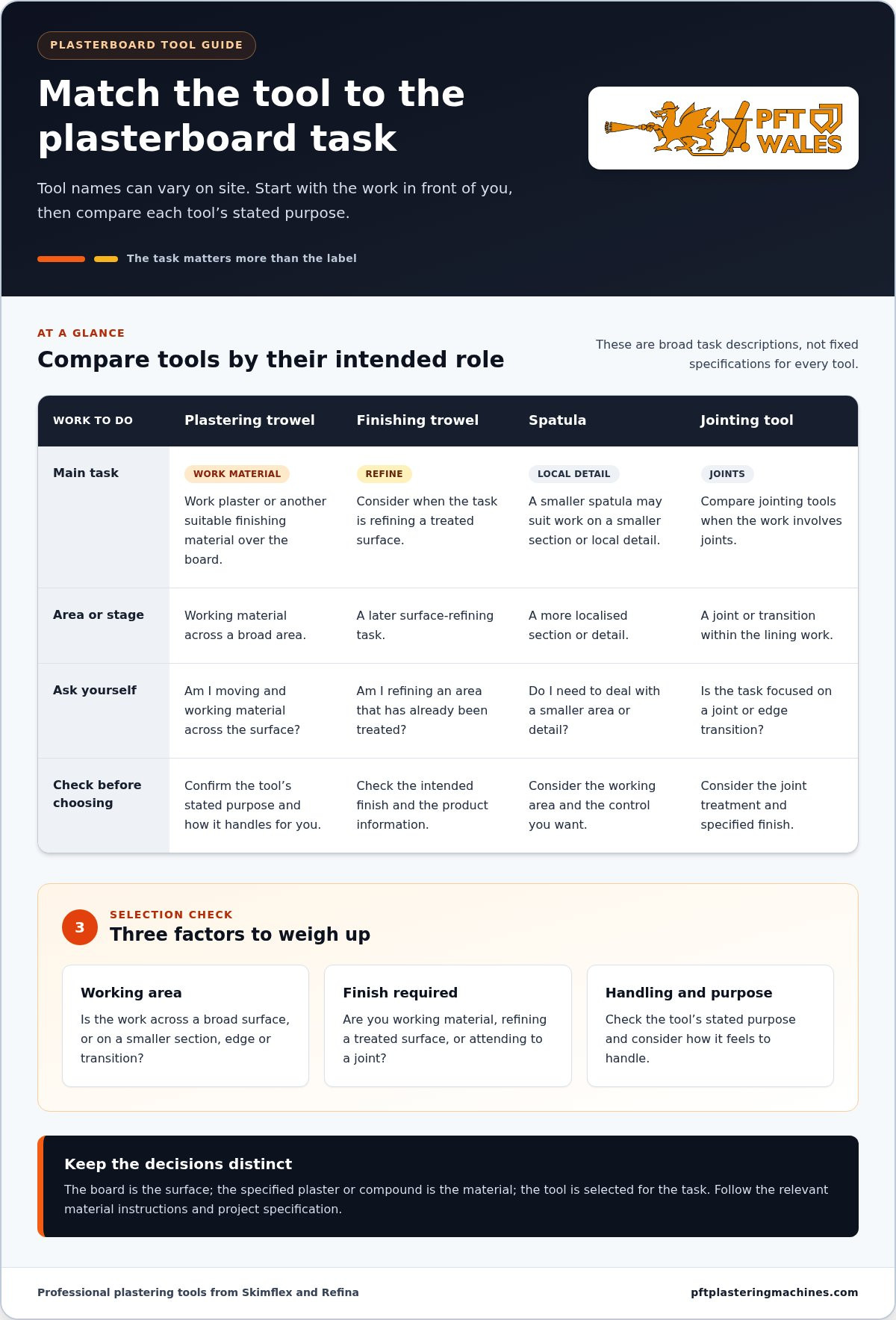
Trade terms aren’t always used in exactly the same way. “Plasterboard trowel” may mean a general plastering trowel used on board, whilst “finishing trowel” points more directly to work refining a surface. Neither label alone tells you exactly what a tool is suited to. Compare the task first, then check the tool’s stated purpose and product information.
The task matters more than the label used to describe a trowel. The table below sets out broad differences between common tool categories. These are role-based descriptions, not claims about particular models or specifications.
| Task | Tool category | What to check |
|---|---|---|
| Working plaster or finishing material across a surface | Plastering trowel | Whether it suits the material and action required for the job. |
| Refining a plastered surface | Finishing trowel | Whether the tool is intended for the stage and finish you’re working towards. |
| Working in a more localised area | Spatula | Whether its stated purpose and handling suit the specific area. |
| Addressing board joints | Jointing tool | Whether it is intended for the jointing task and specified system. |
Use the categories as a starting point, not as a substitute for product guidance. Names can overlap in everyday conversation, and product ranges may use their own descriptions. When comparing tools, say whether you’re working over a broad surface, refining it or dealing with a joint. That detail makes it easier to identify the relevant category.
When is a finishing trowel the more relevant term?
“Finishing trowel” is the clearer description when your question is specifically about refining a surface, rather than working material across the board more generally. It describes the intended stage of the work, not one universal model or specification. To compare professional options by category, browse the plastering trowel range and focus on the stated use of each tool.
How do spatulas and jointing tools differ?
A spatula is a separate tool category, whilst jointing tools are associated with work on board joints. Their intended tasks can differ from using a trowel across a wider plastered area, so don’t assume one replaces another. If the work is focused on a joint, compare tools intended for that jointing task. If you’re refining a broader surface, use that as your point of comparison instead.
PFT Wales supplies professional plastering spatulas as part of its tool range. Compare each tool by its stated purpose, the work at hand, the relevant material instructions and the finish required. If terminology is causing confusion, describe the task in plain trade terms when seeking advice.
How to Choose a Plasterboard Trowel for the Job
Choose a plasterboard trowel by the work in front of you, not by the name alone. This short process helps narrow the options without assuming one tool suits every board, material or finish.
- Define the task. Are you applying material, working it across the board or refining a treated surface? Be specific about the action and the area involved.
- Identify the required finish. The finish and the job requirements help determine which tool category is relevant. Follow the instructions for the material and any applicable project requirements.
- Compare suitable categories. Once the task is clear, compare relevant trowels or other tools by their stated purpose, handling and suitability for the work.
This keeps general tool selection separate from technical compatibility. If the job or product requires a particular tool or method, follow the relevant manufacturer and material guidance rather than drawing conclusions from a tool’s name or appearance.
Start with the task and finish
First ask whether you’ll be applying, working or refining material on the board. Then consider what the finished surface needs to meet. Those answers narrow the tool category more reliably than choosing a trowel simply because it’s described as being for plasterboard. The material instructions and job requirements remain the reference for the working method.
Assess handling, condition and tool range
Think about the working area and how much control you need. If possible, consider how the grip and balance feel in your hand, as handling preference is individual. Check the working edge for visible damage or residue too, since the tool makes direct contact with the material. These practical checks help inform your choice without assuming one design is right for everyone.
Not every job calls for the same tool category throughout. Working across a broad area and refining a localised section may place different demands on control. Consider the tools you already use, the task each one serves and whether another category would better suit the work. PFT Wales’ own Skimflex professional tools range is one option to explore alongside Refina tools.
For wider context on tools used in plastering work, the professional plastering tools range offers a broader category view. Focus on the stated purpose of each tool rather than assuming the range name defines its use. If you want help relating a task to a suitable tool category, contact PFT Wales for practical tool advice.
Finding a Suitable Plasterboard Trowel and Getting Practical Advice
The practical rule is straightforward: match the tool to the work, not just the term “plasterboard trowel”. Start with the action you need to carry out, then consider the working area, the finish required and how the tool feels in use. This gives you a clearer basis for comparing products than relying on a broad label that can mean different things in trade conversations.
Before choosing, set out the job in plain terms. Are you working material across board, refining a surface or dealing with an edge, transition or joint? Note the material instructions and any requirements for the finished lining. That context helps distinguish a general tool-selection question from one involving a specific technical or manufacturer recommendation.
Where to look for professional plastering tools
PFT Wales supplies professional plastering tools from Skimflex, its own tool range, and Refina. Explore Skimflex professional plastering tools and compare them with Refina tools. Use each product description to assess its stated purpose. Don’t assume that a range name, or the fact that a tool is used in plastering, makes it suitable for every task on plasterboard.
Compare like with like. If your work is focused on refining a surface, look at tools described for that role. If the task differs, use it to guide which category you explore. Personal handling preference matters too, so consider grip, balance and control as part of the decision, without treating those preferences as a substitute for the product’s stated use.
When to ask for advice
Ask for guidance if the tool name is unclear, you’re unsure which task a product is intended for, or the material requirements affect your choice. PFT Wales provides telephone technical advice. Describe the work and what you’re trying to achieve, with the product or material information to hand if relevant. Where manufacturer instructions apply, use them to guide the work.
A clear description is a useful starting point: explain what you’re working on, what action the tool needs to perform and what finish the job calls for. That keeps the conversation focused on practical requirements, without assuming an unverified model or specification is the answer.
If you’d like to discuss your requirements, Contact PFT Wales for practical tool advice.
Make Your Next Tool Choice with Confidence
Before your next internal-lining job, note the working area, the action required and any finish or material instructions that apply. A clear brief gives you a practical basis for comparing options and checking that a tool’s stated use matches the work ahead.
When comparing tools, keep the job details in view rather than relying on a broad product label. For help narrowing down the options, discuss your tool requirements with PFT Wales.
Go into the next job with the task clearly defined, and you’ll be better placed to choose with confidence.
Frequently Asked Questions
What is a plasterboard trowel used for?
It’s used by plasterers to work material on an internal board lining. The relevant tool may vary according to whether you’re working a main wall area, a return or a local detail. Check the planned finish and material guidance before choosing. The term alone doesn’t identify the intended application or confirm suitability for a particular system.
Is a plasterboard trowel different from a finishing trowel?
The names don’t always identify separate types of tool. A product described as a finishing trowel should be considered in relation to its stated finishing use, whilst “plasterboard trowel” may be used more generally in conversation. If a catalogue description leaves the intended role unclear, compare it with the work you need to carry out rather than inferring a difference from the name alone.
Can I use a standard plastering trowel on plasterboard?
It may be suitable if the tool’s intended use and the job requirements align. Before relying on a familiar trowel, check that its working edge is clean and serviceable, and review the relevant material instructions. A tool that’s suitable for one material or stage shouldn’t automatically be assumed suitable for another. If a product or system specifies particular requirements, follow those rather than relying on the general label “standard”.
What is the difference between a plasterboard trowel and a jointing knife?
A jointing knife is associated with working board joints, whereas a trowel is commonly considered for broader plastering tasks. The key distinction is the intended operation, not simply the tool’s name. If the work concerns a board-jointing system, use tools and materials in line with that system’s guidance. Don’t assume a trowel can take the place of a jointing knife for every jointing task.
How do I choose a trowel for plasterboard work?
Use the job specification and material instructions as your reference points, then check the tool description against them. Consider whether you’ll be working a large open area or a confined section, and whether the tool feels manageable for that work. If you’re comparing unfamiliar options, note the exact task and any product guidance that applies. Those details make a tool discussion more precise.
Do I need a separate trowel for skimming plasterboard?
There isn’t a universal requirement for a dedicated trowel solely because the surface is plasterboard. The choice depends on the tool’s stated purpose, the material guidance and the requirements of the skim finish. A separate tool may be useful if your existing one isn’t suited to the work or is no longer in suitable condition, but the board itself doesn’t establish that need.
Can one plastering trowel be used for different internal-lining tasks?
It may suit more than one task, but judge each use against its own requirements. A trowel used on a wall area might not be the tool you prefer for a detailed return or a separate jointing operation. Keep the tasks distinct in your kit and follow the relevant material guidance. A broad range of uses doesn’t make every trowel suitable for every application.