

A spray kit isn’t automatically the right choice just because it comes as a kit. With spray render tools, the right fit depends on the application and your existing setup, not the product label alone. Choosing by the wrong criteria could leave you with equipment that doesn’t suit your workflow or intended finish.
It can be difficult to compare a hopper gun with a spray kit or identify which supporting tools you need. This guide focuses on practical differences, including the two Refina spray kit configurations listed by PFT Wales, so you can assess what’s relevant to your work.
Start with the task and the equipment you already have. Then compare the product details and note any setup questions that need technical advice. PFT Wales offers telephone technical advice to help with questions about your equipment. The aim is to give you a clearer next step before you choose.
Key Takeaways
- Start with the job and equipment on site to narrow down which type of spray equipment you need.
- Understand how complete spray kits, standalone hopper guns and preparation or finishing tools serve different roles.
- Compare spray render tools by their listed details and intended task, not by product name alone.
- Use a shortlist of practical questions to identify details that need technical guidance.
- For setup-specific compatibility questions, PFT Wales’ telephone technical advice can help you assess the relevant details.
What are spray render tools and how do they work?
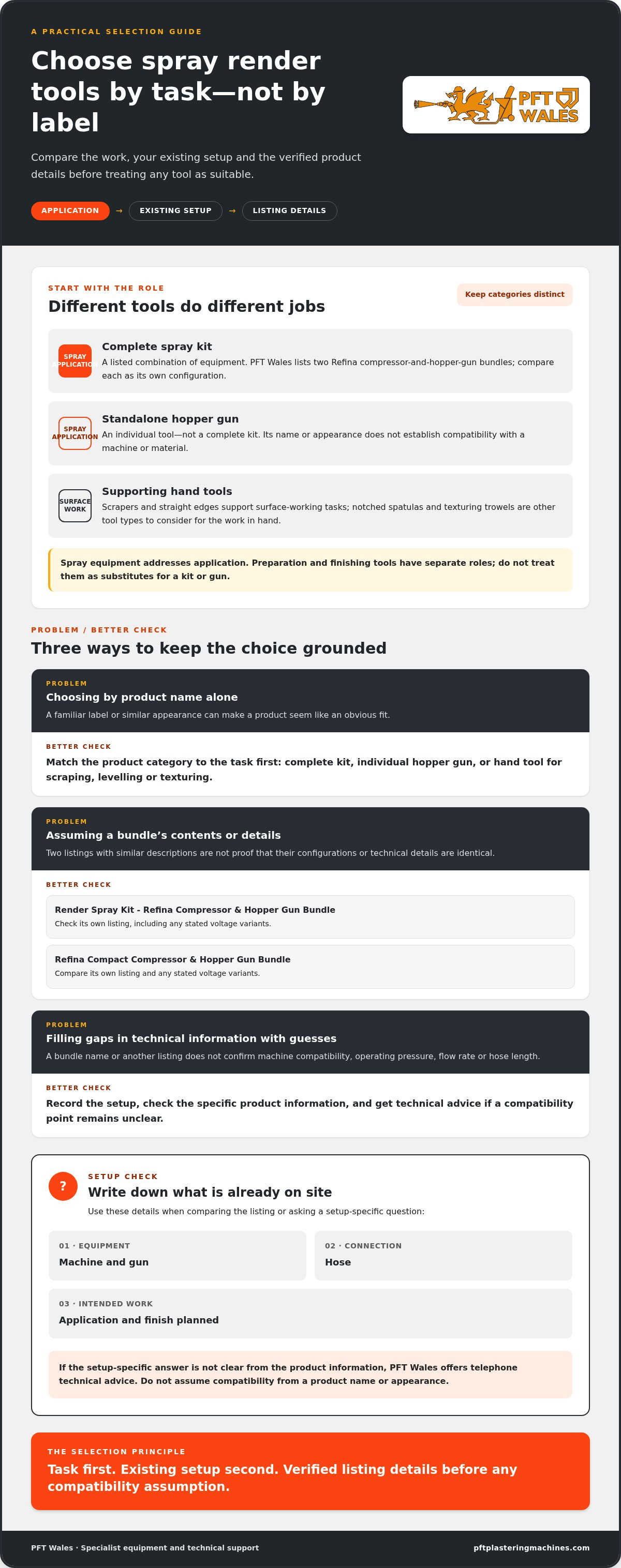
Spray render tools include equipment for applying render by spray, as well as hand tools used for preparation and finishing. The category covers different items, not one interchangeable system: a complete spray kit, a standalone hopper gun and a finishing trowel each have a different role.
Keep the task and existing equipment in view from the start. A kit brings together listed equipment, while a gun is an individual tool. Neither label alone confirms whether an item suits your machine setup, material or intended finish. Check those details for the specific equipment you’re considering.
A spray kit is a listed combination of equipment; a standalone spray gun is an individual application tool. External rendering covers a range of materials and application methods. External Render on Wikipedia provides background to the broader subject.
Spray kit or standalone hopper gun: what is the difference?
A spray kit is presented as a combination, while a standalone hopper gun is an individual tool. PFT Wales lists two Refina spray kits described as compressor-and-hopper-gun bundles. Treat them as separate configurations rather than assuming their contents or technical details are identical. Compare each listing and decide whether you need a combined kit or a gun for an existing setup.
A familiar name or similar appearance doesn’t establish compatibility. Don’t assume a hopper gun suits a particular machine or material without verified information. For setup-specific questions, PFT Wales offers telephone technical advice.
Which hand tools support the rendering workflow?
Hand tools have a separate role alongside spray equipment. Scrapers and straight edges can support surface-working tasks, while notched spatulas and texturing trowels are different tool types to consider for the work in hand. They aren’t substitutes for a spray kit or gun.
Separate the decisions. First, consider the spray equipment needed for application and the setup it must work with. Then identify any hand tools needed for preparation or finishing. This keeps the shortlist practical and avoids treating different tools as one package. PFT Wales’ Skimflex professional tools cover the supporting hand-tool side of that choice.
In short, spray equipment addresses application, while surface-working and finishing tools support other parts of the workflow. Choose by role, and get advice specific to your equipment for technical compatibility questions.
How to compare spray render tools for your application and setup
Start with the work you need to carry out and the equipment already on site. Are you choosing a kit for a spraying setup, a hopper gun, or hand tools for scraping, levelling or texturing? Note the machine and accessories you intend to use, then compare products by role. This keeps your shortlist focused on the job rather than a familiar label.
Selection principle: confirm the whole setup before treating any tool as compatible. A product name identifies its category, but doesn’t establish how it will work with your machine, hose or intended application.
Match the product category to the task
Keep application equipment separate from surface-working tools. The Render Spray Kit - Refina Compressor & Hopper Gun Bundle and Refina Compact Compressor & Hopper Gun Bundle are separate listings. Compare each as presented, including any voltage variants stated in its listing. Scrapers, straight edges and texturing tools serve different tasks, so don’t compare them as alternatives to a spray kit.
For projects with specified quality requirements, assess the equipment separately from the work specification. For new-home work, the NHBC Standards for Rendering may be relevant to wider project requirements. A tool listing isn’t guidance on compliance.
Check setup details without guessing
Before comparing options, record the machine, gun, hose and intended application. Check product information against those details. Don’t infer operating pressure, flow rate, hose length or machine compatibility from a bundle name, appearance or another listing. If a setup-specific point remains unclear, PFT Wales offers telephone technical advice.
Use the spraying guns and hoses collection to compare relevant listings, then resolve technical questions before treating an item as suitable. This helps narrow your options without turning unknown specifications into assumptions.
Standout spray render tools: compare the collection’s relevant options
Start with details you can verify in each listing, then separate those facts from questions that need technical advice. PFT Wales’ range includes compressor-and-hopper-gun bundles and individual supporting tools. They serve different roles, so assess a kit as a listed combination and hand tools by their stated type and variants. The examples below show what product names and descriptions tell you, without assuming they prove compatibility with a particular setup.
Refina spray kit options in the collection
Two named listings provide a starting point for comparing complete spray equipment. The voltage variants below are details stated in the listings, not a recommendation about electrical suitability.
- Render Spray Kit - Refina Compressor & Hopper Gun Bundle: a named compressor-and-hopper-gun kit listing, with 110V and 230V variants.
- Refina Compact Compressor & Hopper Gun Bundle: a separate listing, also showing 110V and 230V variants. Compare its details independently rather than assuming both bundles have the same configuration.
Compare each listing on its own terms. A name or voltage variant doesn’t establish whether a kit suits your machine, site arrangements or intended material. For more context, use the render spray equipment guide alongside the spray-gun and hose collection. Take unresolved setup questions to PFT Wales’ telephone technical advice rather than guessing.
Supporting tools for preparation and finish
Some useful spray render tools aren’t spray equipment. These separate hand tools have listed types or variants that can help you compare them for the task in hand:
- I Section Scraper: a render scraper available in multiple listed sizes. Compare the options with the surface-working task.
- Refina Notched Spatula: a square-notch spatula with size options shown in its listing. Check the stated notch and size details rather than treating it as a spray accessory.
- Skimflex ABS Plastic Texturing Trowel: a texturing trowel listed in 2 mm and 3 mm variants. Use the listing details to identify the tool and its variants, then choose according to the finish task.
These products don’t replace one another. The scraper, spatula and texturing trowel each have a distinct stated form, while the Refina bundles are complete kit listings. Keep the categories separate and use the product descriptions to identify the option you’re considering. If the application or equipment setup raises a technical question, get advice rather than treating a listing detail as proof of compatibility.
Avoid common buying mistakes when selecting spray render tools
A product can look right on the page and still leave important questions unanswered. A headline category, familiar name or similar appearance doesn’t establish whether an item suits your job and equipment. A short pre-purchase check helps separate stated listing details from points that need technical advice.
A practical pre-purchase checklist
Work through these checks in order to build a shortlist around the job, not assumptions.
- Describe the job. Note the task, intended application and finish requirements in practical terms. Keep these separate from the name of a tool or kit.
- Record the existing setup. Write down the machine and relevant gun and hose details. Use the equipment’s own identification rather than relying on memory or a broad category name.
- Compare confirmed listing details. Check the exact product name and details stated in its listing against your notes. Don’t fill gaps with information from another product or bundle.
- Mark unknowns clearly. If the product information doesn’t establish a specification or compatibility point, leave it as an open question. Don’t turn an assumption into a selection criterion.
- Get advice on unresolved points. Contact PFT Wales for telephone technical advice if you’re unsure whether the setup details line up. A clear record of the machine, gun, hose and intended application makes the question more useful.
Reminder: an unverified technical detail is not a specification. Treat it as something to resolve, not a basis for purchase.
Common assumptions to avoid
Two hopper guns can share a broad product label without being interchangeable. The same applies to kits: a familiar name doesn’t prove setup compatibility, and a product category alone doesn’t show whether a tool suits a particular material or application. Check the exact listing and get advice if technical details aren’t clear.
Take care with voltage labels, too. If a listing shows variants such as 110V and 230V, those are listing details only. They aren’t advice about site electrical requirements or confirmation that a variant suits your site. Keep that decision separate and rely on appropriate technical guidance.
Appearance can mislead as well. A tool may look similar to one already in use, but that doesn’t establish matching specifications, configuration or compatibility. Compare the listing details with your recorded setup. If a key point remains unanswered, pause the purchase decision rather than assuming the products are alike.
Use the checklist to narrow your shortlist, then browse the spray render tools collection with your requirements in hand. For setup-specific questions, PFT Wales’ telephone technical advice can help you make a more informed choice.
Choose your spray render tools and take the next step
A sound choice starts with the job: what needs applying, what finish are you working towards, and what equipment is already on site? Compare product categories and listing details against that setup. This keeps the decision focused on the work rather than optional items that may not have a role.
Turn the shortlist into a confident product choice
Keep three categories distinct. A complete kit is a listed combination of equipment; a standalone gun is an individual spray tool; scrapers, spatulas and texturing trowels are supporting hand tools. Each belongs to a different part of the workflow. Choose according to the task, not which category sounds most comprehensive.
Check each item against the information you have: the exact product name, details in the listing and your equipment setup. Don’t treat a product description as proof of compatibility or material suitability unless it establishes that point. If the listing and your requirements don’t give you a clear answer, leave the question open rather than filling the gap with an assumption.
This is particularly useful when weighing up a complete spray kit against a standalone gun. A kit listing describes a combination, but that alone doesn’t confirm it matches your site setup. Select supporting hand tools separately according to the preparation or finishing task. Keep the shortlist focused on items needed for the work, and include others only when they have a clear purpose.
Browse the collection or get practical advice
Ready to compare options? The spray render tools collection brings the relevant equipment together so you can review listed categories and product details. Use it to refine your shortlist, not to infer technical specifications the listings don’t state.
For setup-specific questions, PFT Wales offers telephone technical advice. Have your equipment and intended application details to hand, and ask about anything you can’t establish from the product information. This is more dependable than guessing about compatibility, electrical requirements or material suitability.
Once you’ve identified the task, compared categories and checked the available details, choose an option that fits the requirements you can verify. Resolve any remaining technical questions before committing. Browse the spray render tools collection with your setup in mind.
Set up your next job with confidence
The best choice is the one that fits the planned work and the equipment you’ll use. Before ordering, check whether the product details answer the questions that matter for your setup. If they don’t, PFT Wales can offer technical advice. PFT Wales is an authorised PFT dealer and supplier of Refina spray equipment, and provides machine servicing and repairs.
Compare spray render tools against your actual job, not a hypothetical one. Keep the shortlist focused, check each listing and get advice on any technical point that remains unclear. This gives you a considered basis for choosing equipment and preparing for the work ahead.
Compare the spray render tools and choose the equipment for your next job. Take the next step with a clear plan and the right questions in hand.
Frequently Asked Questions
What tools do I need to spray render?
The equipment depends on the task and the setup you plan to use. Your shortlist may include a spray kit or standalone hopper gun, plus hand tools for surface preparation or finishing. Note the machine and accessories already available, then compare them with the product listing. If a technical detail isn’t clear, get advice rather than assuming the equipment will suit.
What is the difference between a render spray kit and a hopper gun?
A render spray kit is a listed combination of equipment, while a hopper gun is an individual spray tool. PFT Wales lists Refina compressor-and-hopper-gun bundles as kits, as well as standalone hopper guns. Check the contents and description of the specific listing. Don’t assume a separately listed gun is included in a kit, or that two bundles have identical configurations.
Can I use any hopper gun with my rendering machine?
No. Don’t assume that any hopper gun will work with your rendering machine. Similar names or appearances don’t establish compatibility, and a general product category doesn’t confirm suitability for your machine or intended material. Note the machine details and the gun you’re considering, then ask PFT Wales for telephone technical advice if fit or application remains uncertain. Avoid relying on a guess.
How do I choose a spray render gun?
Choose according to the job and the equipment the gun must work with, not appearance alone. Record your machine details, the gun and hose you intend to use, and the planned application. Compare those notes with the product listing and mark missing technical information as a question. This helps narrow your spray render tools shortlist without treating an unverified detail as a specification.
Are compressor and hopper gun kits available in different voltage variants?
Yes. PFT Wales’ listings for the Render Spray Kit - Refina Compressor & Hopper Gun Bundle and the Refina Compact Compressor & Hopper Gun Bundle include 110V and 230V variants. These are listing details, not advice about your site’s electrical requirements or confirmation that a variant suits your setup. Check the specific listing and seek technical advice if you’re unsure about the equipment requirements.
Which hand tools are useful alongside spray render equipment?
Useful options depend on the preparation or finishing task. A render scraper may suit surface-working, while a straight edge, notched spatula or texturing trowel is a different tool type to consider for its stated role. For example, the Skimflex ABS Plastic Texturing Trowel is listed in 2 mm and 3 mm variants. Choose hand tools for the work they’ll do, not as substitutes for spray equipment.