

Why are you still fighting against the clock and your own joints with a tool designed for a different era of plastering? We’ve all been there... halfway through a massive ceiling set on a price-work job, the gear is starting to pull, and your shoulder feels like lead. It’s the physical fatigue that usually gets you before the light fades. Using a modern plastering spatula isn't just about following a trend; it's about working smarter to achieve a flatter finish with half the physical strain.
You already know that consistency is everything when the pressure is on, but traditional trowelling often leaves you chasing lines on large surface areas. This guide will help you master the art of high-speed finishing and explain why the modern spatula is an essential upgrade for every UK tradesperson. We’ll explore which blade flex is right for your specific materials, how to speed up the flattening process on large sets, and the technical reasons why the latest kit from Skimflex and Refina has become the industry standard for 2026.
Key Takeaways
- Learn how selecting the correct blade gauge and material helps you achieve a glass-like finish during the final stages of a set.
- Discover how the ergonomic design of a modern plastering spatula significantly reduces strain on your wrists and shoulders compared to traditional trowelling.
- Master the "Cross-Skimming" technique and understand why a shallower angle is essential for eliminating lines on large ceiling areas.
- Find out why professional tradespeople are switching to wide-span finishing tools to increase speed and precision on high-pressure price-work.
- Compare the flex characteristics of the Skimflex and Refina ranges to ensure you're using the right tool for your specific rendering or skimming material.
What is a Plastering Spatula and Why has it Revolutionised the Trade?
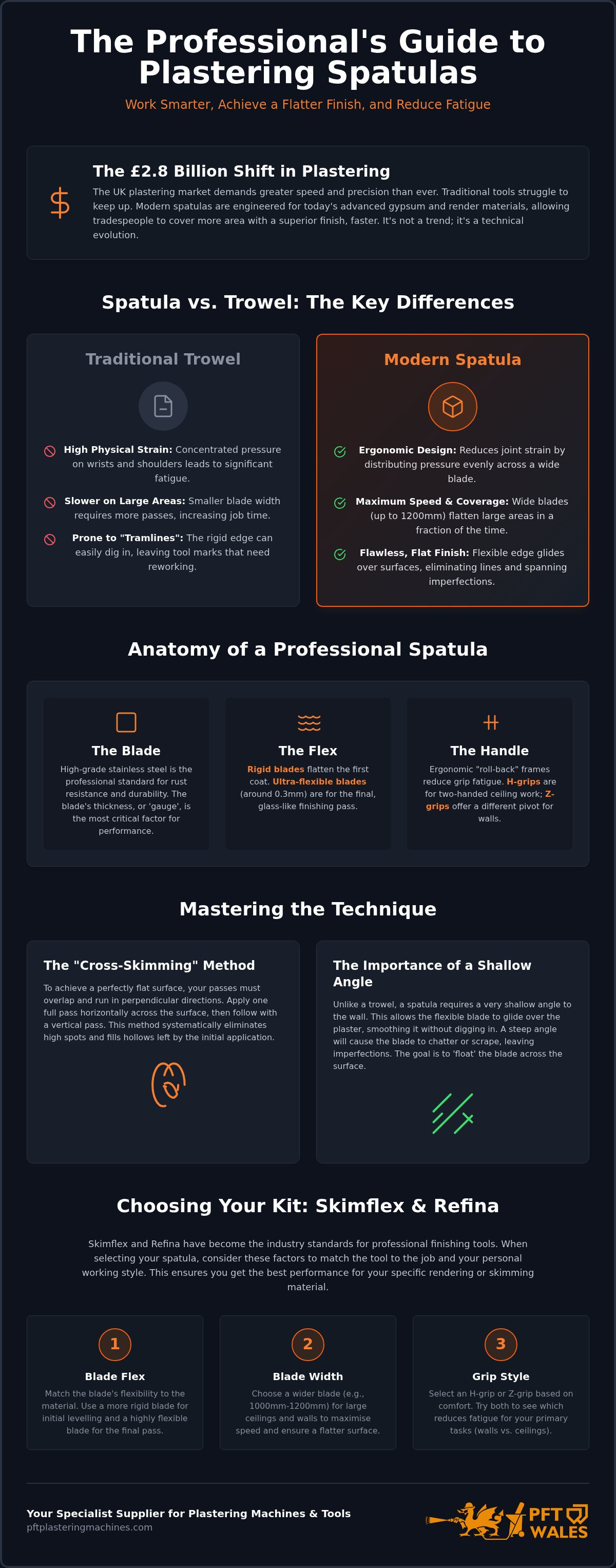
For decades, the steel trowel was the undisputed king of the British building site. It's a versatile tool, but as the UK plastering market has grown to a value of £2.8 billion as of 2026, the demand for speed and precision has forced a shift in our kit bags. A plastering spatula is a wide-blade finishing tool specifically engineered for the flattening and smoothing stages of a set. While a What is a Spatula? might be a generic term in other industries, for a professional plasterer, it represents a move away from heavy, rigid steel towards lightweight, flexible wide-span blades.
This isn't just about following a trend. It's about the physics of the finish. In a traditional three-stage process, you'd use a trowel for everything from laying on to the final polish. Today, smart contractors use the trowel to get the gear on the wall and then switch to the spatula for the critical flattening and finishing passes. It's a revolution that's saving shoulders and improving results on large-scale residential and commercial projects across the UK.
To better understand how this tool changes the workflow on site, watch this helpful video:
The Evolution from Trowel to Spatula
Modern gypsum and render formulations are more refined than ever. They favour the light touch of a high-grade blade rather than the heavy pressure required by older, sandier materials. We've seen a massive transition from the standard 14-inch trowel to 1000mm or even 1200mm spatulas for large ceiling areas. Speed-skimming isn't just about moving faster; it's about tool geometry. A wider blade spans the hollows and bumps in the substrate more effectively, ensuring the finished surface is truly flat rather than just smooth.
Key Benefits for the Modern Plasterer
The most immediate benefit is the sheer surface area you cover with a single stroke. When you're working on high-pressure price-work, every second counts. Using a plastering spatula significantly reduces the frequency of tool marks or "tramlines" that often plague trowel work. Because the pressure is distributed across a wider, more flexible edge, you get a more consistent finish with less effort. It's especially effective when flattening out materials applied by PFT plastering machines, where the volume of material on the wall requires a tool that can keep up with the pace.
Anatomy of a Professional Finishing Spatula: Blades and Materials
A professional plastering spatula isn't just a piece of metal on a handle. It's a precision-engineered instrument where the blade gauge determines the entire finishing experience. Blade thickness is the most critical factor here. A thicker gauge provides the rigidity needed for the initial flattening of the gear, whilst a thinner blade offers the flex required for that final, effortless sweep across the set. Getting this balance wrong usually leads to inconsistent pressure and those dreaded hollow spots.
Handle design is equally vital for long days on site. Most pros now look for the "roll-back" design in the handle frame. This allows you to tuck your fingers into the profile, giving you significantly more control and reducing the grip strength required to keep the tool steady. You'll generally choose between h-grip and z-grip designs. H-grips are the standard for two-handed ceiling work, whereas z-grips offer a different pivot point that many find more comfortable for vertical wall passes and tight corners.
Stainless Steel Blades: The Professional Standard
High-grade stainless steel remains the benchmark for durability and performance. It won't rust in your water bucket, and it holds its edge through months of heavy use. These blades come in various flex profiles to suit different stages of the job:
- Rigid Blades: Typically thicker, these are used for the first pass to knock back high spots and ensure the substrate is level.
- Ultra-Flexible Blades: Often around 0.3mm thick, these are designed for the final smoothing pass where a light touch is essential.
Breaking in a new metal spatula is a simple but necessary task. A quick rub with fine-grit sandpaper on the leading corners prevents the tool from "digging in" on your first set, ensuring a smooth glide from the very first stroke.
Plastic and Composite Blades: The Finishing Secret
Plastic and composite blades have become the secret weapon for achieving a flawless finish without the risk of "burning" the plaster. When the gear is starting to turn, a metal blade can sometimes blacken the finish if the pressure isn't perfect. Plastic blades glide over the surface without this risk, making them the favourite choice for the final water-only pass. The Skimflex range has pioneered replaceable blade systems, allowing you to swap from a stainless steel flattening blade to a plastic finishing blade on the same handle in seconds. This versatility means you carry less kit but have more options on the wall. To learn more about the precision engineering behind professional-grade plastic tools, check out Central Plastics.
Choosing the right combination of blade flex and handle shape can transform your productivity. If you're unsure which blade gauge is best for the specific materials you're pumping, you can always contact PFT Wales for technical advice tailored to your setup.
If you've spent twenty years on the tools, you'll know that your body eventually starts sending you invoices for all those heavy sets. The transition to a plastering spatula isn't about laziness; it's about mechanical advantage. A standard trowel requires a constant, tight grip to maintain the blade angle. This "death grip" is a primary cause of carpal tunnel and tendonitis amongst UK tradespeople. By contrast, the ergonomic frame of a spatula allows for a more relaxed, open-handed technique that shifts the strain away from your smaller joints.
The physics are simple. A trowel handle acts as a lever against your wrist, especially when you're working with heavy gear. Because a spatula handle sits directly behind the blade, the centre of gravity is much closer to the wall. This reduces the rotational force on your wrist and elbow, making the tool feel significantly lighter during use, even if the physical weight is similar to a traditional trowel.
Weight Distribution and Joint Health
Long-term joint health is the most overlooked aspect of a plasterer's career. When you're using a two-handed h-grip spatula, you're distributing the workload across both shoulders and your core, rather than punishing a single arm. This balanced posture is a game-changer for tradespeople prone to RSI or "plasterer's elbow."
- Natural Posture: Working on ceilings with a spatula allows you to keep your neck in a more neutral position.
- Grip Pressure: The wide handle design means you don't need to squeeze the tool to maintain control, reducing forearm fatigue.
- Reduced Vibration: When following a machine like a PFT G4, the spatula absorbs more of the surface resistance, sparing your joints from repetitive shocks.
Surface Area and Efficiency
Efficiency isn't just about finishing the job faster; it's about how many movements your body has to make to get there. Consider a standard 4-metre ceiling. A traditional 14-inch trowel is roughly 355mm wide. A 1000mm spatula covers nearly three times that width in a single pass. This math directly translates to fewer strokes, fewer resets, and significantly less "stepping" across your hop-ups or ladders.
By minimising the number of passes required to flatten a set, you're not just saving time. You're reducing the physical toll of the day. For a deeper look at how these tools fit into a modern workflow, check out our Professional Plastering Tools: 2026 Essential Guide for wider kit context. Working smarter ensures you can stay on the tools for longer without the chronic aches that used to be a mandatory part of the trade.
Mastering the Technique: How to Use a Plastering Spatula
Using a plastering spatula effectively requires unlearning some of the muscle memory developed from years of trowel work. The most common mistake is the angle of attack. Whilst a traditional trowel often performs best at a 45-degree angle, a spatula needs a much shallower approach. You should hold the blade nearly flat against the wall. This shallow angle allows the wide span of the tool to bridge the hollows in the substrate rather than digging into them. If you find yourself applying heavy pressure, you're likely fighting the tool. Let the blade's flex do the work for you.
Integrating this tool with plastering machines is where you see the real profit gains on site. When gear is being pumped onto the wall at high volume, you need a tool that can flatten large areas in seconds to keep up with the machine's output. The "Cross-Skimming" method is the professional standard here. Start with vertical passes to level the material, followed immediately by horizontal passes. This "cross-hatching" technique ensures that any minor deviations in the substrate are neutralised, leaving a surface that is truly flat, not just smooth to the touch.
The Three-Pass Finishing System
We recommend a disciplined three-pass approach to get the most out of your kit. The first pass happens immediately after the material is applied; use a rigid stainless steel blade to knock back high spots and level the set. The second pass is your "filling" pass, where a medium-flex blade helps to eliminate any remaining low spots. The final pass is the "trowel-down." For this, switch to an ultra-flexible or plastic blade. This achieves that glass-like finish without the risk of over-working or "burning" the plaster as it starts to turn.
Maintenance and Longevity
Your spatula is a precision instrument, so treat it like one. Dried-on plaster in the handle profile is the quickest way to ruin the tool's ergonomics and balance. Always keep a bucket of clean water nearby and give the tool a quick scrub between passes. Use blade guards when the tool is in your van to prevent nicks and burrs. Even a tiny nick in a 1000mm blade will leave a line across your entire ceiling. Replace the blade if you notice any permanent bowing or if the leading edge has lost its "spring."
Getting your technique right is the difference between a good job and a great one. If you're struggling to get the perfect finish with your current setup, contact our technical team for a breakdown of the best blade and machine combinations for your specific needs.
Choosing Your Kit: Skimflex vs. Refina Spatulas
Selecting the right plastering spatula often comes down to the specific demands of your project and your personal preference for blade feedback. At PFT Wales, we've spent 16 years on the front lines of the trade, which is why we stock both Skimflex and Refina. We don't believe in a one-size-fits-all approach. Whether you need a 250mm tool for intricate detail work or a 1200mm beast for massive commercial ceilings, your choice of brand determines how the tool responds to the gear on the wall. Buying from an authorised UK dealer means you're getting kit that has been vetted by professionals who actually know how a set pulls.
Skimflex: Professional Quality, Direct Value
The Skimflex spatula range is our proprietary line, designed specifically to meet the needs of the UK plastering community. We source these tools from top-tier European manufacturers in Poland, Austria, and Germany to ensure that the steel quality and handle ergonomics are second to none. By working directly with these manufacturers, we can offer premium kit at a fair price without compromising on durability. The proprietary design focuses on the balance between the handle's "roll-back" profile and the blade's spring tension.
One of the biggest advantages for the working pro is our delivery setup. We understand that when you need a new blade, you need it now. That's why we offer free Royal Mail Tracked 48 delivery on Skimflex tools across the UK. It's reliable, fast, and keeps your overheads down whilst ensuring you're never left waiting for kit on a critical job.
Refina: The Industry Specialist
Refina has been a staple in the UK market for decades, and for good reason. Their tools are known for technical precision and a wide variety of specialised blade flexes. For many firms, Refina is the "gold standard" for finishing thin-coat renders and high-end gypsum finishes. Their range is particularly noted for the consistency of the blade gauge across different lengths. If you're looking for a deep dive into why this brand holds such a strong position in the trade, read our REFINA Brand Analysis for more detail.
When you buy from a specialist like PFT Wales, you aren't just getting a tool in a box. You're getting the backing of a team that services and repairs the machines these tools follow. We know which blade works best with a PFT G4 and which one is better suited for hand-applied backing coats. We stock everything from 250mm detail spatulas to 1200mm ceiling blades to ensure you have the right tool for every square metre of the set. Investing in quality kit from an authorised specialist ensures your tools last as long as your reputation.
Level Up Your Finish for 2026
Adopting a modern plastering spatula is a definitive step toward protecting your physical health whilst increasing your daily output. By moving away from the restrictive grip of a traditional trowel and embracing the "Cross-Skimming" technique, you'll produce flatter surfaces that require far less corrective work. The combination of high-grade European steel and technical heritage gives you the versatility to handle any internal or external set with total confidence.
PFT Wales has been an authorised specialist since 2010, providing the trade with 16 years of hands-on expertise. We don't just supply tools; our team provides expert technical advice from our dedicated workshop to ensure your equipment perfectly matches your machine and material. With free Tracked 48 delivery on all Skimflex tools, upgrading your kit bag is both fast and cost-effective.
Ready to transform your finishing process? Contact PFT Wales today for specialist advice or to find the ideal blade for your next project. Stay ahead of the trade and work smarter for a more profitable future.
Frequently Asked Questions
Is a plastering spatula better than a traditional trowel?
It depends on the stage of the job, but for flattening and finishing large areas, a spatula is often superior. It covers more surface area per stroke and reduces joint fatigue. Whilst a trowel is essential for laying on, the spatula's wide span ensures a flatter finish by bridging hollows that a smaller trowel might follow. Most pros now use both tools as part of a modern, efficient workflow.
What size spatula do I need for skimming a standard room?
A 600mm or 800mm spatula is usually the most versatile choice for standard residential rooms. These sizes provide a significant speed advantage over a trowel without being too cumbersome in tighter spaces or near openings. For large, open ceiling areas, you might move up to a 1000mm or 1200mm blade. Smaller 250mm or 400mm versions are ideal for detail work and vertical passes in narrow corridors or around door frames.
Can I use a spatula for external rendering?
Yes, spatulas are highly effective for flattening basecoats and finishing thin-coat renders. Using a stainless steel plastering spatula on external systems helps to achieve the precise flatness required for modern acrylic or silicone topcoats. For heavier monocouche renders, a more rigid blade is typically preferred during the initial levelling stage. Always ensure the tool is cleaned thoroughly after use, as render can be more abrasive than internal gypsum plasters and can damage the blade edge.
Do I still need to use a trowel if I have a spatula?
Yes, you'll still need a traditional trowel for the initial application or "laying on" of the plaster. Spatulas are designed for flattening and finishing rather than carrying and spreading large amounts of wet material from a hawk. The most efficient pros use a trowel to get the gear on the wall quickly and then switch to a spatula for the subsequent passes. This combination offers the best balance of speed and surface accuracy.
How do I stop my spatula blade from rusting?
Choosing high-grade stainless steel tools like those in the Skimflex or Refina ranges is the best defence against corrosion. Even with stainless steel, you should never leave your tools sitting in a damp bucket overnight. After finishing a set, clean the blade with a soft brush and clean water, then dry it thoroughly with a rag. Storing your spatulas in a dry van or workshop environment will ensure the edge remains sharp and rust-free.
Are plastic-bladed spatulas worth the money?
Plastic-bladed spatulas are an excellent investment for the final finishing pass on internal skimming. They are specifically designed to glide over the plaster as it begins to set, significantly reducing the risk of "burning" or darkening the finish. Unlike metal blades, plastic offers a unique flex that helps to close the pores of the plaster without applying excessive pressure. Many tradespeople find they achieve a much whiter, more consistent finish using these composite tools on the final pass. As the trade moves towards more sustainable material sourcing, you can visit Healix to see how plastic waste is being transformed into high-quality circular plastics for industrial use.
A wide-span plastering spatula, typically 1000mm or 1200mm, is the best choice for following a PFT G4 or Ritmo machine. When gear is being pumped at high volume, you need a tool that can flatten massive areas before the plaster begins to pull. A spatula with a medium-flex stainless steel blade provides the necessary rigidity to move the wet material whilst maintaining the speed required to keep up with the machine's high output.
How do I choose between a rigid and a flexible spatula blade?
Your choice should be based on the specific stage of the finishing process. Use a rigid blade for the initial flattening pass immediately after application to knock back high spots and level the substrate. Switch to a flexible 0.3mm stainless steel or plastic blade for the final smoothing and polishing passes. Having a range of blade thicknesses allows you to adapt to how the material is behaving on any given day or site.