

What if the difference between a profitable week and physical burnout wasn't your skill level, but the ergonomics of your trowel? In a UK plastering market now worth £2.8 billion, the pressure to deliver a flawless finish across massive meterage has never been higher. You know the frustration of plastering tools that lose their edge after a few hits or handles that leave your wrists throbbing by Friday afternoon. It's a common site struggle, but it shouldn't be your daily reality.
We agree that your kit should be an investment, not a recurring expense. This guide provides the definitive kit list for the modern professional, from precision Skimflex finishing trowels to specialist Refina gear designed to follow PFT machine application. You'll discover how to build a durable kit that slashes application times while meeting the latest NHBC Standards 2026 for internal finishes. We're also covering expert maintenance advice and ergonomic specialist equipment to keep you on the wall longer with far less fatigue.
Key Takeaways
- Understand why material choice is critical, comparing stainless and high-carbon steel to ensure your kit stands up to the rigours of a busy UK site.
- Discover how modern plastering tools like Skimflex flexible trowels help you achieve a perfectly flat finish on large areas without the usual hand and wrist fatigue.
- Learn to match your mixing equipment and paddle designs to specific materials to guarantee the perfect consistency and avoid application issues.
- Identify the specialist spray equipment and machine-compatible hand tools required to maximise the efficiency of your PFT plastering or rendering machine.
- Master tool maintenance and organisation techniques that protect your high-quality investment and prevent costly, mid-job equipment failures.
Building a Professional Plastering Kit: Beyond the Basics
To survive and thrive in the trade of plastering, your gear needs to do more than just move mud. In 2026, "professional-grade" means equipment that meets the rigorous NHBC Chapter 9.2 standards for finish quality while surviving the daily grind of a £2.8 billion industry. It's about the "tradesman’s feel". This is the perfect balance between the blade and the handle that stops your forearm from seizing up by lunchtime. If a tool feels "clunky" in the shop, it'll be a nightmare on a ten-hour shift.
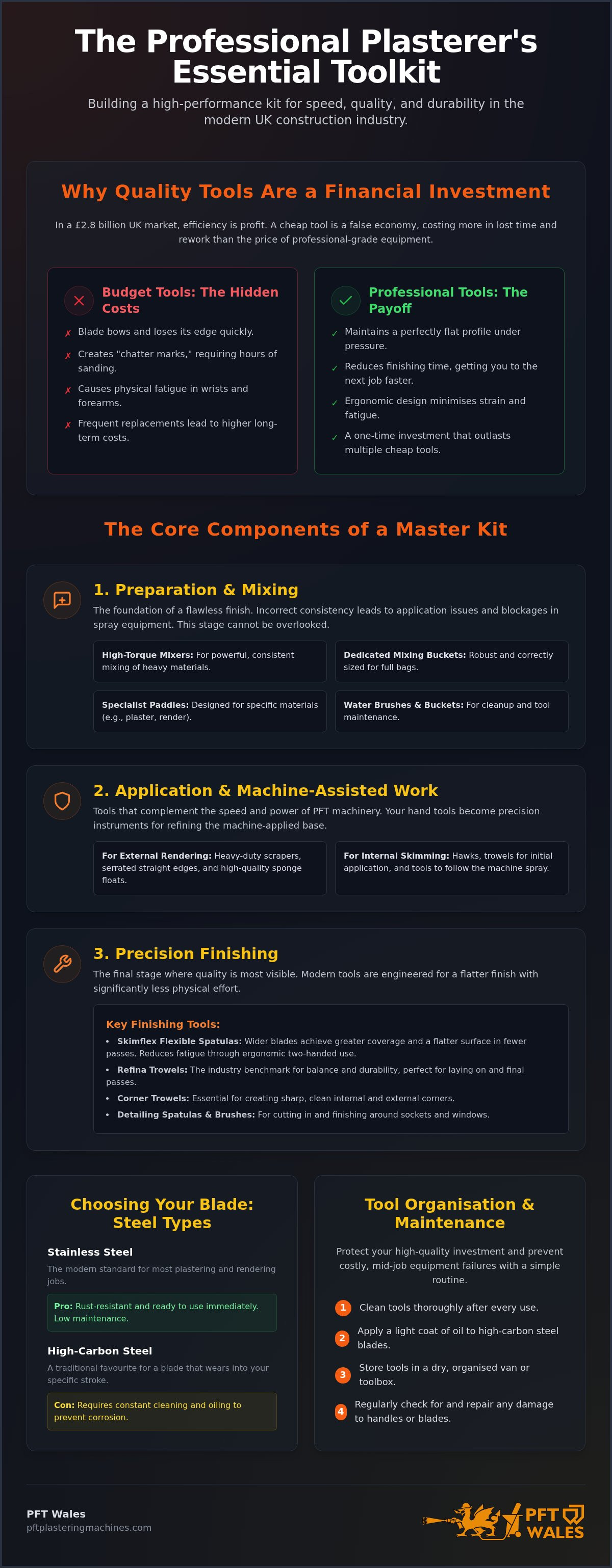
Material choice dictates your daily workflow. Stainless steel is the go-to for most modern plastering tools because it's rust-resistant and ready to use straight off the shelf. High-carbon steel remains a favourite for traditionalists who want a blade that wears into their specific stroke, though it requires constant oiling to prevent corrosion. Whether you're skimming a small bedroom or rendering a commercial block, your kit must be categorised into prep, application, and finishing stages to maintain efficiency.
Why Quality Plastering Tools Save Money
Buying a cheap trowel is a false economy. A budget blade will bow or lose its edge within weeks, leading to "chatter marks" that you'll spend hours sanding out. Professional plastering tools are engineered to maintain a perfectly flat profile under pressure. This precision reduces your finishing time, meaning you're off the job and onto the next one faster. We've seen it time and again; the "buy cheap, buy twice" trap usually ends up costing you more in wasted labour than the price of a premium Refina or Skimflex trowel.
The Core Components of a Master Kit
Your van should be organised to support a fast-paced site environment. The synergy between hand tools and modern PFT machinery is where the real profit lies. If you're using a machine to spray, your hand tools become the precision instruments that refine the finish rather than the heavy lifters. Every master kit needs a clear distinction between internal and external requirements:
- Internal Skimming: You'll need a range of flexible stainless steel trowels and plastering spatulas for achieving that glass-like finish on multi-finish plasters.
- External Rendering: This requires heavy-duty scrapers, serrated straight edges, and high-quality sponge floats that won't tear on abrasive surfaces.
- Preparation: Don't overlook the foundation. High-torque mixers and dedicated mixing buckets ensure your material is lump-free and consistent, preventing blockages in your spray equipment.
By investing in tools designed to work alongside PFT machines, you ensure that the speed of the pump is matched by the speed of your finish. It's about creating a synchronised system that protects your physical health whilst delivering the high-end results your clients expect, especially when working with high-quality facade and roofing systems from specialists like Pauresta.
Precision Finishing: The Role of Trowels and Spatulas
The days of lugging around heavy, rigid steel trowels for every single pass are long gone. The evolution of plastering tools has moved decisively towards lightweight, flexible blades that do the hard work for you. Why fight the material when the tool can glide over it? This shift isn't just about comfort; it's about speed and consistency. Flexible blades allow you to feel the substrate, ensuring a flatter finish on large areas without the physical strain associated with traditional heavy-duty steel. By reducing the pressure required to flatten the wall, you minimise the risk of "drawing" the plaster too tight or leaving unwanted trowel marks.
Skimflex and the Art of the Final Pass
Skimflex spatulas have changed the game for finishing large ceilings and walls. By using a wider blade than a standard trowel, you achieve greater coverage and a significantly flatter surface in fewer passes. It's about efficiency. These spatulas feature interchangeable blades, allowing you to switch between different thicknesses or materials like multi-finish or jointing compounds. For drywall and skimming, a professional finishing spatula is no longer optional; it's the standard for achieving a glass-like finish with half the effort. The ergonomic grip allows for two-handed use, which distributes the workload across your shoulders rather than just your wrist. This is a massive advantage when you're facing a long day of skimming.
Refina Trowels: The Industry Benchmark
Whilst Skimflex leads in spatula innovation, Refina remains the industry benchmark for durability and variety. Their range covers everything from the classic stainless steel trowel to specialist plastic options designed for finishing without leaving dark marks on the plaster. Every kit needs the basics too. Refina’s corner trowels and bucket trowels are essential for the prep work that makes or breaks the final skim. Their precision-ground edges mean you don't have to spend days "breaking in" a new tool. Explore our range of professional plastering trowels to see the variety available for every stage of the job.
Choosing between a traditional trowel and a modern spatula depends on the stage of the job. We recommend using your traditional trowel for the initial lay-on and first flatten. Switch to the spatula for the final passes where precision and flatness are paramount. It’s about using the right tool for the specific moment. If you're unsure which blade thickness or handle style suits your current project, our team of experts can advise you on the best setup for your specific material and machine setup. Having the right plastering tools in your hand makes the difference between a job that looks okay and one that looks truly professional.
Preparation and Mixing: Ensuring the Perfect Consistency
A perfect finish starts long before your trowel touches the wall. If the consistency isn't spot on, even the most expensive plastering tools won't save the job. We've all seen what happens when a mix is rushed; lumps, air bubbles, and "fatty" sections that make laying on a nightmare. For those using PFT machines, the mix is even more critical. A poorly gauged bag can lead to operating pressure spikes or, worse, blocked hoses that bring the whole site to a standstill. Consistency is the foundation of speed.
This focus on consistency is a principle shared by many heavy industries; for instance, F.A. Maker highlights how selecting the right industrial separators and processing equipment is vital for maintaining material quality in large-scale operations.
The Power of the Correct Mix
A standard drill won't cut it for professional workloads. You need a high-torque motor that can handle the resistance of heavy mortars without burning out. Browse Refina Megamixers and mixing equipment to see why these machines are non-negotiable for the trade. They provide a smooth, consistent drive that ensures every bag is blended perfectly from top to bottom. The choice of paddle is just as important as the mixer itself:
- Spiral Paddles: These are designed to pull heavy material from the bottom of the bucket upwards. They're essential for thick renders and floor screeds.
- Birdcage Paddles: Best for skimming and light plasters. They mix thoroughly without introducing excessive air, which prevents those frustrating pinholes in your final finish.
Durable Site Accessories
Your mixing station should be a model of efficiency. Professional mixing buckets and tubs from Skimflex are built with thicker walls to withstand the high-speed impact of a Megamixer. Cheap buckets often split or flex too much, wasting material and creating a mess. Keeping your gear clean is another "pro" habit that pays off. Plastering brushes and scrapers aren't just for cleaning up at 4 pm; using them to keep the edges of your buckets clean during the day prevents dried grit from falling into your fresh mix.
Organising your station also means managing the environment. Professional masking and prep equipment ensures that dust and splatter stay in the mixing zone, not on the finished joinery or windows. It's about working cleaner and smarter. By the time you're ready to load your machine or your hawk, you should have total confidence that the material is lump-free and ready for application. This level of prep is what separates the masters from the amateurs, ensuring your plastering tools can do their job without being hindered by poor material quality.
Specialist Tools for Machine Plastering and Rendering
Machine application doesn't replace the skill of a plasterer; it amplifies it. When you transition from hand-applying to using a PFT machine, your requirement for plastering tools shifts from "laying on" gear to "finishing" gear. You're no longer spending hours manually hauling material onto the wall. Instead, you're managing the flow from a spray lance or hopper gun. This speed requires a different approach to your hand kit. You need tools that can keep up with the volume of material being applied without sacrificing the high-tolerance flatness required by modern building standards.
The spray kit itself is your primary tool. High-quality lances and spray guns are essential for achieving a consistent pattern. A poor spray pattern leads to uneven thicknesses, which then takes twice as long to flatten out by hand. Using the correct nozzle size for your specific material, whether it's a base coat render or a thin-coat finish, is a technical necessity. This is where the synergy between machine and hand tool becomes obvious. If the machine does the heavy lifting, your hand tools must be precision-engineered to refine that work instantly.
PFT Machine Accessories and Spares
In the world of machine plastering, your rotors and stators are arguably the most important tools in your van. They dictate the operating pressure and flow rate of your material. Using non-genuine parts can lead to premature wear or inconsistent delivery, which directly impacts the quality of your finish. It isn't just about the pump, though. Specialist hoses and couplings are vital for maintaining flow. A kinked or worn hose creates back-pressure that can damage your machine and ruin your mix consistency. Find genuine PFT machine parts and accessories to ensure your setup remains reliable on every site.
Finishing Machine-Applied Materials
Once the material is on the wall, the clock is ticking. This is where straight edges and feather edges become your best friends. Because machine application is so fast, you need long-reach tools to strike off large areas quickly. For external rendering, electric power floats have become a staple for large-scale projects. They provide a uniform texture that is almost impossible to replicate by hand over hundreds of square metres. Skimflex tools are specifically designed to bridge this gap, offering the flexibility needed to follow a machine-applied coat whilst maintaining the rigidity required for a flat finish.
Are you looking to upgrade your setup or need technical advice on which spray kit fits your current machine? Our team at PFT Wales provides more than just equipment; we offer the training and technical support to help you master machine application. Contact PFT Wales today for expert advice on building a machine-compatible tool kit that works as hard as you do.
Investing in Quality: How to Organise and Maintain Your Kit
"Buy cheap, buy twice" isn't just a catchy phrase in this industry; it's a financial reality. If you're constantly replacing snapped trowels or struggling with handles that degrade in the rain, you're bleeding profit. A professional kit should be viewed as a long-term asset. Protective cases for your trowels and spatulas prevent the edges from getting "nicked" in the van, which saves you from hours of unnecessary sanding on site. Speed comes from knowing exactly where every piece of gear is when you need it. An organised van isn't just about being tidy; it's about protecting your plastering tools from the vibrations and impacts of transit.
Tool Care and Longevity
Clean tools are the mark of a master. Don't wait until the end of the day to wash your gear. Keeping a bucket of clean water nearby to rinse your blades between sets prevents the buildup of dried grit that scratches your finish. For high-carbon steel, a light coating of oil after cleaning is essential to prevent rust. Stainless steel is more forgiving, but the edges still benefit from a regular check for burrs using a fine-grit stone. These small habits extend the life of your kit by years.
Machine maintenance is even more critical. You need to recognise the warning signs of wear before a failure happens. A gradual drop in operating pressure or a change in the material's flow rate usually indicates that your rotors and stators are reaching the end of their life. Don't push them until they fail completely. Regular professional servicing and repairs for your PFT machinery will extend its lifespan and ensure you aren't hit with an unexpected breakdown mid-pour. A well-maintained pump is the heart of a productive site.
Expert Support from PFT Wales
Choosing the right supplier is as important as choosing the right trowel. You need an expert peer who understands the daily realities of the trade. PFT Wales provides more than just a shopfront; we offer the technical wisdom and training required to get the most out of your plastering tools and machinery. Being an authorised PFT supplier means we only provide genuine parts that protect your warranties and ensure machine performance. We've seen every site scenario imaginable, and we use that experience to guide you toward the right equipment choices.
We believe in supporting the professional from the first mix to the final pass. Whether you need a specialist part, a machine repair, or a full training session for your team, having a reliable partner in your corner makes all the difference. Contact PFT Wales for expert advice on tools and machinery to ensure your kit is site-ready for the demands of 2026.
Future-Proof Your Trade with the Right Kit
Succeeding in the modern UK construction market means choosing plastering tools that work as hard as you do. By integrating precision-engineered Skimflex spatulas with reliable PFT machinery, you aren't just buying equipment; you're investing in faster application times and a longer, healthier career. The secret to a flawless finish remains consistency, from the initial mix in a high-torque Refina Megamixer to the final pass with a flexible finishing blade.
PFT Wales has been a dedicated ally to the trade since 1988. As an authorised PFT specialist and the team behind Skimflex engineering, we provide the genuine parts, technical wisdom, and specialist training you need to master your workflow. Don't leave your site efficiency to chance or settle for gear that fails under pressure. Our experience is rooted in the daily realities of the working professional, ensuring you get advice that actually works on the wall.
Speak to the experts at PFT Wales for your professional tool needs and ensure your kit is ready for the challenges of 2026. We look forward to helping you perfect your craft and grow your business.
Frequently Asked Questions
What are the most essential plastering tools for a beginner professional?
Essential plastering tools for any new pro include a high-quality stainless steel trowel, a lightweight hawk, and a reliable bucket trowel. You'll also need a water brush for finishing and a heavy-duty mixing paddle. Whilst it's tempting to buy cheap kits, investing in professional-grade gear from the start prevents the frustration of tools that bow or rust. A solid foundation kit ensures you can meet NHBC standards from your first day on site.
Why should I choose Skimflex trowels over other brands?
Skimflex trowels are engineered specifically to provide a superior finish with less physical effort. As the proprietary brand of PFT Wales, they feature unique blade flexibility that allows for a glass-like skim on large areas. They are particularly effective when following machine-applied plaster, where speed and flatness are paramount. The ergonomic handles are designed by tradespeople for tradespeople, reducing the hand and wrist fatigue that often comes with cheaper, poorly balanced alternatives.
Can I use standard hand tools for machine-applied rendering?
You can use standard tools, but they often struggle with the sheer volume of material a machine produces. Specialist straight edges and wide spatulas are much more efficient for striking off machine-applied render quickly. Using the right plastering tools alongside your PFT machine ensures that you maintain the speed advantage of the pump. Traditional trowels are still useful for detail work, but for large elevations, dedicated machine-finishing tools are far superior.
How do I maintain my plastering spatula to ensure a clean finish?
Maintaining your spatula starts with immediate cleaning after every set to prevent dried material from scratching your next wall. Use a stiff brush and clean water to remove all residue from the blade and handle. Always store your spatulas in a protective case or rack to prevent the edges from getting nicked during transit. If you use carbon steel blades, apply a light coat of oil to prevent corrosion whilst they are in storage.
What is the difference between a finishing trowel and a skimming spatula?
A finishing trowel is primarily used for laying on material and the initial flattening stages. In contrast, a skimming spatula is much wider and more flexible, designed specifically for the final passes to achieve maximum flatness. Spatulas allow you to cover more surface area with less pressure, which is ideal for large ceilings and walls. Most professionals use a trowel for the heavy work and switch to a spatula for that perfect, high-end finish.
Are Refina tools worth the investment for small plastering firms?
Refina tools are absolutely worth the investment because they are built to survive the rigours of a busy site. For a small firm, the "buy cheap, buy twice" cycle can seriously hurt your margins. Refina gear is the industry standard for durability, meaning you spend less on replacements over the year. Additionally, the precision edges reduce the amount of sanding required, which lets your team finish jobs faster and move on to the next contract.
Where can I get technical support for my PFT plastering machine?
You can get full technical support, servicing, and repairs directly from PFT Wales. As an authorised PFT supplier with trade experience dating back to 1988, we provide expert guidance on everything from rotor and stator compatibility to fault diagnosis. Whether you need a genuine spare part or advice on material flow rates, our technical team is available to help you keep your machine running at peak performance. Contact us directly for any specialist support.
Do I need special training to use machine-specific plastering tools?
Whilst you don't need formal training to use hand tools like spatulas, machine operation is a different story. PFT Wales offers specialist training and technical support to ensure you use your spray equipment safely and efficiently. Learning the correct setup for different materials prevents costly blockages and machine wear. Investing a day in professional training often pays for itself within a week through faster application times and reduced waste on site.