

Why are you still spending days "breaking in" a new blade when the right gear should be site-ready from the very first pass? We've all been there, grinding down a fresh steel edge on a sand-cement floor just to stop it from digging in. It's a chore that steals time and, if the balance is off, leaves your wrist aching before the morning break. You know that a flawless, mirror-like finish depends as much on the blade's flex as it does on your technique. Selecting the right finishing trowel is about more than just picking a brand; it's about matching the tool to the way you work.
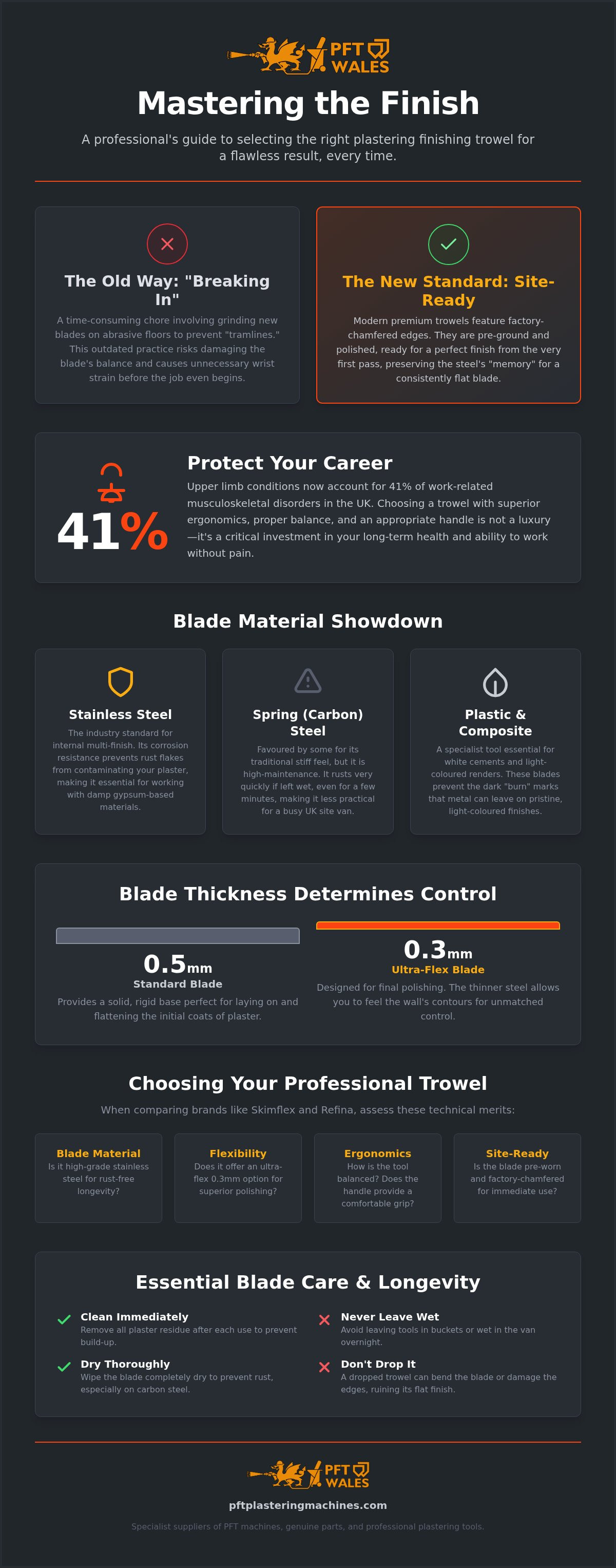
We understand that blade chatter on high-polish finishes and the rising risk of RSI are real concerns on a busy site. In fact, upper limb conditions now account for 41% of work-related musculoskeletal disorders in the UK. This guide will help you master the technical nuances of blade materials and ergonomics so you can deliver a perfect skim every time. We will explore the latest 2026 blade technologies, from ultra-flexible 0.3mm stainless steel to ergonomic grips, ensuring your next kit upgrade is a professional investment that protects your career.
Key Takeaways
- Learn why the choice between stainless and spring steel dictates how your blade reacts to different plasters and prevents premature rust in the van.
- Discover how specific handle materials and tool balance can mitigate the risk of repetitive strain injuries during intense skimming sessions.
- Compare the technical merits of Refina and Skimflex to identify which finishing trowel offers the best "site-ready" performance for your specific trade.
- Find out why modern manufacturing has made the traditional, time-consuming breaking-in process almost entirely obsolete for the professional plasterer.
- Implement expert maintenance routines that protect your blade's edge and ensure a consistent, flawless finish on every internal project.
Why the Right Finishing Trowel is Non-Negotiable for UK Trades
In the final "third coat" or polishing stage, your choice of finishing trowel is the difference between a mirror-like sheen and a surface riddled with imperfections. This isn't just about aesthetics; it's about your reputation on-site. If you're fighting your tools to get a flat finish, you're losing money. Every minute spent over-working a patch is a minute you aren't moving to the next wall. Professionals across the UK are ditching budget options for specialist gear from brands like Skimflex and Refina. These tools aren't just flat pieces of metal. They are precision instruments designed to work with the plaster, not against it.
Understanding what a finishing trowel is in a professional context means looking beyond the handle and the blade. It's about the physics of the finish. A high-quality tool allows for a consistent application of pressure across the entire surface area. This reduces the physical effort required to achieve a "fat-free" finish. When you use a tool that is perfectly balanced, you work faster. Your finishes are more consistent. Most importantly, you don't go home with a throbbing wrist at the end of the shift.
The Evolution of the "Pre-Worn" Blade
Traditionally, a new trowel was a liability. You'd spend hours "breaking it in" on sand and cement to round off the sharp factory corners. If you didn't, you'd end up with "tramlines" or scratches on your final pass. Modern manufacturing has changed the game. Many premium blades now come factory-chamfered. This means the edges are pre-ground at a specific angle. They glide over the plaster without digging in from day one. This site-ready approach preserves the blade's "memory." This is the steel's ability to return to a perfectly flat state after being flexed. A blade that loses its memory becomes bowed, making it impossible to get a true finish. This level of precision is particularly vital for architectural concrete work; for example, the smooth, mirror-like surfaces seen on handcrafted products from CRÉER demonstrate why a perfectly flat tool is essential for luxury design.
Matching Your Trowel to the Material
Not all materials behave the same. Your blade shouldn't either. For internal multi-finish, a stainless steel finishing trowel is the standard. It resists the corrosive nature of damp gypsum. It also provides the necessary flex to pull the "fat" to the surface during the final trowel-to-water stage. Rendering requires a different approach. External renders are heavier and more abrasive. You often need a stiffer blade to move this material effectively. We've also seen a rise in plastic finishing trowels for white cements. These prevent the dark "burn" marks that metal blades can leave on light-coloured finishes. Using the right tool for the material isn't just a preference; it's a technical requirement for a professional result.
Decoding Blade Materials: Stainless Steel vs Spring Steel Behaviours
Choosing a professional finishing trowel starts with the blade material. It's not just a matter of preference; it's about how the metal interacts with the chemical makeup of the plaster. While carbon spring steel offers a traditional, stiff feel that some seasoned tradespeople swear by, it's high maintenance. Leave it wet for ten minutes, and you'll see rust. In the damp environment of a UK site van, stainless steel has become the undisputed industry standard for its resilience and longevity.
For those looking to expand their kit or transition from traditional tools, checking out an can clarify how these materials differ across various construction tasks. Beyond steel, plastic and composite blades have carved out a vital niche. These are essential for preventing "burnishing" or dark metal rub marks on white cements and light-coloured renders, ensuring the final surface remains pristine without the need for intense sanding.
Blade thickness is the final technical hurdle. A standard 0.5mm blade provides a solid, rigid base for laying on and flattening. However, the modern 0.3mm "ultra-flex" models are designed specifically for the final polishing stages. These thinner blades allow you to feel every contour of the wall, providing a level of control that thicker steel simply can't match. If you're unsure which blade thickness suits your current project, you can always speak with our technical team for tailored advice.
The Benefits of Stainless Steel in Professional Skimming
Corrosion resistance isn't just about keeping the tool looking new; it's about preventing rust flakes from contaminating your mix. A stainless finishing trowel maintains a clean, sharp edge far longer than carbon steel, holding its shape even after years of heavy use. Skimflex stainless steel finishing trowels, sourced from specialist manufacturers in Germany and Austria, represent a top-tier choice for UK plasterers because they combine exceptional rust resistance with the precise blade memory required for a perfect finish.
When to Choose a Flexible Finishing Trowel
Ultra-flex blades, typically around 0.3mm thick, are your secret weapon for achieving a mirror-like finish with reduced physical effort. They provide that elusive "broken-in" feel right out of the box, mimicking the behaviour of an old favourite tool. The key to success with these thinner blades is managing "chatter," those tiny ripples that occur if the blade vibrates. High-quality Skimflex tools solve this by using a robust blade-to-handle mounting that absorbs these vibrations. This allows the blade to glide smoothly, even when you're applying the light pressure needed for that final, flawless pass.
Ergonomics and Handle Design: Reducing Fatigue on Large Skimming Jobs
Plastering is one of the most physically demanding trades in the UK. When you're working an eight-hour shift on a large ceiling, the weight and balance of your finishing trowel become critical. Poorly designed tools don't just slow you down; they lead to long-term injury. In the 2024/25 period, upper limb and neck conditions accounted for 41% of all work-related musculoskeletal disorders in the UK. This isn't just a statistic; it's a warning to choose equipment that supports your body. Proper professional plastering techniques only go so far if you're fighting a tool that's top-heavy or has a handle that causes blisters.
The "Tang" or bracket connecting the handle to the blade is the unsung hero of pressure distribution. If this component is too short or improperly aligned, the force you apply won't spread evenly across the steel. This leads to "digging in" at the corners and forces you to grip the handle tighter to compensate. A well-engineered mounting ensures that every ounce of pressure you apply is translated into a smooth, flat surface, reducing the strain on your tendons.
Cork vs Leather vs Rubber: The Pro Choice
The material you grip all day dictates your comfort and control. Leather handles are a favourite amongst seasoned pros because they absorb sweat and gradually mould to the unique shape of your hand. They offer a premium, heritage feel that improves with age. Cork grips are an excellent alternative; they are exceptionally lightweight and manage moisture well in humid conditions. For those working on cold, damp UK sites during winter, rubberised soft-grips provide the best traction. They ensure you maintain maximum control whilst wearing gloves, preventing the tool from slipping during the final pass.
Weight Distribution and Tool Balance
A common mistake is choosing a heavy blade with a lightweight, flimsy handle. This creates an imbalance that forces your wrist to work twice as hard to keep the blade level. A well-balanced trowel makes the "laying on" phase feel effortless, allowing you to focus on the finish rather than the ache in your shoulder. To achieve this without adding unnecessary bulk, Skimflex tools utilise high-grade aluminium alloy mountings. These are robust enough to withstand the rigours of the site whilst being light enough to reduce the overall weight of your kit. When you invest in a professional-grade finishing trowel, you aren't just buying a piece of metal; you're buying extra years of pain-free labour.
Skimflex vs Refina: Choosing Your Professional Daily Driver
Deciding on a new finishing trowel often comes down to two names in the UK market: Refina and Skimflex. For decades, Refina has been the benchmark, particularly with their Superflex and Plaziflex ranges. However, many modern tradespeople are shifting towards Skimflex. Why? It's about the balance between high-end performance and realistic pricing. Whilst Refina offers a legacy of reliability, Skimflex provides an engineered alternative that feels site-ready from the moment it leaves the box. Both brands are compatible with PFT plastering machines, allowing you to build a complete application system that maintains quality from the hopper to the final polish.
The Refina Superflex: A Benchmark for Flex
Refina remains a staple on UK sites for a reason. Their Superflex range introduced many to the benefits of ultra-flexible stainless steel. One of their most notable innovations is the twin blade technology. This design uses a secondary backing blade to provide structural support whilst allowing the primary finishing blade to remain incredibly thin and flexible. It's a setup that excels in large-scale commercial rendering, where you need to cover vast surface areas without the blade losing its "memory" or becoming permanently bowed under the weight of heavy material. The Plaziflex range also offers a unique plastic-blade solution for those working with light-coloured finishes where metal marking must be avoided at all costs.
Skimflex: Engineered for the Modern Plasterer
Skimflex is our proprietary brand at PFT Wales, developed from 16 years of hands-on industry experience. We've focused on removing the "big brand" price tag without compromising on the mechanical integrity of the tool. Every finishing trowel in the range is sourced from high-quality manufacturers in Poland, Austria, and Germany. Using European steel isn't just a marketing point; it's a technical choice. This steel has a higher fatigue resistance, meaning the blade holds its edge and flex characteristics through hundreds of bags of multi-finish. You can explore the full Skimflex tools collection to see how these specifications translate into a professional-grade kit.
Choosing between these two depends on your specific workload and personal preference for blade "feedback." If you've always used Refina, the Superflex is a safe, high-performance bet that delivers consistent results. If you want a tool that offers identical technical specs with a faster return on investment, Skimflex is the logical choice for the modern tradesperson. We've seen a significant shift in the trade where professionals now mix and match, using Refina for certain renders and Skimflex for their daily internal skimming. If you're looking to kit out an entire team or need advice on tool compatibility for a specific machine, get in touch with us today for expert guidance from a team that's been in the trade since 2010.
Maintenance and Longevity: Keeping Your Blade in Prime Condition
A professional finishing trowel is a precision instrument. It's an investment in your craft, but it's only as good as the care you provide. Neglecting maintenance doesn't just shorten the tool's life; it actively ruins your finish. Even the highest quality European steel will fail if it's mistreated on a daily basis. Most tradespeople understand the basics, but true longevity comes from a disciplined routine that protects the blade's edge and its mechanical "memory."
Metal fatigue and edge degradation are the two biggest threats to a flawless skim. Over time, the constant friction against abrasive plasters can cause "rounding" at the corners. This changes how the blade distributes pressure, making it harder to achieve a flat surface. Similarly, nicks and burrs from contact with beads or grit can leave unsightly scratches in your final polish. Addressing these issues early prevents a minor annoyance from becoming a reason to bin an expensive tool.
Daily Cleaning and Protection
Leaving gypsum or render on the blade overnight is a cardinal sin. Once these materials set, they bond to the steel. Removing them often requires aggressive scraping, which can lead to permanent scratches. A few simple steps will keep your blade site-ready:
- Immediate Wash: Use a stiff nylon brush and clean water to remove material as soon as you finish a set. Avoid using metal scrapers on flexible blades.
- Dry Thoroughly: Even stainless steel can suffer from "spotting" if left damp in a humid van. Wipe the blade dry with a clean rag before storing to prevent corrosion.
- Surface Protection: For non-stainless spring steel, a quick wipe with a light oil prevents surface rust. For all blades, using dedicated trowel cases or even heavy-duty protection tape during transport prevents the edge from being dinged by other gear.
Sourcing Genuine Parts and Replacements
There comes a point where even the best-maintained tool must be retired. If you notice a permanent bow in the steel or the blade has lost its "spring," it's time to upgrade to a new plastering trowel. Continuing to use a fatigued blade forces you to apply more physical pressure, which increases the risk of wrist strain and RSI. Buying from an authorised UK dealer like PFT Wales ensures you are receiving genuine gear that meets professional standards. Our specialist workshop serves as a national hub for technical advice, where we help tradespeople select the right tool for their specific machine or material setup. Whether you need a specialist Skimflex blade or a Refina replacement, sticking to genuine quality ensures your work remains at a benchmark level.
Elevate Your Finish and Protect Your Trade
Selecting the right equipment is an investment in your physical longevity as much as your finish quality. By moving beyond generic gear and embracing the technical advantages of modern blade materials, you reduce the daily strain on your body whilst ensuring every wall meets a professional standard. A high-quality finishing trowel shouldn't just be a tool; it should be a reliable partner that helps you work smarter, not harder, across every project.
Don't settle for tools that require a long breaking-in period or compromise your results. As an authorised PFT and Refina dealer with 16 years of trade expertise, we provide the specialist support you need to stay ahead of the competition. With free Royal Mail Tracked 48 delivery on all Skimflex tools and expert technical advice available from our national team, you can order with confidence knowing your kit is backed by industry specialists.
Ready to find your next daily driver? Upgrade your kit with professional Skimflex finishing trowels from PFT Wales and take the first step towards a more efficient, pain-free shift. We look forward to helping you reach that perfect finish.
Frequently Asked Questions
Do I need to break in a new Skimflex finishing trowel?
You don't need to break in a new Skimflex finishing trowel because they arrive site-ready with factory-chamfered edges. Traditional steel blades often required hours of manual grinding on sand and cement to prevent digging in, but our proprietary range is engineered to deliver a flawless finish from the very first pass. This saves you significant time and ensures the blade's memory isn't compromised by the aggressive sanding typically needed for older tool designs.
What is the best trowel size for a beginner vs a professional?
For beginners, an 11-inch or 12-inch blade is recommended as it offers better control and places less strain on the wrist during the learning phase. Professional plasterers often prefer larger sizes, such as 14-inch to 18-inch models, to increase their speed and coverage on large ceilings. Choosing the right size is a balance between your physical strength and the surface area you need to cover in a single set to maintain a wet edge.
Can I use a stainless steel finishing trowel for external rendering?
Yes, you can use a stainless steel tool for external rendering, and it's often preferred for its rust resistance in damp conditions. However, rendering materials are typically heavier and more abrasive than internal gypsum, so you might require a thicker 0.5mm blade rather than an ultra-flexible 0.3mm model. Stainless steel ensures that no rust contaminants enter the render mix, which is vital for maintaining the colour integrity of the final external finish.
What is the difference between a finishing trowel and a plastering spatula?
The main difference lies in their application and how they distribute pressure. A trowel is primarily used for the final polishing stages and laying on material, offering precise control through a central handle. In contrast, a plastering spatula, often called a flexi-blade, is designed for flattening large surface areas quickly. Spatulas allow you to level out ridges across a wider span with minimal physical effort compared to the repetitive sweeping motion of a standard tool.
How do I prevent my finishing trowel from rusting in the van?
To prevent your tools from rusting, always wash them immediately after use and dry the blade thoroughly with a clean rag. Storing gear in a damp van is the primary cause of corrosion, especially for high-carbon spring steel. For non-stainless tools, applying a light coat of oil or using a dedicated trowel case can provide an extra barrier against moisture. If you want a maintenance-free option, our Skimflex stainless steel range is the best choice.
Why is my finishing trowel leaving black marks on the plaster?
Black marks, often called burnishing, occur when the metal blade reacts with the plaster or cement, usually due to over-trowelling or using a carbon steel blade on light-coloured materials. To avoid this, ensure you aren't over-working the set as it begins to harden. If you are working with white cements or light renders, switching to a plastic blade or a high-grade stainless steel model can effectively eliminate these unsightly grey or black streaks on the wall.
Which handle type is best for reducing wrist pain whilst plastering?
Cork and leather handles are generally best for reducing wrist pain because they offer superior shock absorption and better moisture management. A leather handle will mould to your specific grip over time, whilst cork is exceptionally lightweight, reducing the overall weight you have to lift. It's also vital to ensure your tool is well-balanced; a tool that is too top-heavy forces your wrist to compensate, leading to fatigue and potential repetitive strain injuries during long shifts.
Is a plastic finishing trowel better than steel for certain renders?
Plastic finishing trowel models are often superior to steel when working with thin-coat acrylic renders or white cements. Because plastic is non-reactive, it won't leave metal rub marks or burn the surface during the final pass. Whilst steel is better for the initial flattening and laying on of heavy basecoats, a plastic blade provides a softer touch that is perfect for achieving a consistent, mark-free finish on delicate topcoat systems and light-coloured internal plasters.