

A 240 mm medium isosceles trapezoid Venetian trowel is described by its length, a size label and a blade shape. Those details help narrow a search, but they do not tell you how the complete tool is made or how it will feel in use. Two trowels with similar names may have different widths, edge details and handles.
Before choosing, compare the product’s full dimensions and stated construction details with the finish and working area you have in mind. This guide explains what to look for in a listing, how blade outline and handle information can help you compare tools, and where descriptions leave room for uncertainty. PFT Wales supplies professional plastering tools, including Skimflex and Refina, and can provide product advice when you need help understanding a specification.
Key Takeaways
- The label “240 mm medium isosceles trapezoid Venetian trowel” does not give you every blade dimension or edge detail. Read the product specification before comparing tools.
- Consider the blade outline, stated edge details and handle information together when assessing a tool for your work.
- Compare product specific measurements, because size labels and measurement conventions can vary between listings.
- Choose with the intended finish, working area and your preferred handling in mind, rather than assuming one shape or size suits every task.
- PFT Wales supplies professional plastering trowels, including Skimflex and Refina tools, and offers product advice.
What does a 240 mm medium isosceles trapezoid Venetian trowel do?
A 240 mm medium isosceles trapezoid Venetian trowel is identified by a stated length, a product specific size label and a blade outline. These are useful starting points, but they do not confirm the blade width, thickness, material, edge treatment, handle or exact shape.
“Venetian trowel” places the tool in a specialist decorative finishing category. For a particular finish, use the maker’s stated applications to judge whether the tool is intended for that task. Then compare the dimensions and design details with the access and control you need. Browse PFT Wales’ professional plastering trowels to see tools from its range, including Skimflex and Refina.
What does “medium” mean on a Venetian trowel listing?
“Medium” is a size label used for a particular product or range. It is not a standard dimension shared by every maker. The 240 mm figure gives the stated length, while a separate figure may describe the blade width. Check what the listing measures and compare the full dimensions, rather than relying on the label alone.
For example, a listing that gives dimensions of 240 × 100 mm describes that product. The 100 mm figure is not a universal width for a medium trowel. If the listing does not explain what a measurement refers to, avoid treating it as directly comparable with another product’s figure.
What does an isosceles trapezoid shape describe?
In geometry, an isosceles trapezoid has a pair of parallel sides and equal non parallel sides. This Isosceles trapezoid definition explains the term, but a product label does not specify the maker’s exact blade shape or finish. Do not infer particular angles, corner radii or edge details from the name.
The blade outline is one feature to consider when assessing how a tool may meet the surface and move through the area you are working on. The name alone cannot tell you how it will handle. Review the product images and description for the actual outline, then check the edge and corner details separately. Similar descriptions do not prove that two tools have the same design.
How blade geometry, edge finish and handle design affect control
A tool’s handling depends on its complete design, not just the name in the listing. Blade material, thickness, outline, corners, edge treatment and grip may all help you compare trowels. Use product specific information to establish what a particular model actually has. Terms such as “polished” or “bevelled” are not enough on their own to show that two blades are finished in the same way.
How to assess the blade and finishing edges
Start with the maker’s description. Does it state the blade material? Does it describe the edges as bevelled, polished or otherwise finished? Are the corners described? These details can help you distinguish products, but they should be read in context. For instance, “rounded corners” does not specify the corner radius or explain whether all edges have the same finish.
Use product images to check the visible outline, but do not treat an image as a substitute for missing technical information. Separate details confirmed for that particular trowel from general descriptions of Venetian finishing tools. An edge description alone cannot guarantee how a blade will behave on a surface or what finish it will produce.
What to look for in the handle and construction
Check whether the listing states the handle material and profile, and how the handle is attached to the blade or foot. Cork, rubber, aluminium and welded construction may appear in individual product descriptions, but none should be assumed without product specific information. Compare stated details and avoid drawing conclusions about balance, comfort, durability or service life where the listing gives no basis for them.
Consider whether the described grip suits the way you hold and guide a finishing trowel. Product information can help you shortlist tools, but it cannot promise reduced fatigue or a particular result for every user. For broader trade context, see Professional plastering tools and techniques.
For a practical comparison, note the stated blade material and dimensions, edge and corner details, and handle profile and attachment for each tool. This gives you more to work with than a shared product label. Browse PFT Wales’ professional plastering trowels, or use the contact page for product advice if you want help interpreting a listing.
240 Mm trapezoid Venetian trowel compared with other sizes and shapes
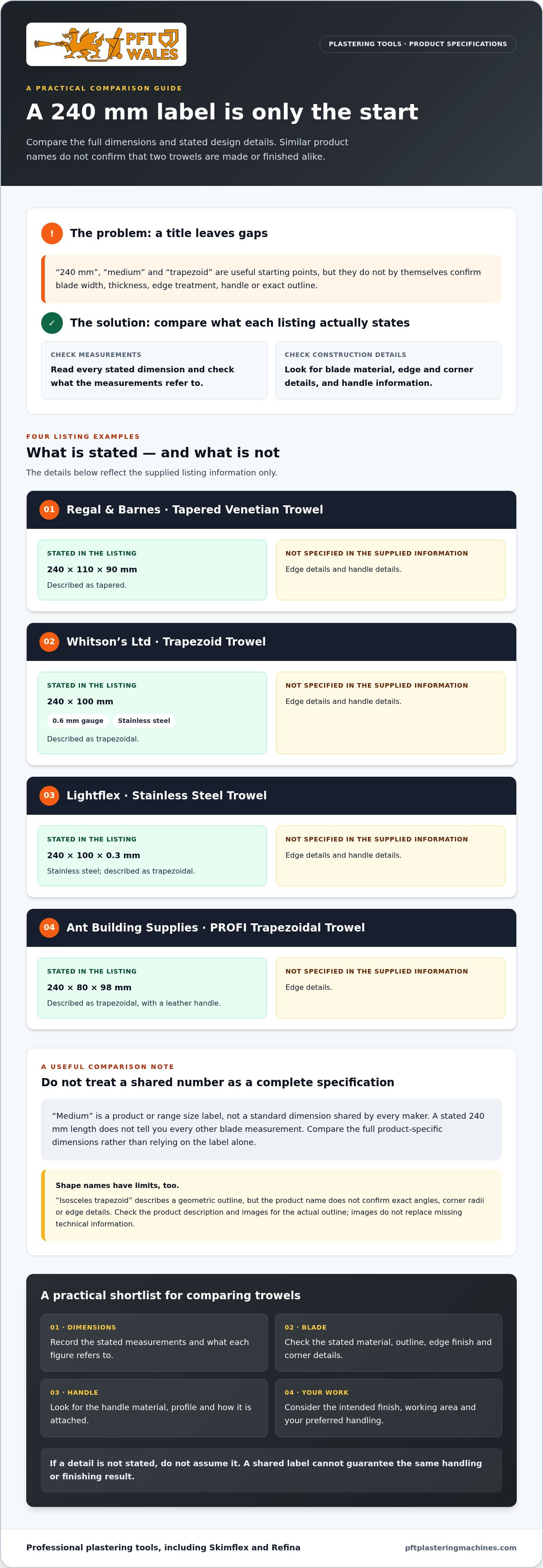
Comparing sizes is useful when you compare the measurements and construction details of specific products. “Medium” is not a universal specification, and a 240 mm blade may be listed with different widths, thicknesses and handle details. The examples below show why it is worth reading each product listing rather than comparing titles alone.
| Product listing | Dimensions and blade details stated | Outline, edge and handle details stated |
|---|---|---|
| Regal & Barnes, Tapered Venetian Trowel | 240 × 110 × 90 mm | Described as tapered; edge and handle details aren’t specified in the supplied listing information. |
| Whitson’s Ltd, Trapezoid Trowel | 240 × 100 mm; 0.6 mm gauge; stainless steel | Described as trapezoidal; edge and handle details aren’t specified in the supplied listing information. |
| Lightflex stainless steel trowel listing | 240 × 100 × 0.3 mm; stainless steel | Described as trapezoidal; edge and handle details aren’t specified in the supplied listing information. |
| Ant Building Supplies, PROFI trapezoidal trowel | 240 × 80 × 98 mm | Described as trapezoidal with a leather handle; edge details aren’t specified in the supplied listing information. |
These measurements and descriptions are specific to the named product listings, not standard dimensions for all 240 mm trowels. The table compares details stated in those listings; it does not establish how a tool will perform or confirm which materials it suits. Where information is missing, do not fill the gap with an assumption.
When might a medium blade be worth comparing with a smaller one?
Start with the size of the working area and the movements you need to make. A smaller blade has different dimensions, but that fact alone cannot tell you which tool will suit your technique or intended finish. Compare the maker’s measurements for each option, including width as well as length, then consider the available space and the level of control you want to maintain.
How does a trapezoid compare with other blade outlines?
Compare product images and stated measurements to understand how the outline differs from other shapes. Think about the edges, corners or restricted areas involved in your work, but assess access and handling as practical factors rather than guaranteed benefits. There is no basis for ranking blade outlines or claiming that one shape suits every decorative finish.
When comparing a 240 mm medium isosceles trapezoid venetian trowel with another tool, consider the maker’s dimensions, outline, edge description and handle information together. This gives you a more useful comparison than the words “medium” or “trapezoid” alone.
How to choose a 240 mm Venetian trowel for your work
Begin with the finish you are aiming for, then compare the tool’s stated details with your technique and working area. A 240 mm medium isosceles trapezoid venetian trowel is not fully described by its size label or outline. Check the maker’s specification and treat terms such as “medium” or “polished” as descriptions, not complete technical details.
A practical checklist before buying
- Identify the finish and task. Check whether the maker lists the trowel for the decorative finishing work you have in mind. Do not assume that its name makes it suitable for a particular material or application.
- Compare the dimensions. Note the stated blade length and width, along with any other measurements. Compare the full figures for each tool instead of relying on size labels.
- Inspect the blade details. Look for product specific information about the blade material, edges and corners. “Rounded”, “bevelled” and “polished” describe different details, so do not treat the terms as interchangeable.
- Assess the handle and construction. Compare the stated handle material, profile and attachment. Consider whether the grip suits your hand and working movement, without assuming it guarantees comfort or a particular result.
Next, consider the space you will be working in and the movements your technique calls for. If you are comparing two tools, put their verified dimensions, outline, edge details and handle information side by side. This makes the differences easier to assess than a comparison based only on shared product labels.
Compare specifications, not marketing shorthand
Separate measurable details from descriptive wording and personal preference. A listing may call a blade “medium” or an edge “polished”, but neither term establishes the full design. Use images to understand the outline and the maker’s information for stated dimensions and construction details. If a detail is unclear, leave it out of your comparison rather than guessing.
Browse PFT Wales’ professional plastering trowels to compare tools for your work. For advice about a particular product, contact PFT Wales about trowel selection.
Explore professional Venetian plastering trowels and tool advice
Choose by assessing the tool as a whole. Check the stated dimensions and blade outline alongside the edge and handle information, then consider how those features relate to the working area, technique and intended finish. “Medium” can help you find options, but it is not a replacement for product specific details.
Find related professional trowels and Skimflex tools
PFT Wales supplies professional plastering tools, including Refina tools and its own Skimflex professional tools brand. Browse the professional plastering trowels and compare the product information for individual tools. Skimflex is another part of the range; check each listing for its dimensions and construction details rather than assuming the brand name identifies a particular blade or specification.
For a 240 mm medium isosceles trapezoid venetian trowel, focus on the blade measurements, outline, edge description and grip information together. When comparing listings, note which details are stated and which aspects come down to your own handling preference. Similar terminology does not prove that tools have identical designs or suit the same work.
When to get product-specific advice
A product listing may leave a practical question unanswered, such as how a measurement is taken or what an edge description means for that tool. PFT Wales provides technical support, including telephone technical advice. Having the listing and your intended finishing task to hand can help keep the discussion focused on the details that matter to your choice.
If you need help interpreting product information, contact PFT Wales for professional tool advice. Share the listing or product details you are considering and explain which specification is affecting your decision.
Choose your next trowel with confidence
Judge a 240 mm medium isosceles trapezoid venetian trowel by more than its size label. Compare the stated dimensions, blade outline, edge details and handle information for the specific product, then consider how it fits your working area and technique. Similar descriptions do not necessarily mean identical designs.
PFT Wales supplies professional plastering tools, including Refina and Skimflex, its own professional tools brand. For help comparing product details or choosing a trowel for your work, contact PFT Wales for professional tool advice.
Compare the specification with the task before making your choice. Product specific information gives you a sound basis for selecting a tool for your next finishing job.
Frequently Asked Questions
What is a 240 mm medium isosceles trapezoid Venetian trowel?
It is a trowel described by a stated 240 mm length, a product specific “medium” size label and an isosceles trapezoid blade outline. The name does not confirm the blade width, material, edge treatment or handle construction. Check the maker’s listing for those details. “Venetian” identifies the tool with a decorative finishing category, but the product description should guide whether it suits a particular task.
Is a 240 mm Venetian trowel suitable for every decorative plaster finish?
No. The 240 mm measurement alone cannot establish suitability for every decorative plaster finish. Check the individual product listing for the maker’s stated applications, then consider the work area and your technique. Do not assume a tool suits a particular material or finishing process simply because “Venetian” appears in its name. If the listing leaves a technical point unclear, PFT Wales can offer product advice.
What does medium mean on a Venetian trowel?
“Medium” is a size label used for an individual product or range, not a universal measurement shared by every maker. Look for the stated blade length and width instead of relying on the label. A medium trowel from one range may have different dimensions from a medium option in another. Compare the figures for the specific products and check what each measurement refers to.
How do I compare trapezoid Venetian trowel dimensions?
Compare all the dimensions stated for each product, including blade length and width, and note any other measurements the maker provides. A listing may give dimensions of 240 × 100 mm, but that describes that particular tool, not a standard for all trapezoid trowels. Check that each listing measures the same parts of the blade before treating the figures as a direct comparison.
Can a trapezoid Venetian trowel have different edge finishes?
Yes. Product listings may describe edges as polished, bevelled or rounded, and those terms refer to details of the individual tool. They do not establish that two tools have identical edge profiles or corner shapes. Read the maker’s description alongside product images. An edge description alone cannot guarantee that a blade will not mark a surface or produce a particular finish.
What should I check before buying a Venetian plaster trowel?
Check the maker’s stated dimensions, blade outline, material, edge and corner details, handle profile and construction. Read the listed intended applications and compare them with your finishing task, working area and technique. Treat terms such as “medium” or “polished” as descriptions rather than complete specifications. If an important product detail is unclear, contact PFT Wales for advice.
How does a Venetian trowel differ from a standard plastering trowel?
A Venetian trowel is described as a specialist tool for decorative plaster finishing, while “standard plastering trowel” is a broader category name. Exact differences in blade shape, dimensions, edges and handle depend on the products being compared. Check each maker’s stated use and specification rather than assuming every Venetian trowel shares one design or that a general plastering trowel suits every decorative finish.