

A flawless finish isn't won on the final trowel pass; it's decided minutes earlier by matching sponge density to the material's set time. Every tradesperson knows the frustration of a cheap pad delaminating on harsh monocouche or tearing across an abrasive base coat. When selecting durable sponge floats for plastering, rendering & tiling | Refina & Skimflex UK trade ranges deliver the exact pore cell structure required to keep work moving smoothly without surface scarring.
Working with the wrong grain size can ruin hours of careful prep, whether you are accidentally hollowing out fresh tile grout joints or dragging aggregate through setting gypsum skim. In this 2026 guide, you will discover how to match sponge grades, foam densities, and plate sizes to your specific trade discipline for uniform, streak-free results. We compare the distinct engineering behind Refina and Skimflex finishing tools, giving you the practical insight needed to maximise site speed and tool longevity across every project.
Key Takeaways
- Learn how matching open-cell and closed-cell sponge grades controls surface moisture and draws aggregate fat without tearing wet plaster or scarring fresh render.
- Explore how specialist sponge floats for plastering, rendering & tiling | Refina & Skimflex UK selections balance pad durability with streak-free performance across internal gypsum, external monocouche, and delicate grout joints.
- Compare output rates between manual hand floats, extendable pole systems, and rotary power discs to choose the most efficient setup for domestic rooms or expansive commercial facades.
- Unpack the distinct engineering behind Refina and Skimflex tools, evaluating handle ergonomics, plate rigidity, and advanced sponge vulcanisation methods.
- Follow an essential on-site maintenance routine to stop cementitious binder buildup, protecting foam cellular structures and extending the working life of your floats.
What Is a Sponge Float and Why Is It Essential?
A sponge float is a precision moisture-management tool designed to regulate hydration at the wall face. Rather than simply smoothing or wetting a surface, the open-cell face draws moisture and fine binder particles, commonly known as the "fat", directly to the substrate surface. Understanding what plaster is and how gypsum, lime, or cementitious binders hydrate clarifies why this mechanical draw is critical. Modern hydrorubber compounds maintain their cellular structure under heavy friction, outperforming cheap generic foams that quickly collapse, tear, and leave ragged drag marks across fresh material.
Whether you are handling multi-finish skimming, rubbing up monocouche, or washing down grout lines, using purpose-engineered sponge floats for plastering, rendering & tiling | Refina & Skimflex UK trade ranges ensure consistent suction control and prevent shrink crazing long before your finishing steel touches the wall.
To see how a float opens up the surface during application, take a look at this practical demonstration:
While hand floats provide tactile feedback on detailed patches, larger commercial render applications often transition to electric cordless power floats fitted with matched sponge discs to maintain pace on expansive elevations.
The Mechanics of Sponge Floating in Internal Plastering
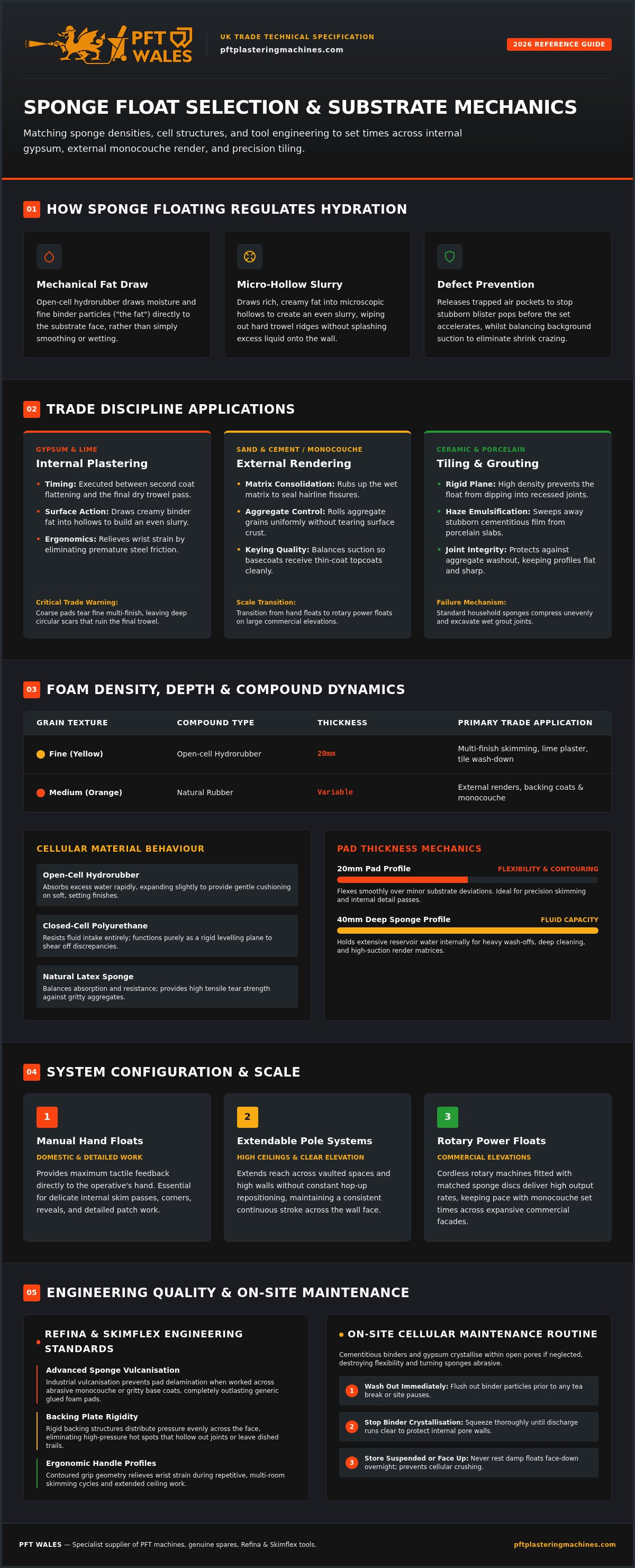
Running a damp, fine-grain sponge float across setting gypsum draws the creamy fat into micro-hollows, creating an even slurry without splashing excess water onto the wall. This pass sits between your second coat flattening and the final dry trowel. It removes hard trowel ridges, relieves wrist strain, and releases trapped air to stop stubborn blister pops before the set accelerates.
External Rendering: Rubbing Up and Controlling Suction
On sand-and-cement backing coats or one-coat monocouche systems, sponge floating consolidates the wet matrix to seal hairline fissures and eliminate shrink crazing. The abrasive face rolls aggregate grains uniformly without ripping the surface crust. This uniform consolidation balances background suction, ensuring basecoats are keyed correctly before applying decorative thin-coat topcoats.
Tiling and Grouting: Clean Joints Without Aggregate Washout
Standard household sponges compress unevenly, digging into recessed tile joints and washing out fresh cementitious grout. High-density tiling sponge floats maintain rigid contact across adjacent tile edges. They emulsify and sweep away stubborn grout haze from large-format porcelain slabs and delicate natural stone tiles whilst leaving the joint profile flat, sharp, and uniformly packed. If you are sourcing premium natural stone materials or bespoke marble slabs for high-end wall and floor installations, you can find out more from specialist suppliers to achieve an impeccable architectural finish.
Comparing Sponge Float Textures: Fine, Medium, and Coarse Grains
Foam composition determines how a float interacts with setting material. Open-cell hydrorubber absorbs excess water rapidly, expanding slightly to cushion contact on soft finishes. Closed-cell polyurethane resists fluid intake entirely, acting purely as a rigid levelling plane. Natural latex sponge balances both properties, offering high tensile strength against gritty aggregates. Thickness matters just as much. A 20mm pad flexes over minor substrate deviations, whereas a 40mm deep sponge holds extra reservoir water for heavy wash-offs. Slapping a coarse pad onto multi-finish plaster is a classic mistake; it tears the fine surface apart and leaves deep circular scars that ruin your final trowel pass.
When selecting professional sponge floats for plastering, rendering & tiling | Refina & Skimflex UK trade options provide precisely calibrated foam densities for each trade task:
| Grain Texture | Compound Type | Thickness | Primary Trade Application |
|---|---|---|---|
| Fine (Yellow) | Open-cell Hydrorubber | 20mm | Multi-finish skimming, lime plaster, tile wash-down |
| Medium (Orange) | Natural Rubber | 18mm - 20mm | Backing coats, sand-cement basecoats, general floating |
| Coarse (Brown/Grey) | Reticulated Polyurethane / Heavy Rubber | 20mm - 30mm | Monocouche aggregate exposure, heavy scratch coats |
Fine Texture Hydrorubber Floats for Internal Skimming
Fine hydrorubber floats gently lubricate board finishes and multi-finish plasters without dragging setting particles. The micro-pore structure brings up a micro-thin layer of cream without scratching. For plasterers chasing a mirror-flat internal wall, tools like the Skimflex Fine Texture Plastering Sponge Float compress evenly, eliminating swirl lines before your finishing trowel touches the surface.
Medium Grain Floats for General Plastering and Render Basecoats
Medium orange rubber serves as the dependable workhorse for British job sites. An 18mm or 20mm medium grain pad provides enough bite to open up setting basecoats without gouging into the backing plaster. Options like the Skimflex SkimSmooth medium float offer balanced moisture retention, helping tradespeople rub up consistent scratch coats across domestic renovations.
Coarse Grain Rubber Floats for Sand Finishes and Monocouche
Coarse sponge faces are essential when working external one-coat monocouche or traditional sand-and-cement renders. The open, large-cell rubber pulls back surface fat to expose aggregate uniformly, creating the decorative texture clients expect. Heavy-duty Refina coarse rubber sponge floats withstand the punishing friction of sharp sands, resisting surface delamination across demanding commercial projects.
Hand Floats, Pole Systems, or Power Floats: Selecting Your Setup
Output requirements dictate whether manual hand tools or mechanical power systems belong on your scaffold. A skilled plasterer floating by hand averages around 15 to 20 square metres per hour on domestic walls. On expansive commercial facades, however, machine-driven discs easily triple that coverage rate. Selecting the right setup among premier sponge floats for plastering, rendering & tiling | Refina & Skimflex UK suppliers stock ensures you hit project deadlines without sacrificing joint precision or overworking your shoulders.
Standard Handheld Sponge Floats for Precision and Detailing
Handheld floats remain irreplaceable for domestic rooms, window reveals, and awkward boxing. Standard 11-inch plates provide nimble control around tight sockets, whilst broader 16-inch or 18-inch bases speed up wide hallway walls. Narrow, elongated floats let you consolidate internal angles and deep reveals cleanly. For all-day comfort, modern composite soft-grip handles cushion palm impact, reducing hand fatigue far better than unyielding traditional timber grips.
Pole-Mounted Swivel Sponge Floats for High Walls and Ceilings
Skimming large ceilings or double-height stairwells usually means constantly shifting hop-ups and low-level staging. Pole-mounted swivel sponge floats solve this bottleneck. A multi-directional knuckle joint keeps the baseplate flush against the substrate regardless of the handle angle. Equipping a tool like the Skimflex Swivel Base Sponge Float with an extending pole allows you to draw fat across high ceilings directly from the floor, shaving hours off commercial site setups.
Electric Power Float Sponges for Rapid Commercial Contracting
When spraying sand-cement or monocouche across expansive elevations, manual floating creates an enormous labour drain. Motorised discs attached to electric cordless power floats rotate at controlled speeds, flattening high spots and bringing slurry to the face in a single swift pass. As detailed in our guide to professional plastering tools, these rotary discs use hook-and-loop systems for rapid changes. Contractors can swap between coarse brown foam for rapid rubbing up, medium orange discs for general levelling, and fine yellow discs for final surface consolidation.
Refina vs. Skimflex: Comparing Leading UK Trade Sponge Floats
Selecting between Refina and Skimflex comes down to matching manufacturing engineering with daily site demands. Both manufacturers build professional gear, but their construction philosophies differ noticeably. Refina leans into heavy industrial legacy with rigid backing structures, whilst Skimflex focuses on modern ergonomics and proprietary hydrorubber formulations engineered across European specialist centres. When stocking dependable sponge floats for plastering, rendering & tiling | Refina & Skimflex UK ranges give contractors access to the two highest-performing tool formats on British building sites today.
Refina Sponge Floats: Industrial Heritage and Precision Rubber
Refina tools feature thick, industrial-grade orange rubber bonded directly to high-impact backing plates. These plates resist twisting under heavy lateral pressure, keeping the pad dead flat when flattening stiff basecoats. Their 16-inch medium and coarse rubber models stand up to harsh sands, while vulcanised bonding ensures the sponge face refuses to peel at the perimeter during aggressive rubbing up.
Skimflex Sponge Floats: Trade-Engineered Hydrorubber Innovations
Skimflex takes an ergonomic, material-first approach to finishing equipment. Their hydrorubber pads deliver superior tear resistance against sharp substrate aggregate, maintaining soft surface contact that protects wet skim coats. Paired with contoured SkimSmooth handles, these tools reduce wrist fatigue during long shifts. Contractors equipping whole crews can explore the wider catalogue of Skimflex trade tools, including multi-pack cartons that lower consumable costs across busy teams.
Specialist Tiling Solutions: Skimflex Washboy Sets and Grout Sponges
For high-spec tiling jobs, the Skimflex Tilers Washboy system pairs heavy-duty twin-roller extraction buckets with segmented sponge floats. The 40mm high-absorbency sponge draws grout slurry cleanly from tile faces, transferring wash water into the washboy without drips. Meanwhile, dense brown grout floats shape clean, uniform joints across textured porcelain without aggregate pull-out.
Need to refresh your site kit before the next big run? Discover our full lineup of specialist sponge floats and secure trade-tested tools built to last.
Buyer's Checklist and Maintenance: Getting the Longest Life from Your Floats
Quality finishing tools pay for themselves quickly on site, but poor wash-down habits can ruin a fresh pad in a single afternoon. When cementitious slurry or gypsum binders set inside open pores, the cellular foam hardens and loses its flexible draw. Selecting the best sponge floats for plastering, rendering & tiling | Refina & Skimflex UK trade ranges provide means nothing if you dissolve the vulcanised rubber backing with white spirit or let the plate warp under heavy buckets. A disciplined routine keeps your gear running smooth across dozens of jobs.
Key Factors to Confirm Before Ordering Your Sponge Float
- Substrate compatibility: Pick fine hydrorubber for gypsum skimming, medium rubber for basecoats, and coarse grades for scraping monocouche.
- Working scale: Compact 11-inch plates handle tight domestic reveals, whereas 16-inch formats maximise speed on unbroken walls.
- Trowel pairing: Align your floats alongside matched plastering trowels to keep your finishing sequence balanced from initial lay-on to dry shine.
- Drive mechanism: Choose handheld handles for detailing, pole attachments for high ceilings, or rotary machine discs for sprayed render facades.
Cleaning and Preserving Rubber Sponge Faces on Site
Dunk and flush your float in clean water the moment you step off a wall. Never let render cure on the pad while you break for tea. If aggregate settles deep into the foam matrix, work it out with a soft nylon bristle brush under running water. Scaping the face with the sharp edge of a steel trowel will slice through the rubber cells, ruining the pad permanently. Press water out flat against a board instead of wringing or twisting the float backing plate out of shape.
Workshop Storage and Avoiding Sponge Delamination
Store your gear properly overnight. Laying floats sponge-down on dusty van racking stamps permanent flat-spots into the resilient rubber, leaving dips that drag unevenly across wet skim. Hang them by their handle eyelets or store them face-up in dry crates. Keep natural rubber far away from van cab heater outlets, as dry heat weakens vulcanised glue seams and leads to edge delamination. Ready to upgrade your kit? Explore our wide range of professional sponge floats at PFT Wales for rapid UK delivery directly to your site.
Equip Your Kit for Flawless Surface Finishes
Achieving a uniform, defect-free substrate comes down to pairing sponge pore density directly with your material's curing phase. Fine hydrorubber draws up the fat on setting gypsum without scratching, whilst industrial orange rubber and coarse reticulated pads consolidate external basecoats and expose monocouche aggregates cleanly.
Backed by 16 years of specialist trade experience supporting UK contractors, PFT Wales stocks a comprehensive selection of genuine Refina tools alongside proprietary Skimflex hand floats, swivel pole systems, and replacement power discs. When sourcing dependable sponge floats for plastering, rendering & tiling | Refina & Skimflex UK trades benefit from proven workshop durability and free Royal Mail Tracked 48 delivery on all Skimflex orders across mainland UK.
Upgrade your finishing kit with trade-grade sponge floats from PFT Wales today and keep your trowel passes moving fast, flat, and blister-free across every project.
Frequently Asked Questions
Can I use a sponge float instead of a plastering trowel to finish multi-finish?
No, a sponge float prepares the surface but cannot replace the final steel trowel pass. The float's role is to draw moisture and fine aggregate fat to the surface while scouring out ridges and air pockets. Once the sponge pass creates a uniform slurry across the setting plaster, you still require a clean steel trowel to compress, flatten, and polish the multi-finish into a smooth, hard-wearing interior wall.
What is the difference between hydrorubber and standard sponge floats?
Hydrorubber features an open-cell, highly hydrophilic synthetic structure that absorbs water and releases it under controlled pressure. Standard polyurethane foam pads tend to collapse or tear under continuous friction. By contrast, specialised hydrorubber used in modern sponge floats for plastering, rendering & tiling | Refina & Skimflex UK ranges resists aggregate abrasion, springs back into shape immediately, and eliminates surface scoring during delicate gypsum skimming passes.
Which sponge float texture should I choose for monocouche scratch render?
A coarse-grain rubber or reticulated polyurethane float is the standard choice for monocouche scratch render. Coarse textures feature wider pore cells that cut through the setting surface crust without clogging. This action opens the matrix to roll and expose decorative coloured aggregates evenly across the facade. Medium or fine sponges hold too much surface slurry, which can smear pigment and dull the intended textured finish.
How do I prevent my sponge float from tearing on abrasive render basecoats?
You prevent tearing by monitoring material cure timing and keeping the sponge adequately hydrated. Working basecoats while they are bone dry forces sharp aggregate against the cellular rubber, ripping the pad. Keep a clean water wash bucket nearby, lubricate the face regularly, and let the sponge glide over high spots using broad circular sweeps rather than forcing the edge into the stiffening mortar.
Are replacement sponge discs compatible across different electric power float brands?
Most rotary sponge discs feature universal hook-and-loop backings, making them compatible across multiple power float brands that share the same plate diameter. Standard commercial machines typically take 350mm to 400mm discs. When selecting sponge floats for plastering, rendering & tiling | Refina & Skimflex UK stockists supply replacement pads with industrial hook-and-loop backing designed to lock securely onto standard driving discs without slipping at high working speeds.
Why is a washboy system better than a handheld sponge for grouting tiles?
A washboy system provides twin extraction rollers that wring out excess water evenly across the entire float face. Using a handheld sponge rinsed in a standard bucket leaves pockets of surplus water that flood grout joints, causing efflorescence and aggregate wash-out. Washboy sponge floats maintain a uniform dampness, letting you emulsify grout haze across large-format tiles quickly without hollowing out newly struck joints. If you are preparing a wet room or shower area alongside your finishing kit, explore E-commerce sale of waterproofing systems and tiling accessories to secure reliable substrate protection beneath the tiled face.
Submerge the float in clean lukewarm water for twenty minutes to soften the binder before cleaning. Once the plaster loosens, gently agitate the open cells using a soft nylon bristle brush. Never use scraper blades or wire brushes, as metal edges sever vulcanised rubber cells. Avoid white spirit or acid washes, which break down the waterproof adhesive bond between the sponge and the backing plate.