

Modern plastering is no longer a manual-only trade; it is a mechanical process where the right sprayer defines a contractor’s profitability. You’ve likely felt the physical strain of a long week spent hand-applying render, or perhaps you've struggled with the frustration of an inconsistent mix across a large surface area. It's a common hurdle in the UK construction industry, where the pressure to finish projects faster often clashes with the physical limits of the human body. We understand that your reputation depends on the quality of your finish and the efficiency of your team.
In this guide, you'll discover how a professional plastering sprayer and industry-leading PFT machines are revolutionising the way tradespeople work. By switching to machine application, you can achieve superior speed and a perfectly consistent mix whilst significantly reducing labour costs and site fatigue. We'll walk you through the essential equipment, from genuine PFT parts to Skimflex finishing tools. As specialists in PFT machinery, training, and technical support, we'll show you how the right mechanical setup can transform your workflow and ensure every project meets the highest professional standards.
Key Takeaways
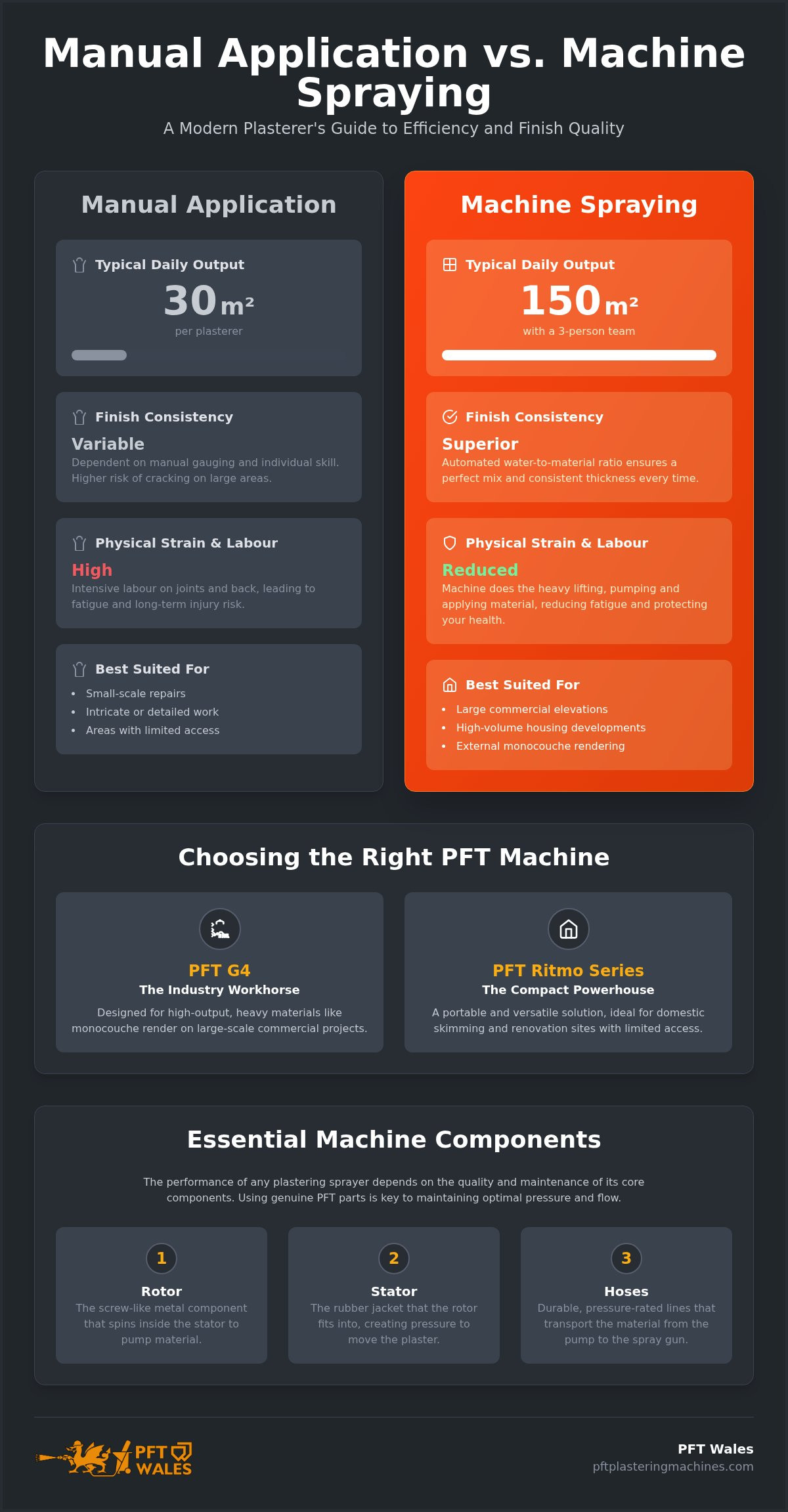
- Discover how a modern plastering sprayer can increase your daily output from roughly 30m² to as much as 150m².
- Learn to choose between the heavy-duty PFT G4 for commercial projects and the compact Ritmo series for domestic skimming.
- Understand why machine-mixed render delivers a more consistent, durable finish that reduces the risk of cracking on large surface areas.
- Identify the essential roles of rotors, stators, and hoses in maintaining optimal pumping pressure and project flow.
- See why professional training and genuine PFT parts are the keys to reducing physical strain and protecting your long-term profit margins.
The Evolution of the Plastering Sprayer: Why the UK Trade is Shifting
The trade has changed. It's no longer just about the hawk and trowel. While the history of plasterwork is rooted in manual skill, the modern UK site demands more. A manual plasterer might manage 30m² on a good day. Compare that to a three-man team using a plastering sprayer, who can comfortably hit 150m². It's a massive jump in productivity. With the UK construction sector facing a persistent labour shortage, these machines aren't just a luxury; they're becoming the standard for any firm looking to stay competitive. In an industry that has grown to a market size of £2.8 billion as of 2026, you need every advantage to keep up with the pace of modern builds.
We've seen a clear move away from traditional internal gypsum work towards high-performance external monocouche rendering. This shift requires equipment that can handle heavier materials and larger volumes without breaking a sweat. Investing in PFT plastering machines allows contractors to take on these bigger, more lucrative contracts that manual teams simply can't service efficiently. The ability to spray through the winter months and maintain a high output is what separates the top-tier firms from the rest.
What is a Plastering Sprayer?
A modern sprayer is a motorised mixing and pumping system designed to take the donkey work out of the application. It consists of a hopper for the material, a mixing tube where water is added, a pump unit (rotor and stator), and a spray gun. It's vital to understand the difference between "spraying" the finish onto the wall and "pumping" it through the lines to move material across a site. A PFT mixing pump is a continuous-operation machine that combines dry material with water automatically, ensuring a perfect mix every time. This automation removes the human error often found in manual gauging, providing a reliable flow that keeps the job moving.
The Economic Case for Machine Plastering
Why make the switch? It's about the bottom line. Machines offer precise water-to-material ratios, which means far less waste compared to hand-mixing in a tub. You get a consistent thickness across every square metre, leading to faster drying out times and a more reliable finish. Beyond the materials, it's about your health. Hand-applying render is brutal on the joints. Using a plastering sprayer reduces physical strain and long-term injury risks, keeping you on the tools for longer. When you pair these machines with specialist Skimflex tools, you achieve a level of finish quality that manual application struggles to match. It's a smarter way to work that protects both your body and your profit margins.
Types of Plastering Sprayers: Choosing the Right Rig for the Job
Selecting a plastering sprayer isn't just about buying a machine; it's about matching the rig to your daily workload. If you're tackling large-scale commercial elevations or massive housing developments, the PFT G4 is the undisputed industry workhorse. It's designed for high-output rendering and can handle heavy materials like monocouche with ease. On the other hand, the PFT Ritmo series provides a compact, highly portable alternative. These machines are ideal for domestic skimming and smaller renovation sites where access is limited but speed is still a priority. Choosing the right setup depends entirely on the materials you use, whether that's traditional gypsum, modern monocouche, or thin-coat renders.
The choice between these systems often comes down to the scale of the project and the available power on site. While a larger machine might offer the highest output, a smaller, more agile unit might be more profitable for a team focused on residential interiors. Understanding the technical differences between Plaster vs. Drywall applications helps in deciding which machine will deliver the best return on investment for your specific trade niche. If you're unsure which voltage or model fits your current projects, get in touch with our technical team for expert advice.
Continuous Mixing Pumps vs. Batch Mixers
Continuous mixing pumps, like the PFT G4, are superior for large external elevations because they automate the entire process. They combine dry material with water in a constant flow, ensuring the mix never varies. For internal work, the PFT Ritmo M or L is often preferred for multi-finish spraying. You must also consider the power supply. UK sites vary between 110v, 240v, and 415v requirements; always verify your site's electrical capacity before committing to a specific machine to avoid costly downtime.
Specialist Spray Kits and Hopper Guns
Not every job requires a full-scale mixing pump. For smaller renovation projects or patching work, entry-level options like hopper guns and spray kits are essential. These tools are often used with a standalone compressor and are perfect for applying "tyrolean" or textured finishes. They provide a cost-effective way to achieve a professional machine-applied look on smaller surface areas or for repair jobs where setting up a large rig wouldn't be practical. These kits are a vital part of a renderer's arsenal for finishing touches and detail work.
Manual Application vs. Machine Spraying: Efficiency and ROI
Every contractor knows that labour is the highest cost on any project. When you stick with manual application, you're limited by the physical capacity of your team. A typical three-man manual crew might struggle to finish 40m² in a day, especially on demanding external elevations. Switch that same crew to a plastering sprayer, and those figures change dramatically. You're looking at outputs reaching 150m² per day. This isn't just about working harder; it's about working smarter. By increasing your daily coverage, the initial investment in a PFT machine often pays for itself within the first few major contracts through pure labour savings alone.
The Speed Comparison
The efficiency of a spray team comes from the continuous nature of the process. One person manages the machine, one sprays, and the third follows with a straight edge or spatula. This setup allows for "wet-on-wet" application, which is nearly impossible to maintain manually over large areas. Because the application is so much faster, you also slash the time spent on scaffolding hire. Getting off the site several days earlier isn't just a win for the client; it's a direct boost to your profit margin and allows you to move the crew to the next job sooner.
Quality and Consistency of the Mix
Consistency is where the machine truly shines. Hand-mixing in tubs inevitably leads to "dry spots" or slight variations in the water-to-material ratio. These weak points are exactly where cracks tend to form as the render cures. A plastering sprayer uses a calibrated flow meter to ensure every single bag is mixed with the exact same amount of water. This mechanical precision eliminates the guesswork. When the mix is perfectly uniform, you get a more durable finish and significantly fewer "snagging" issues or callbacks. Pairing this consistency with Skimflex tools ensures a professional finish that manual methods simply can't replicate reliably.
Finally, we have to talk about the "fatigue factor." Manual plastering is exhausting. By mid-afternoon, a manual team's pace drops, and the quality of the finish can start to suffer as joints ache. A spray team maintains the same pace from the first bag to the last. The machine does the heavy lifting, meaning your team stays fresh and focused on the finish. To ensure your crew hits the ground running, we highly recommend PFT machine training to master these high-output techniques and avoid site downtime.
Essential Components: Rotors, Stators, and Hoses
The rotor and stator are the absolute heart of any plastering sprayer. Without them, you've just got a very expensive mixing tub. These components work together to create the pressure needed to pump material through your lines and out of the nozzle. The rotor is a screw-like metal part that turns inside the rubber stator. As it spins, it pushes the mixed plaster or render forward. If you don't understand how these parts interact, you'll find yourself facing unnecessary downtime and expensive repairs. It's the technical core of the machine that dictates your flow rate and finish quality.
Understanding Rotors and Stators
Wear and tear is an inevitable part of the job. Materials with high sand content act like sandpaper, slowly grinding down the tolerance between the rotor and stator. One of the biggest killers is running the machine dry. Without the lubrication of the wet mix, the heat generated will destroy the rubber lining in minutes. You'll know a stator is failing when you see a drop in pumping pressure or a noticeable decrease in the spray pattern's reach.
We often get asked about the difference between specific models. For example, the D6-3 rotor and stator is a common standard for many PFT machines, while a D7-2.5 might be used for different output requirements or specific materials. Some stators are maintenance-free, while others are adjustable. This allows you to tighten the jacket to squeeze a bit more life out of the part as it wears. If you aren't sure which one fits your specific PFT model or material, it's always best to check the parts drawings or ask us for advice.
Hoses, Couplings, and Spray Guns
Your hoses are the veins of the system. Using the correct diameter is critical. A hose that's too narrow increases back-pressure, which puts unnecessary strain on the motor and wears out your stator faster. Most professional setups use a combination of different diameters to maintain flow over long distances. The couplings must be genuine and secure. A blowout on a finished driveway or inside a customer's house is a nightmare you want to avoid. Always inspect your couplings for wear before starting the pump.
The air compressor plays a vital role at the very end of the line. It provides the air that atomises the material at the spray gun, turning a steady stream into a controlled spray pattern. Cleaning is the most important part of your daily routine. The cleaning ball is your best friend here. It must be pumped through the hoses and spray guns after every shift to clear out any residue. If plaster sets inside your hose, it's usually destined for the skip. To keep your rig running perfectly, we offer full servicing and technical support for all PFT machinery.
The Professional Edge: Sourcing Machinery and Specialist Tools
Investing in your first plastering sprayer is a significant step for any business, but the machine is only part of the equation. Where you source your equipment defines how much value you'll actually get from it over its working life. Many contractors make the mistake of chasing the lowest price from unverified online listings, only to find themselves without support when a technical fault occurs on a Friday afternoon. We've been an authorised PFT supplier since 1995, and we know that the "technical wisdom" behind the sale is what keeps you on site and earning. Whether it's through professional training or rapid access to spares, having a specialist partner ensures your rig remains an asset rather than a liability.
Why Genuine PFT Parts Matter
Non-genuine rotors and stators are a false economy. Whilst they might look identical to the real thing, they often lack the precise tolerances required for a consistent mix. Using imitation parts can lead to poor material flow, increased motor strain, and even permanent damage to your mixing pump. Authorised dealers provide genuine PFT machine parts that are engineered to last. For those just starting out, we also offer a range of used and refurbished plastering machines. These provide a reliable, cost-effective entry point into the trade, backed by the confidence of a machine that has been through an authorised service centre.
Finishing the Job: Skimflex and Refina Tools
The machine handles the heavy lifting, but the final finish still depends on your skill and the quality of your hand tools. A machine-applied render or plaster needs to be flattened and finished with precision to maintain the speed gains you've made. We recommend pairing your sprayer with Skimflex professional tools. Using a large Skimflex spatula allows you to rule off massive surface areas in a fraction of the time it takes with a standard trowel. For external work, Refina floats are the industry standard for achieving that perfect, uniform sand-finish render that clients expect.
Maximising your site efficiency isn't just about the spray; it's about the entire workflow from the hopper to the final float. Accessing expert servicing and repairs is vital for minimising downtime and protecting your profit margins. From technical advice to on-site troubleshooting, the professional edge comes from having the right equipment and the right support in your corner. Explore our full range of PFT machines and Skimflex tools today to see how we can help you revolutionise your application process.
Future-Proof Your Trade with Machine Application
Adopting a plastering sprayer is a strategic move that transforms your business from a manual operation into a high-output powerhouse. We've seen how the right mechanical setup can quintuple your daily coverage whilst ensuring a level of mix consistency that manual methods simply can't replicate. By reducing physical fatigue and eliminating the guesswork of gauging by hand, you protect both your reputation and your long-term health. The shift towards machine application is the most effective way to stay competitive in the modern UK construction industry.
Success on site comes down to more than just the rig; it requires the right tools and the right support. As an authorised PFT dealer since 1995, we provide the technical wisdom, professional training, and dedicated machine servicing needed to keep your projects moving. From the heavy-duty G4 to our proprietary Skimflex finishing tools, we supply everything you need to achieve a superior finish every time. Don't let manual limitations hold your business back any longer.
View our range of professional PFT plastering machines and Skimflex tools to see how we can support your transition to spray application. It's time to work smarter and start seeing the real return on your investment.
Frequently Asked Questions
What is the best plastering sprayer for a small domestic contractor?
The PFT Ritmo series is the best choice for small domestic contractors due to its compact size and portability. It's designed to fit through standard doorways and can often run on a 240v supply, making it ideal for residential skimming or smaller rendering jobs. This plastering sprayer bridges the gap between manual work and large-scale commercial rigs, allowing smaller teams to increase their daily output without needing a massive van or 3-phase power.
Can I spray standard multi-finish plaster through a PFT machine?
Yes, you can spray multi-finish plaster, but it requires the correct machine setup and rotor and stator combination. The PFT Ritmo is a popular choice for this application, as it provides the controlled flow needed for internal skimming. Spraying multi-finish significantly reduces the physical effort of application, though you'll still need your Skimflex spatula to achieve that perfect, polished finish once the material is on the wall.
How often do I need to replace the rotor and stator on my sprayer?
Replacement frequency depends entirely on the abrasiveness of the materials you're pumping and your daily volume. Highly abrasive renders with high sand content will wear the rubber lining faster than smooth internal plasters. You'll notice a drop in pressure or a thinning spray pattern when the parts are nearing the end of their life. Always keep a spare set of genuine PFT rotors and stators in your van to avoid stopping mid-job.
Do I need a special power supply to run a PFT G4 on a UK building site?
The standard PFT G4 usually requires a 415v 3-phase power supply, which is common on large commercial UK sites. However, different versions and configurations exist, including those that can run on different voltages or via specific generators. Because site power requirements are critical for safety and machine longevity, we strongly advise you to contact PFT Wales to verify the electrical specifications for your specific machine model before connecting it.
Is it difficult to learn how to use a plastering machine?
While the basic operation is straightforward, mastering a plastering sprayer takes time and practice. It's not just about pulling the trigger; it's about understanding mix consistencies, flow rates, and maintenance. We highly recommend professional PFT machine training. Investing a day in proper instruction prevents costly site errors, reduces material waste, and ensures your team knows how to handle the equipment safely and efficiently from day one.
What happens if the plastering hose gets blocked during spraying?
If a hose blocks, you must stop the pump immediately and release the pressure safely before investigating. Blockages are usually caused by an incorrect mix, a dry spot, or a failure to clean the lines properly after the previous shift. Once the pressure is gone, locate the blockage and clear it. Regular use of a cleaning ball and maintaining a consistent water-to-material ratio are the best ways to prevent this from happening on site.
Can a rendering machine also be used for floor screed?
Many PFT rendering machines are versatile enough to pump flowable floor screeds with the right rotor and stator setup. The PFT G4, for example, is frequently used for self-levelling compounds and liquid screeds on commercial projects. This versatility allows you to expand your service offering without buying multiple rigs. If you're planning to switch between render and screed, contact us to ensure your machine is configured correctly for the material's density.
Is it better to buy a new or used PFT machine?
Buying a new machine offers the best long-term value through manufacturer warranties and maximum component life. However, a refurbished or used PFT machine is an excellent entry-level option for those on a tighter budget. The key is sourcing from an authorised service centre that has fully inspected and tested the unit. This ensures you're getting a reliable rig that won't let you down on your first big contract.