

What if the secret to doubling your daily metreage had nothing to do with moving your arms faster? For any spread working on high-end residential or commercial projects, the challenge isn't just about effort; it's about the physics of the material. When you're trying to figure out how to plaster large walls fast, you're constantly battling the "going off" point, where the first section starts to pull before you've even finished the second mix.
We've all been there, staring down a massive surface area whilst the sweat pours, knowing that a single dry joint could ruin the entire finish. It's physically draining and, frankly, an outdated way to work in a modern trade. This guide is designed to change that. We'll show you the mechanical advantages and specialist finishing techniques that allow professional contractors to cover huge areas in half the time, all while reducing physical fatigue. You'll discover how the right combination of PFT spray machines and Skimflex spatulas can turn a daunting two-man struggle into a streamlined, one-man operation. From mastering the spray pattern to perfecting the flattening process with wide-blade tools, we're diving into the professional workflow that ensures a flawless, large-scale finish every time.
Key Takeaways
- Learn how to overcome material suction and drying time challenges that typically slow down traditional hand-applied plastering on large expanses.
- Discover how to plaster large walls fast by transitioning to mechanical application, allowing you to significantly increase your daily square metre output.
- Understand the ergonomic and speed advantages of using Skimflex spatulas and Refina finishing tools over standard trowels for wide-scale projects.
- Implement a streamlined "Spray and Skim" workflow that allows a two-person team to achieve flawless, joint-free results with less physical effort.
- Explore how specialist machine training and genuine PFT equipment can help you scale your business and handle larger commercial contracts with confidence.
The Challenge of Large Walls: Why Traditional Methods Slow You Down
Plastering a standard bedroom is one thing, but tackling a 40-square-metre gable end or a long commercial corridor is a different beast entirely. The sheer scale of the surface area introduces variables that can quickly overwhelm even the most experienced spread. When you're trying to figure out how to plaster large walls fast, the first hurdle isn't your skill; it's the material's chemistry. High-suction masonry or vast expanses of dry plasterboard act like a sponge, pulling moisture out of the mix before you've had a chance to flatten the first pass.
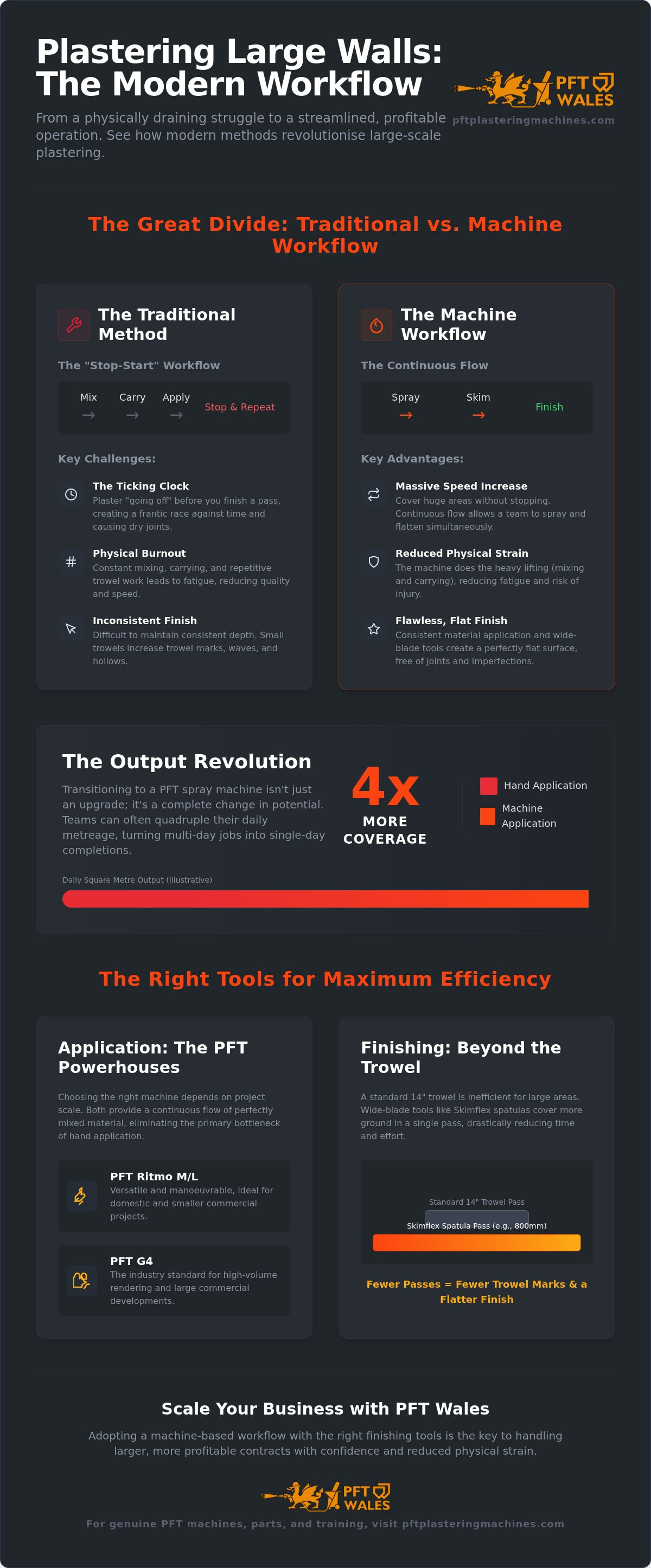
Traditional hand-mixing in mixing buckets creates a stop-start workflow that is inherently inefficient for large-scale work. You mix, you carry, you apply, and then you stop to mix again. This creates a bottleneck. By the time the second mix is ready, the first section is already "going off", making it nearly impossible to maintain a wet edge. This is where the physical toll starts to mount, as you're forced to work at a frantic pace just to keep the wall alive.
Understanding the Ticking Clock of Plaster Sets
Environmental factors are often the enemy of speed. In the height of summer or in buildings with high airflow, the window of opportunity to work the plaster shrinks significantly. On large walls, this leads to the dreaded "cold joint" where two separate mixes meet but don't bond seamlessly. You end up with visible ridges or, worse, a finish that requires excessive water to trowel up, which often leads to crazing. Manual application also makes it difficult to maintain a consistent depth across a wide area. You might start at 3mm but find yourself thinning out to 1mm as you rush to beat the set, resulting in an uneven finish that shows up under site lighting.
The Limitations of the Standard 14-Inch Trowel
Relying on a standard 14-inch trowel for massive areas is a recipe for physical burnout. If you want to know how to plaster large walls fast, you have to look beyond the hand-tools in your van. Think about the number of passes required to cover a 6-metre wall. Each stroke adds to the physical fatigue in your shoulder and wrist, leading to uneven pressure as the day progresses.
- Increased Margin for Error: More passes mean more trowel marks to remove later, adding time to the final trowel-up.
- Final Finish Quality: As fatigue sets in, your ability to maintain a flat surface diminishes, leading to hollows or "waves" that are only visible once the wall is painted.
- Inefficiency: Small plastering trowels are designed for detail and residential rooms, not for the high-volume output required in modern construction.
Transitioning to Machine Plastering: The Ultimate Speed Upgrade
If you're still hauling buckets and mixing by hand, you're hitting a ceiling on your daily earnings. Machine plastering is more than just a tool upgrade; it's a complete shift in workflow. By using a mixing pump to spray plaster directly onto the wall, you decouple the application from the finishing. This is the single most effective answer to how to plaster large walls fast. Instead of the stop-start rhythm of hand-mixing, a machine provides a continuous flow of material. This eliminates the physical bottleneck of manual mixing, allowing your team to focus entirely on the wall surface. On large-scale projects, switching to a machine can quadruple your daily square metre coverage, turning a multi-day slog into a single afternoon's work.
Choosing the Right PFT Machine for Large Scale Work
The choice of machine depends on your typical project scale and power availability. The PFT Ritmo M/L is a versatile powerhouse, perfect for domestic renovations or smaller commercial jobs where manoeuvrability is key. It's compact enough to fit through standard doorways but powerful enough to handle expansive walls. For those tackling massive commercial developments or high-volume rendering, the PFT G4 is the undisputed industry standard. It's built for continuous operation, ensuring that every time you pull the trigger, the water-to-material ratio is identical. This consistency is vital for large walls. Variations in a hand-mix can lead to patchy drying times, but a machine ensures the entire wall pulls at the same rate. Explore our range of professional plastering machines to see which model fits your current workload.
The Mechanical Advantage of Spraying vs Hand Applying
Spraying material offers a level of precision that hand-application simply cannot match. When you spray, you achieve a uniform depth across the entire surface in a fraction of the time. What usually takes hours of back-breaking trowel work is reduced to mere minutes. This speed is what allows you to "stay ahead" of the plaster's set, even on the largest gable ends. Controlled spray patterns also mean less mess and significantly reduced material waste. You aren't just working faster; you're working cleaner and more profitably. If you're unsure which machine suits your specific electrical or site requirements, you can always speak with our technical team for tailored advice. Transitioning to this method doesn't just save time; it protects your longevity in the trade by removing the most physically punishing parts of the job.
High-Speed Finishing Tools: Beyond the Standard Trowel
Once the PFT machine has sprayed the material, the clock starts ticking. If you're still reaching for a 14-inch trowel to flatten a massive gable end, you're undoing all the speed benefits the machine just provided. This is the stage where most tradespeople struggle with how to plaster large walls fast. The answer lies in switching from traditional trowels to professional finishing spatulas. These tools, often featuring blades up to 1000mm wide, allow you to flatten huge sections in a single pass.
The ergonomic shift is massive. Trowels rely on one-handed pressure, which quickly leads to wrist and shoulder strain on expansive surfaces. Spatulas, like those from Refina or Skimflex, are designed for two-handed use. This distributes the physical effort across your entire upper body, allowing for more consistent pressure and a flatter finish. Browse Skimflex professional finishing spatulas to see the range of sizes available for different wall types.
Skimflex Spatulas: Covering More Ground in Fewer Passes
In the "machine-spray" workflow, speed is king. A wide Skimflex spatula doesn't just move material; it organises the surface. Because the blade is flexible stainless steel, it follows the contours of the wall while bridging small hollows that a shorter trowel would simply dip into. Using a 1000mm spatula means you can flatten a wall with 60% fewer strokes than a standard hand trowel. This doesn't just save time; it reduces the number of trowel marks you need to close in later. It's the essential partner to any PFT machine, ensuring the finish matches the speed of the application. While Refina tools offer exceptional durability, Skimflex blades are specifically engineered for the high-speed requirements of modern spray plastering.
The Role of the Power Float in Large Scale Rendering
When moving from internal plastering to external rendering, the scale often increases again. Achieving a uniform texture across a massive elevation by hand is a nightmare, especially with modern monocouche or silicone renders that can be temperamental. This is where electric and cordless power floats for faster finishing become invaluable.
A power float uses a rotating sponge or plastic disc to even out the surface far more quickly than a manual float. It ensures a consistent grain and texture, which is vital when you're trying to figure out how to plaster large walls fast without leaving ghosting or visible joints between mixes. By using a power float, you can manage the surface of an entire elevation in one go, ensuring the finish is professional, durable, and, most importantly, profitable.
The Step-by-Step Workflow for Maximum Efficiency
Mastering the art of high-speed application requires more than just a machine; it requires a disciplined system. When you're looking at how to plaster large walls fast, the workflow must be continuous. Any break in the process risks a dry joint or an uneven set. The most efficient approach is the "Spray and Skim" method. This involves a two-person team where one operative manages the spray gun while the second follows immediately behind with a wide-blade spatula. This division of labour ensures that the material is flattened whilst it is at its most workable, preventing the "pulling" that makes large walls so difficult to manage solo.
Pre-Spray Checklist for Large Areas
Preparation is where the battle is won. Before the machine is even switched on, your environment must be ready. This means ensuring your water pressure is stable and your power supply is consistent. If you're on a site with limited power, using reliable generators is essential to avoid mid-mix shutdowns. You also need to protect the surrounding areas properly. High-quality Blue Dolphin tapes and masking materials save hours of cleaning time later. Finally, always prime the wall. Controlling the suction is the only way to extend your working window on expansive elevations, giving you the time needed to achieve a flawless finish without rushing.
The Flattening and Finishing Sequence
Timing is everything once the material hits the wall. The sequence must be methodical to maintain the wet edge across the entire elevation.
- First Pass: Flatten the spray ridges immediately after application. You aren't looking for perfection yet; you're just distributing the material to a uniform depth.
- Second Pass: Once the plaster begins to pick up, move to the "wing" technique. This involves using a wide Skimflex spatula in broad, sweeping arcs to level the surface and bridge any minor hollows.
- Closing In: As the plaster firms up, use a finishing trowel or a fine-blade spatula to close the pores of the material.
If you're ready to move away from the bucket and trowel and want to see these techniques in action, contact our team for machine training and technical support to get your crew up to speed.
Scaling Your Business with PFT Wales: Equipment and Training
Investing in a PFT machine is a significant step, but it is the only way to move from small residential work into high-profit commercial contracts. When you master how to plaster large walls fast, your business model changes. You aren't just a plasterer anymore; you're a high-output contractor capable of handling massive m2 targets that would break a manual crew. We've spent 16 years helping UK tradespeople make this jump. It isn't just about buying a machine and hoping for the best. True scalability comes from the right setup, the right tools, and the skills to use them. That is why we encourage contractors to book professional PFT machine training in Swansea to ensure their crew is productive from day one.
Expert Technical Support and Machine Servicing
Our Swansea-based workshop is the hub for PFT maintenance and support. We know that if your machine is sat in the van, you aren't earning. Our seasoned experts provide telephone technical advice to solve site issues quickly, often getting you back up and running without a trip to the workshop. When maintenance is required, we provide full PFT plastering machine servicing and repairs to keep your equipment at peak performance. We stock a massive range of genuine PFT parts and spares, and for rare components, we can express-order urgent parts directly from Germany to minimise your downtime. You can even access plastering machine parts drawings on our site to identify exactly what you need for a repair.
Finance and Part-Exchange Options
Upgrading to a PFT G4 or Ritmo is a long-term profit driver, and we work to make that transition as smooth as possible. We offer finance plans to make the switch to machine plastering affordable for growing firms, allowing the machine to pay for itself through increased speed and reduced labour costs. If you're looking to move up from an older machine, our part-exchange programme allows you to trade in your old kit for the latest PFT models. Every new PFT machine we sell comes with a 1-year warranty, giving you the peace of mind needed when tackling demanding projects. It is an investment in your firm's future, backed by a partner that has been rooted in the industry since 2010. Understanding how to plaster large walls fast is the first step; having the right support network is what keeps you profitable in the long run.
Transform Your Productivity on the Big Jobs
Scaling up for large elevations doesn't have to be a constant battle against the clock. By moving away from manual mixing and adopting a mechanical spray workflow, you're not just working harder; you're working far more intelligently. We've seen how the right PFT machine, paired with wide Skimflex spatulas, removes the physical bottlenecks that slow down traditional crews. Mastering how to plaster large walls fast is ultimately about having the right equipment and the technical knowledge to back it up.
As an authorised PFT dealer with 16 years of trade experience, PFT Wales is here to support your transition. Whether you need expert technical support, genuine parts, or hands-on training, we have the industry heritage to ensure your investment pays off. Don't let your business be limited by the size of your trowel or the speed of your arms. It's time to take on those commercial contracts with confidence.
Upgrade your speed with professional PFT Plastering Machines and start seeing the difference in your daily square metre output. The big jobs are waiting; it's time you had the tools to finish them.
Frequently Asked Questions
Is machine plastering faster than hand applying for large walls?
Yes, machine application is vastly superior for speed. By spraying the material, you eliminate the physical bottleneck of hand-mixing and manual application. This allows a small team to quadruple their daily m2 output compared to traditional methods. When considering how to plaster large walls fast, the machine's ability to provide a continuous, consistent mix ensures you stay ahead of the set, preventing dry joints and reducing the physical strain on your crew.
Can I use a PFT machine for both internal plaster and external render?
Most PFT machines are highly versatile and can handle both internal plasters and external renders. The PFT G4, for instance, is the industry standard for high-volume work across both types of material. You will simply need to ensure you're using the correct rotor and stator combination and mixing shaft for the specific material you're pumping. If you're unsure about material compatibility or setup requirements, it's best to contact our technical team for specific advice.
Do I need a special type of plaster for spray machines?
You must use machine-grade plasters specifically formulated for spray application. These materials have a different setting profile and consistency compared to standard hand-applied products. Using the wrong material can lead to blockages in the hoses or excessive wear on your rotor and stator. Most major manufacturers provide spray-specific versions of their products that are designed to flow through the machine pump without compromising the final finish or durability.
What is the best spatula size for flattening a large wall fast?
For expansive elevations, a spatula size between 800mm and 1000mm is usually the most effective choice. These wider blades allow you to flatten the spray ridges in significantly fewer passes than a standard trowel. Using a large Skimflex spatula ensures a flatter finish across the entire wall by bridging minor hollows in the masonry or board. This is a key component in how to plaster large walls fast whilst maintaining a professional, high-end result.
How many people do I need for a machine plastering team?
A two-person team is the most efficient setup for machine plastering. One operative handles the spray gun, applying a consistent depth of material, whilst the second person follows immediately behind with a wide-blade spatula to flatten and level. This "Spray and Skim" approach keeps the workflow moving without the machine stopping. Larger commercial sites might add a third person to manage material loading and hose management, further increasing the daily square metreage.
Is it worth buying a used PFT machine to start with?
Buying a used PFT machine can be an excellent way to enter the market, provided it has been properly maintained. At PFT Wales, we supply refurbished and used machines that have been thoroughly checked in our workshop. This offers a more affordable entry point whilst still giving you the reliability of genuine PFT engineering. It's a smart way to start scaling your business before committing to the investment of a brand-new model.
How do I prevent the plaster from drying too fast on a large wall?
Controlling suction is the most important factor in managing drying times on large surfaces. Always use a high-quality primer to equalise the wall's suction before you start spraying. Additionally, you should manage the environment by closing windows to reduce drafts and avoiding work in direct sunlight where possible. The speed of the machine itself is your best defence, as it allows you to cover the entire wall before the first section begins to pull.
Does PFT Wales provide training for new machine users?
We provide comprehensive machine training and technical support from our base in Swansea. Mastering high-speed application takes more than just owning the kit; you need to understand the maintenance, setup, and finishing techniques that drive profit. Our training sessions are led by tradespeople with years of hands-on experience, ensuring you and your crew can operate safely and efficiently from the very first day on site.