

You're mid-way through a big rendering job when your machine suddenly grinds to a halt, leaving your crew standing idle whilst you scramble to clear a preventable blockage. It's a nightmare scenario that hits your pocket hard, especially when you factor in the cost of wasted material and lost hours. This professional guide shares the essential pft g4 maintenance tips you need to stop these site disasters before they happen, ensuring your machine stays as reliable as the day you bought it.
We can all agree that the PFT G4 is a legendary workhorse, but even the best gear won't survive long-term neglect or improper cleaning. I'll show you how to implement a maintenance strategy that extends the life of your rotors and stators and protects your water pump from those brutal winter frosts. We will cover everything from daily shutdown routines to identifying early signs of wear. You'll also learn how expert servicing, technical support, and genuine parts from PFT Wales can keep your machine performing at its peak for years to come.
Key Takeaways
- Learn why a disciplined daily shutdown and mixing tube cleaning routine is your best defence against site blockages and wasted material.
- Discover how to identify early wear in your D6-3 rotor and stator to maintain consistent pumping pressure and avoid mid-job failures.
- Master these pft g4 maintenance tips to protect your water pump during winter and keep your air systems flowing without interruption.
- Understand the importance of checking gearbox oil levels and motor bearings to prevent expensive mechanical breakdowns and extend machine life.
- See why professional operator training and using genuine PFT parts from PFT Wales are the smartest investments for reducing long-term repair bills.
Essential Daily Cleaning Routines for the PFT G4
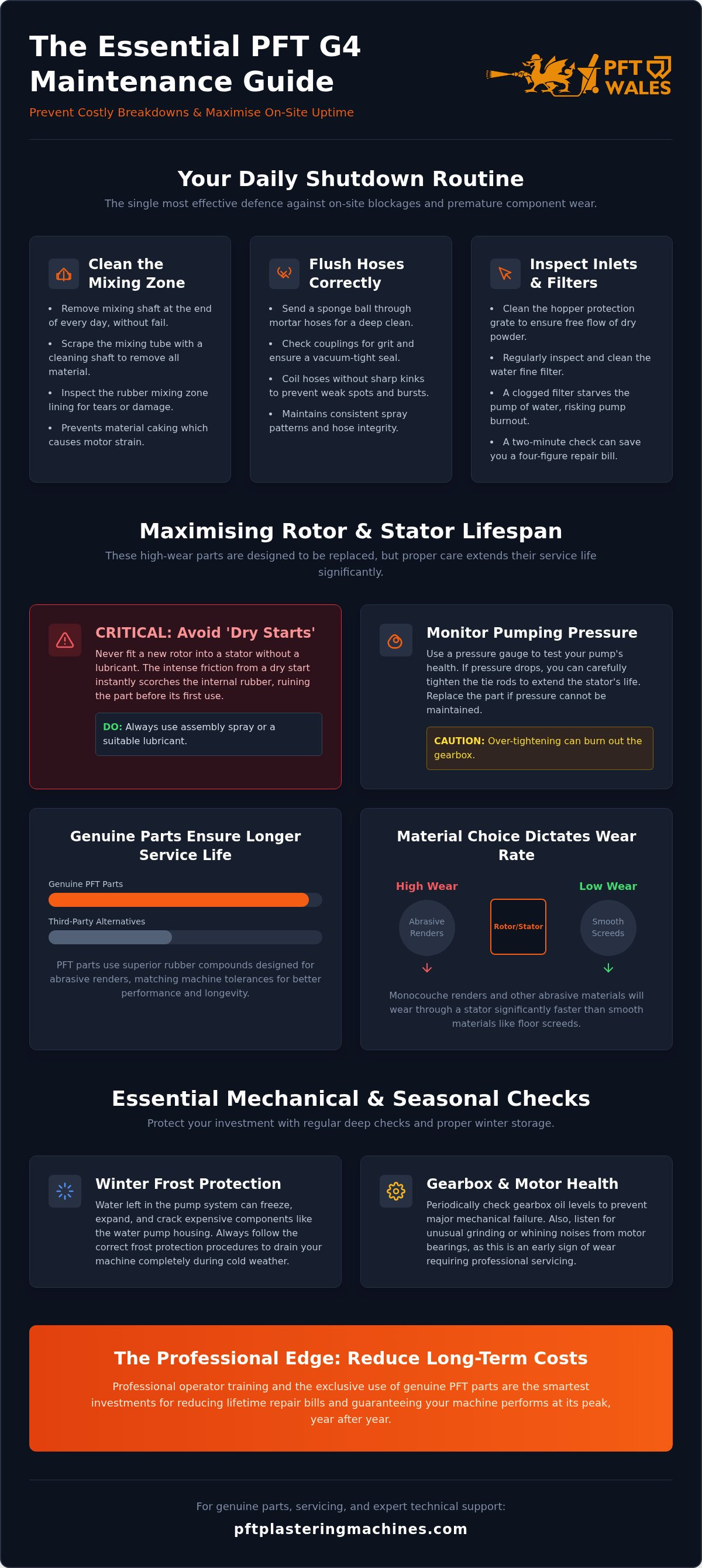
After a ten-hour shift, the last thing anyone wants to do is spend time scrubbing gear. However, skipping the end-of-day clean is the single biggest mistake a renderer can make. While the history of plasterwork is built on manual craft, modern efficiency depends entirely on mechanical reliability. These pft g4 maintenance tips aren't just suggestions; they are the difference between a profitable week and one spent chasing blockages. If you leave material to set in the mixing tube, you aren't just looking at a slow start tomorrow. You're risking expensive damage to the drive motor and mixing components.
The Mixing Zone: Preventing Material Caking
The mixing shaft is the heart of your G4. You must remove it at the end of every day without fail. Use the mixing tube cleaner and cleaning shaft to scrape away every trace of wet render from the internal walls. It's also a good time to inspect the rubber mixing zone. Check for any tears or thinning in the lining. Even a tiny bit of dry material left behind acts as a seed for more caking the next morning. This build-up restricts flow and forces the motor to work harder, leading to premature failure.
Hose Maintenance and Sponge Ball Flushing
Don't just run water through your lines and call it a day. To do it properly, you need to send a sponge ball through the mortar hoses. This physical scrubbing action removes the film of material that water alone leaves behind. Whilst you're at it, check the couplings. Grit in the seals prevents a vacuum-tight connection, which causes air leaks and inconsistent spray patterns. When coiling your hoses for storage, ensure there are no sharp kinks. Kinks create permanent weak spots in the internal lining, which eventually lead to a burst hose mid-spray.
Finally, turn your attention to the hopper and the water fine filter. Clean the protection grate thoroughly; if old material builds up here, it blocks the flow of dry powder. The water fine filter is a small part that often gets ignored. As part of your pft g4 maintenance tips, inspecting this filter should be non-negotiable. If it's clogged with site debris, it starves the pump of water, causing cavitation and eventually burning out the pump motor. A two-minute check here can save you a four-figure repair bill.
Maximising the Lifespan of Rotors and Stators
The rotor and stator are the heavy lifters of your machine. Because they are friction-based parts, they are designed to wear out, but how fast that happens is largely in your hands. A common mistake is ignoring the pressure gauge until the pump stops pushing material entirely. By then, you've likely overstressed the motor and wasted half a day. Understanding these pft g4 maintenance tips will help you get every last bit of value from your D6-3 setup before you need to swap it out.
One of the easiest ways to kill a new stator is a "dry start." If you don't use assembly spray or a lubricant when fitting the rotor, the friction generates instant, intense heat that scorches the internal rubber. It's a rookie error that costs money. Similarly, whilst it's tempting to save a few quid on third-party parts, genuine PFT rotors and stators are manufactured to tolerances that cheaper alternatives simply can't match. They last longer because the rubber compound is designed specifically for the abrasive nature of modern renders. Proper maintenance also aligns with broader OSHA machine safety requirements regarding the integrity of mechanical components during high-pressure operation.
Tensioning and Pressure Testing
Don't guess your pump's health. Use a pressure gauge to see exactly what's happening. If your D6-3 isn't hitting the required bars for the material you're spraying, it's time to act. You can often extend the life of a stator by tightening the tie rods, but do it carefully. Over-tightening creates too much resistance, which can burn out your gearbox or trip the breakers. If you've tightened the rods and the pressure still won't hold, the part is spent. Some contractors flip the stator to get a final few hours out of it, but this is usually a stop-gap, not a long-term solution.
Material Compatibility and Part Selection
The material you pump dictates your wear rate. Monocouche renders are notoriously abrasive and will eat through a stator faster than a smooth floor screed. Always Browse genuine PFT rotors and stators to ensure you're matching the right part to your specific job. Running the machine dry is the fastest way to ruin your gear. Without material to act as a coolant and lubricant, the stator will disintegrate internally within minutes. If you're unsure which setup is best for your current project, reach out to our technical team for a quick chat.
Maintaining Water and Air Systems for Consistent Flow
Consistent material quality depends on a steady flow of water and air. If either fluctuates, your finish suffers. The water pressure switch is a critical safety feature. It stops the machine if the pressure drops, preventing the rotor and stator from running dry and burning out. Cleaning the water fine filter is one of those essential pft g4 maintenance tips that prevents pump cavitation. Cavitation often sounds like marbles rattling inside the pump. It is actually air bubbles imploding under pressure; this can pit the internal metal and lead to a total pump failure.
Troubleshooting Water Pressure Issues
Site water supply in the UK is notoriously inconsistent. Before you blame the machine, check the site tap. If the pressure is fine there but low at the rotameter, you probably have an air lock. Bleeding the water pump is a simple fix. Open the bleed screw until water runs clear without bubbles. You should also regularly clean the flow meter, or rotameter. Limescale or grit build-up makes the internal float stick. This gives you a false reading and ruins your mix consistency. If you are struggling with persistent pressure drops, it is worth checking the parts drawings to ensure all manifold seals are seated correctly.
Air Compressor Care
Your air compressor needs more than just a quick look. Moisture builds up in the tank every day. If you don't drain it via the valve at the bottom, that water travels through the air lines. This causes "spitting" at the spray gun and internal corrosion. Check the V-belts for correct tension. If they're loose or fraying, the compressor won't reach its operating pressure. This results in a narrow, uneven spray pattern. Ensure the automatic cut-off is functioning. If this fails, the motor will keep running until it overheats or blows a fuse. Finally, check your RONDO hoses for leaks. A tiny hiss at a coupling means less air pressure at the nozzle. This leads to a heavy, poor-quality finish that requires more work with the spatula. Keeping a few small parts for machines in your van, such as spare seals and filters, prevents these minor issues from stopping your day. Following these pft g4 maintenance tips for your air and water systems ensures you get a professional spray every time.
Deep Servicing and Protecting Your Machine in Winter
Moving beyond the daily wash-down is what separates a professional renderer from an amateur. Whilst daily cleaning prevents immediate blockages, deep servicing ensures your machine doesn't let you down in the middle of a massive contract. Establishing a routine for weekly and monthly checks is the best way to catch minor wear before it turns into a site-stopping failure. These pft g4 maintenance tips focus on the mechanical heart of your equipment, ensuring every gear and bearing remains in top condition.
Every week, you should check the gearbox oil levels. Low oil leads to excessive heat and friction, which eventually seizes the drive system. If you're running a 2026 model, check your manual or reach out to our technical support team for specific oil change intervals, as these requirements can vary. You also need to grease the main motor bearings. A quick pump of high-quality grease keeps the motor spinning freely and reduces the electrical load on your generator. Ignoring these simple tasks is the fastest way to land yourself with a four-figure repair bill.
Frost Protection for the Water Pump
UK winters are notoriously hard on rendering gear. A single night of sub-zero temperatures is enough to crack a PFT water pump housing. When water freezes, it expands with immense force; if that water is trapped inside your pump, the metal housing will split. To prevent this, you must completely drain the water system before overnight storage. Open all drain cocks and run the pump for a few seconds to purge any remaining liquid. For long-term winter storage, we recommend filling the system with food-grade antifreeze. This protects the internal seals and prevents corrosion whilst the machine is idle.
Electrical Safety and Component Checks
Site life is brutal on electrical components. Cables get dragged over sharp scaffolding, and plugs get stomped into the mud. Regularly inspect your power leads for nicks, fraying, or exposed wires. You should also test your emergency stop buttons and safety cut-out switches every week to ensure they function perfectly. Inside the control box, check for dust ingress or loose connections caused by site vibrations. Staying on top of these checks is especially important with the upcoming 2027 UK machinery safety regulation updates, which place a higher emphasis on electrical and software safety functions. To keep your machine compliant and safe, you can Shop PFT machine accessories and small parts to replace any worn switches or damaged seals immediately.
Following these pft g4 maintenance tips during the colder months ensures you aren't met with a cracked pump on a Monday morning. If you're unsure about the internal condition of your machine or need a technical deep-dive, it is always safer to book a professional service with our expert technical team.
Why Professional Training and Genuine Parts Matter
You can follow every maintenance checklist to the letter, but if the person operating the machine doesn't understand the logic behind the process, you are still at risk. Industry experience shows that operator error remains the leading cause of preventable site breakdowns. Whether it's an incorrect water-to-material ratio or a failure to seat a coupling correctly, these small mistakes lead to massive delays. These pft g4 maintenance tips are most effective when backed by professional knowledge and high-quality components.
The Value of Expert Training
Investing in a Book your PFT G4 training course is one of the smartest moves you can make for your business. Our technical support and training facility offers hands-on sessions that go far beyond the basic manual. You'll learn the "tricks of the trade" that speed up your morning setup and evening cleaning routines. This isn't just about avoiding breakages; it's about pure efficiency. When your crew can set up fifteen minutes faster and clean down without missing a spot, the ROI on that training is realised within weeks. You also gain the confidence to troubleshoot minor issues yourself, keeping the machine running whilst others would be waiting for a mechanic.
Sourcing Genuine PFT Spares
It is often tempting to look for cheaper, non-genuine spare parts when a stator wears out or a seal perishes. Don't fall into that trap. Counterfeit parts are a false economy. They are usually made from inferior rubber compounds or metals that wear faster, potentially damaging the machine's drive system or manifold. Using non-genuine parts can also void your manufacturer's warranty, leaving you unprotected if a major fault occurs. As a national authorised supplier, PFT Wales ensures you have access to genuine components that fit perfectly every time.
We always advise our customers to carry a "first-aid kit" of essential spares on every job. This should include spare seals, a cleaning shaft, and a backup rotor and stator. Having these items in the van means a minor part failure is a ten-minute fix rather than a lost day of work. If you ever hit a problem you can't solve, having an expert peer on the other end of the phone is vital. Our technical support team is here to guide you through complex diagnostics, ensuring your PFT G4 remains the most reliable tool in your arsenal. Proper training and genuine parts are the final, most important pft g4 maintenance tips for any serious professional.
Protect Your Investment and Boost Your Site Efficiency
Your PFT G4 is a legendary workhorse, but its reliability is only as good as the care you give it. By sticking to a disciplined daily cleaning routine and monitoring your water and air systems, you've already won half the battle against site downtime. These pft g4 maintenance tips are designed to help you catch wear early, protect your pump during the harsh UK winters, and ensure every bag of material is mixed to perfection. Consistency on site is built on these small, professional habits.
Consistency on site often involves coordinating multiple finishing trades; for those who require professional spray painting for commercial or residential properties, SKR Specialists provides high-quality respray services that complement a perfectly rendered finish.
The smartest way to lower your long-term repair bills is through a combination of expert knowledge and quality components. Between our authorised technical support, UK-wide delivery on all genuine machine parts, and training courses led by industry veterans, we're here to support your business every step of the way. Don't wait for a mid-job breakdown to start thinking about your maintenance strategy; proactive care is always cheaper than an emergency repair.
Maintaining this level of professionalism across all trades is what sets a construction business apart; if you're also looking for excellence in paving and groundworks, you can check out Wolverhampton Driveways Ltd for insights into expert local surfacing.
Keep your machine running perfectly with genuine PFT G4 spares from PFT Wales. Staying proactive today means a more profitable and stress-free site tomorrow. You've got the skills to deliver a top-tier finish; let us help you keep the machine running to match them.
Frequently Asked Questions
How often should I change the gearbox oil in my PFT G4?
Gearbox oil change intervals depend on your specific model and usage intensity. For the latest 2026 models, recommendations have been updated to ensure maximum durability under heavy site conditions. Because these requirements can vary based on machine age and the materials you pump, it's best to contact PFT Wales for advice or to book a professional service. Keeping the oil clean is essential to prevent internal gear wear and expensive motor failures.
What is the best way to clean a blocked mortar hose?
If a hose blocks, you must first safely release the pressure before attempting to clear it. Once the pressure is off, disconnect the hose and locate the blockage by feeling for a hard spot in the line. You can often clear it by using a sponge ball and water pressure, but never try to force it with high-pressure air as this is dangerous. For persistent issues, our technical support team can talk you through safe recovery steps.
Can I use any rotor and stator in my G4 machine?
No, you cannot just use any rotor and stator in your G4. The part must match the machine's drive specifications and the material you're pumping, such as the standard D6-3 for rendering. Using an incompatible part can overload the motor or result in poor material flow. Always check your machine's manual or ask us for a compatibility check before buying new spares to ensure you're getting the right match for your specific equipment.
Why is my PFT G4 losing water pressure mid-spray?
Losing pressure mid-spray is usually down to site supply fluctuations or a clogged water fine filter. If the site tap is fine, check the filter for debris that might be starving the pump. You should also check for air locks; if air gets into the system, you'll need to bleed the pump to restore consistent flow. These pft g4 maintenance tips are vital for maintaining a professional mix and a consistent finish on every job.
Is it necessary to grease the machine every day?
Whilst you don't need to grease every bearing every day, daily cleaning is non-negotiable. You should inspect and grease the main motor bearings weekly to keep the drive system running smoothly. Consistent lubrication reduces the electrical load and prevents the machine from tripping breakers during heavy use. Regular checks like this, combined with professional technical support, ensure your equipment lasts for years rather than months on the tools.
How do I protect my PFT G4 from frost during winter?
To protect your machine from frost, you must completely drain the water manifold and pump housing after every shift in cold weather. Water expands when it freezes, which can easily crack the metal pump housing overnight. For long-term storage during the winter months, we recommend filling the system with food-grade antifreeze. This simple step saves you from the cost and downtime of a burst water system when the temperature drops.
What are the signs that my air compressor needs a service?
Signs that your air compressor needs a service include a noticeable drop in air pressure at the nozzle or moisture appearing in your air lines. You should also inspect the V-belts for fraying or loss of tension. If the compressor takes longer than usual to reach its cut-off pressure, it's working too hard and needs attention. Regular servicing prevents these minor issues from turning into a total compressor failure in the middle of a job.
Where can I find genuine PFT G4 parts drawings and manuals?
You can find a comprehensive range of genuine PFT G4 parts drawings and manuals directly on the PFT Wales website. These documents are essential for identifying the correct part numbers when you need to order spares for your pft g4 maintenance tips routine. Having the right drawings to hand makes troubleshooting much faster and ensures you're ordering genuine components that are guaranteed to fit your machine perfectly without any site-side modifications.