

How many more years can your shoulders and back realistically handle a full day on the hawk and trowel? It is a question every solo trader eventually faces. You want to scale up and take on those lucrative commercial rendering or floor screed jobs, but there simply aren't enough hours in the day or strength in your arms to do it all manually. You're likely finding that high labour costs and inconsistent lead quality are making it harder to protect your profit margins whilst the physical toll of the trade mounts up.
We understand that the jump from being on the tools to running a high-capacity firm feels daunting. However, learning how to grow a plastering business in 2026 is no longer about just working harder; it is about mechanical leverage. With the UK plastering industry estimated at £2.8 billion this year, the demand is there. By transitioning to modern PFT machinery and Skimflex finishing tools, you can significantly increase your daily square-metre output without the associated fatigue.
This guide shares proven strategies to professionalise your operation and move away from the domestic grind. We will cover how to invest in the right spray equipment, build a reliable team, and win the larger contracts that ensure long-term stability. It is time to stop being the engine of your business and start being the one who steers it.
Key Takeaways
- Understand the transition from a manual solo trader to a strategic manager by breaking through the "time vs. money" ceiling.
- Discover how to grow a plastering business by integrating PFT spray machinery to massively increase daily output whilst reducing physical fatigue.
- Professionalise your brand and finish by upgrading to specialist Skimflex and Refina tools designed for high-speed commercial environments.
- Identify and target high-margin niches, such as monocouche rendering and thin-coat systems, to win more profitable contracts.
- Build a more resilient team by using modern equipment that makes the work more attractive and efficient for skilled tradespeople.
The Growth Mindset: Moving Beyond the Solo Plasterer
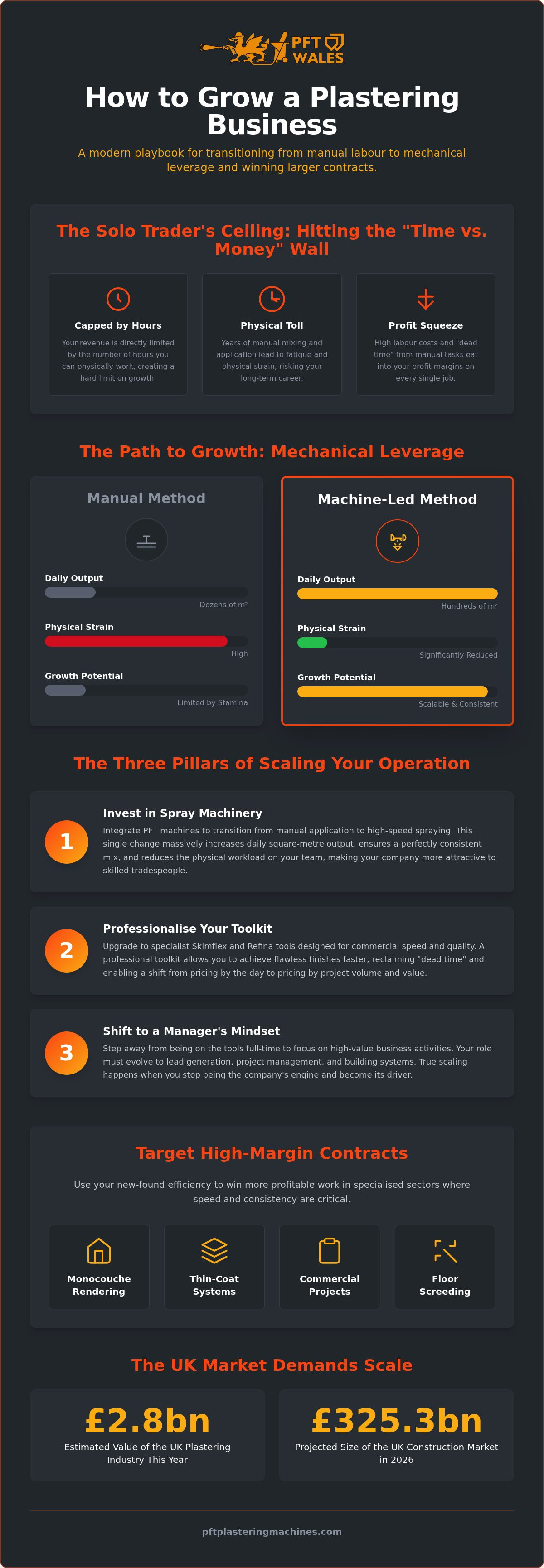
Scaling a plastering business is often misunderstood as simply working longer hours or taking on an extra labourer. In reality, it's the fundamental shift from manual labour to business management. Most solo traders hit a "Time vs. Money" ceiling where their physical output cannot possibly generate more revenue. To understand how to grow a plastering business, you must recognise that your hands are your most expensive resource. Relying on them for every bag mixed and every wall flattened limits your growth to your own stamina. You're effectively capped by the number of hours you can physically stand on a scaffold.
The UK construction market in 2026 is projected to reach a size of £325.33 billion. This growth demands a level of speed and volume that traditional "patch and repair" domestic work cannot match. Whilst the history of plasterwork is rooted in manual craftsmanship, the modern industry rewards those who can deliver high-capacity results on larger commercial and new-build sites. Moving into these sectors requires a mindset that prioritises efficiency over tradition.
To better understand the marketing and lead generation side of this transition, watch this helpful video:
Transitioning from Tradesman to Business Owner
You need to stop doing all the "bags" yourself. If you're constantly on the tools, you aren't focusing on high-level tasks like lead generation or project management. There's a specific point where your physical presence on site actually hinders the company's expansion. Scaling requires you to step back and build systems. Interestingly, investing in high-quality PFT plastering machines is a key part of this. It isn't just about speed; it's about making the job physically easier for your team. This makes your firm far more attractive to high-calibre staff who want to work with modern, efficient equipment rather than breaking their backs with manual application.
Evaluating Your Current Profit Margins
True growth is impossible without understanding the cost of your time. Manual mixing and application involve significant "dead time" that eats into your margins. Think about the hours spent lugging bags, hand-mixing, and cleaning up. When you calculate your current square-metre rate against the potential of a machine-led approach, the gap is often startling. By using Skimflex professional tools and spray machinery, you reclaim that lost time. This allows you to move from pricing by the day to pricing by the project volume. Reclaiming just two hours of dead time per day can be the difference between a struggling solo outfit and a profitable contracting firm.
Investing in Efficiency: The Role of Plastering Machines
If the goal is to double your turnover without doubling your staff, you need mechanical leverage. A PFT plastering machine transforms your daily output capacity from a few dozen metres to hundreds. It isn't just about speed; it's about consistency. When you spray, the mix is identical from the first bag to the last. This eliminates the patchy results often seen with hand-mixing, especially on large-scale external rendering projects. If you're serious about how to grow a plastering business, the shift from the hawk and trowel to a spray gun is the most significant move you'll make.
When reviewing government guidance on business growth, one of the core pillars is investing in technology to improve productivity. In our trade, that technology is the spray pump. Transitioning from hand-applying to spraying allows your team to focus on the finish whilst the machine handles the heavy lifting. This doesn't just increase speed; it fundamentally changes the type of contracts you can realistically bid for and win.
Choosing the Right Machine for Your Business Model
Selecting the right kit depends entirely on your target market. The PFT G4 is the undisputed workhorse for large-scale commercial rendering and floor screeds. It's built for high volume and continuous operation. Conversely, the PFT Ritmo is a versatile choice for firms focusing on internal skimming or smaller external jobs. It's easier to transport and perfect for residential sites. When evaluating the ROI, don't just look at the price tag. Calculate how many extra jobs you can complete in a month. Most firms find that the increased square-metre output covers the investment within just a few large contracts. For a smooth transition, we highly recommend professional machine training to ensure your team is competent from day one.
The Benefits of Spraying vs. Hand Application
Spraying delivers a level of consistency that hand-mixing can't touch. You reduce material waste because the machine provides a precise water-to-material ratio every time. Beyond the finish, consider the physical toll. Plastering is a demanding trade. Using a machine reduces the repetitive strain on your shoulders and back, ensuring career longevity for you and your staff. Being able to promise faster completion times also makes you a hero to site managers, helping you secure repeat business on larger developments. To ensure a clean and professional setup when spraying, check out Fosseway Tapes & Fixings Limited for high-quality industrial masking tapes and adhesives.
A broken machine is a parked business. Regular machine servicing prevents costly downtime that can ruin your reputation on a tight schedule. You should always budget for essential spares, including rotors, stators, and hoses. Having these on the van means a minor part failure doesn't end the day's work. As an authorised dealer, we provide genuine PFT parts and technical advice to keep your fleet operational. If you're unsure which spares you need for your specific model, get in touch with our technical team for expert support.
Building a Professional Toolkit for Speed and Finish
Your toolkit is more than just a collection of equipment in the back of the van; it is a direct extension of your brand. If you are researching how to grow a plastering business, you must recognise that high-growth firms treat their tools as a statement of intent. A site manager walking onto a job and seeing a well-maintained set of Skimflex tools immediately knows they are dealing with a contractor who values precision. Professionalism starts with the gear you bring to the site.
The most significant shift in modern plastering is the move from traditional trowels to specialist finishing spatulas. Whilst the trowel remains essential for application, a wide spatula allows you to flatten large areas in a fraction of the time. This efficiency is critical when you are trying to increase your daily square-metre output. Ergonomic tool design is not just a luxury for the comfortable. It is a practical necessity that reduces physical fatigue. By using tools that put less strain on your wrists and shoulders, your team can maintain a higher work rate for longer, more productive days without the burnout associated with older methods.
The Essential Scaling Kit: Beyond the Basics
To move beyond small domestic patches, you need a kit designed for large-area skimming. This is where spatulas and straight edges become your most valuable assets. They ensure a level of flatness on big walls and ceilings that is difficult to replicate with a standard trowel alone. However, professional-grade plastering trowels from brands like Refina remain a non-negotiable investment for that final, polished touch. Organisation also plays a huge role in your daily profit. Reducing setup and pack-down time by having a structured tool system means more time spent actually earning. As the UK government guide to growing your business highlights, improving operational efficiency is a primary driver for sustainable expansion.
Proprietary Tools for a Competitive Edge
PFT Wales developed the Skimflex range specifically for the UK market because we saw a gap in what traditional tools could offer. Modern thin-coat systems and monocouche renders behave differently to the materials of twenty years ago. You need equipment designed specifically for these modern materials to achieve a superior finish. Using premium tools helps you deliver a "flawless" result that site managers and homeowners will notice. In the plastering trade, your finish is your best marketing tool. It generates the high-value referrals that allow you to move away from low-margin work and focus on more profitable, large-scale contracts.
Winning High-Value Contracts and Lead Generation
Scaling past the local domestic market means you can't just wait for the phone to ring. Word of mouth is a fantastic bonus, but it isn't a growth strategy. If you're serious about how to grow a plastering business, you need to move from being reactive to being proactive. This starts with targeting high-margin niches like monocouche rendering, floor screeding, and thin-coat systems. These projects are larger, more technical, and far more profitable than standard domestic skim jobs. By positioning yourself as a specialist with machine-plastering capability, you offer a unique selling point (USP) that traditional firms simply can't match. Site managers care about deadlines. If you can spray a whole house in a day whilst the competition is still mixing by hand, you'll be the first person they call for the next phase.
Building relationships with developers, architects, and larger construction firms is the next step. These clients aren't looking for the cheapest price; they're looking for reliability and speed. They need to know that you have the infrastructure to handle the volume without the quality dropping. This is where your investment in modern machinery, combined with professional site branding from Banner 4 Sale, becomes your strongest marketing tool. It proves that you're a professional outfit capable of meeting the demands of a high-speed site.
Don't just tell developers you're fast; show them. Use video content to demonstrate the speed and cleanliness of your PFT plastering machines in action. A time-lapse of a large-scale rendering project is far more persuasive than a static photo. When you do take photos, focus on the scale of the projects you can handle rather than just the finish. Highlighting your status as a firm using PFT-authorised equipment and having undergone specialist machine training builds immediate trust. It shows you've invested in your business and have the technical support behind you to prevent site delays.
Professional Tendering and Pricing
Winning larger tenders requires a shift in how you view your time. Move away from "day rates" and start pricing by the "price per metre." This is where your investment in machinery really starts to pay off. When you can apply material at three times the speed of a manual team, your profit per metre sky-rockets. Understanding your margins is essential when learning how to grow a plastering business into a sustainable contracting firm. Ensure your quotes are professional and detailed. Architects and developers expect clear contracts and itemised costs. They want to hire a contracting firm, not just a man with a van. Professionalism in your paperwork is just as important as the finish on the wall.
If you're ready to bid for larger contracts but need the right equipment to back up your claims, contact our technical team to discuss your fleet requirements.
Scaling Your Team and Managing Operational Risks
The UK construction sector faces a significant structural challenge with a skills shortage estimated at 266,000 additional workers needed by 2026. For those wondering how to grow a plastering business, the primary hurdle isn't always finding the work; it is finding and keeping a reliable crew to execute it. Plastering is a punishing trade on the body. If you want to attract the best talent, you must offer an environment that reduces physical burnout. By investing in modern plastering machinery, you make the job significantly more attractive to potential employees. A team that spends the day spraying rather than hand-mixing is a team that stays productive, stays healthy, and stays loyal to your firm.
Managing operational risk is the flip side of scaling. As you move from being on the tools to managing multiple sites, you lose direct oversight of every bag mixed. This transition requires a shift in focus toward systems and reliability. You are no longer just a plasterer; you are a logistics manager ensuring that your fleet, your materials, and your men are all performing at peak efficiency.
Training Your Crew for Success
Quality control is the first thing to suffer when a business grows too quickly. To prevent this, every new hire should undergo professional machine training. It is not enough for them to be "good with a trowel." They need to understand the technical nuances of the equipment they are using. Standardising your application techniques ensures a uniform brand finish across every project, regardless of which crew is on site. Utilising technical support from your supplier to troubleshoot site issues quickly is also vital. When your team knows they have a direct line to expert advice, they can resolve minor mechanical hurdles without the day's production grinding to a halt.
Financial Planning for Long-Term Growth
Expanding your business brings financial complexities that require a sharp eye on the books. You must be mindful of the VAT registration threshold, which currently sits at £90,000 per annum. Managing your cash flow whilst navigating this threshold and the Construction Industry Scheme (CIS) is a common pain point. Most subcontractors will be verified at the 20% CIS deduction rate, but you must ensure your margins account for these outflows alongside your equipment investments.
To scale sustainably, look at flexible finance options or part-exchange programmes to upgrade your fleet. It is also worth considering the "true cost" of downtime. A "service-while-you-wait" appointment at a specialist workshop is often worth the travel time compared to a local general mechanic. Having your kit maintained by experts who understand PFT machines ensures longevity and prevents the insolvency risks associated with major site delays. Managing these financial and operational risks is the final, essential step in how to grow a plastering business into a high-capacity contracting firm.
Take the Next Step Toward Your Contracting Future
Scaling a plastering business requires a fundamental shift from manual application to strategic management. You've seen how mechanical leverage through PFT machinery and specialist Skimflex tools can transform your daily output whilst protecting your physical health. Winning high-value commercial contracts is no longer a distant goal when you have the speed and consistency to outpace the competition. It's about moving from the domestic grind to a professional contracting firm that operates with precision and efficiency.
Understanding how to grow a plastering business in 2026 means embracing modern technology and reliable support. You need a partner who understands the grit of the site and the technicalities of the machine. With 16 years of trade experience as an authorised PFT specialist, we provide the UK-wide delivery and expert technical support necessary to keep your crews operational. Whether you're looking for new kit or refurbished machinery, our flexible finance options are designed to support your growth without straining your margins.
Stop being the engine of your business and start being the one who steers it. Explore our range of PFT Plastering Machines and start scaling your business today. We're ready to help you build a firm that lasts and thrives in the modern construction landscape.
Frequently Asked Questions
Is it worth buying a plastering machine for a small business?
Investing in a machine is absolutely worth it for a small firm aiming for growth. Whilst the initial cost is an investment, the increase in square-metre output allows you to complete jobs faster and take on more projects. It significantly reduces the physical toll on your body, ensuring you can stay on the tools longer. For many, the machine pays for itself within a few large contracts by reclaiming "dead time" spent mixing manually.
How much can a plastering business owner earn in the UK?
Individual plasterers in the UK typically see day rates between £170 and £300, rising to £350 in London. However, a business owner focusing on how to grow a plastering business can earn significantly more by moving to project-based pricing. By managing a team and using high-capacity PFT machinery, you move from earning an hourly rate to capturing higher profit margins on large-scale commercial rendering and floor screeding projects across multiple sites simultaneously.
What are the best ways to get commercial plastering leads?
The most effective way to secure commercial leads is by building direct relationships with site managers, developers, and architects. Showcasing your machine-plastering capability is a major unique selling point, as commercial clients prioritise speed and reliability. Use video content of your PFT setup to prove you can handle high-volume work. Registering on tendering platforms and maintaining a professional digital presence will also attract higher-margin contracts than relying on domestic word-of-mouth alone.
Do I need a special licence to operate a PFT plastering machine?
You don't need a specific government-issued licence to operate a PFT machine, but professional training is highly recommended. Most site managers and insurance providers will require proof of competence before allowing machine use on a commercial site. We provide comprehensive machine training to ensure you and your team can operate the equipment safely and efficiently. This training covers setup, cleaning, and basic maintenance, which is vital for preventing accidents and ensuring machine longevity.
How do I transition from domestic to commercial plastering contracts?
Transitioning requires professionalising every aspect of your business. Start by upgrading to high-capacity spray machinery to meet commercial volume demands. You should also move from domestic day rates to "price per metre" models. Ensure your insurance, health and safety documentation, and CIS registration are all in order. Building a portfolio that showcases large-scale project success and demonstrating your ability to meet tight site schedules will help you win trust with larger construction firms.
Should I buy a new or used PFT machine to start scaling?
Both options have distinct advantages for a growing firm. A new PFT machine comes with a one-year warranty and the latest technical specifications, providing maximum peace of mind. However, a high-quality refurbished machine is an excellent, cost-effective entry point for those scaling on a tighter budget. We often stock used and refurbished machines that have been fully serviced by our expert technicians. The choice usually depends on your current cash flow and immediate project volume.
What is the best plastering trowel for a professional finish?
For a truly professional finish, many tradespeople prefer Refina stainless steel trowels or our proprietary Skimflex range. Whilst traditional trowels are essential for application, using specialist finishing spatulas for flattening large areas is the key to modern speed. The "best" tool often depends on the specific material you are using, such as monocouche render or thin-coat systems. We recommend a combination of high-quality trowels for detail work and wide spatulas to achieve a flawless finish.
How often should I service my rendering machine to avoid downtime?
Daily maintenance, such as thorough cleaning and greasing, is non-negotiable to prevent blockages. For professional servicing, we recommend a full workshop check-up every six to twelve months, depending on your workload. Regular servicing helps identify wear in rotors and stators before they fail on site. Our workshop labour rate is £72 per hour, and we provide expert repairs to keep your fleet operational. Preventing downtime is far cheaper than losing production due to preventable mechanical failure.