

You're halfway through a massive gable end when the pump pressure drops and the motor starts straining. It's that sinking feeling every tradesperson dreads; staring at a hopper of expensive render whilst the clock ticks and your profit margin thins. Guesswork on site isn't just stressful, it's costly. Investing in professional pft training is the only way to swap that anxiety for total mechanical confidence. At PFT Wales, we've spent over thirty years on the tools and in the workshop, so we know that a machine is only as good as the person operating it.
We understand that your reputation relies on a flat finish and a fast turnaround. It's frustrating when poor calibration leads to wasted bags or unnecessary physical strain from incorrect handling. This article explores how mastering your PFT G4 or Ritmo through expert guidance can transform your site efficiency. We'll show you how to reduce downtime through proper maintenance, troubleshoot common faults without calling for help, and significantly increase your daily square footage. Get ready to turn your plastering machine into a high-performance asset that pays for itself every single day.
Key Takeaways
- Learn how to significantly increase your daily square metre coverage to meet the growing demands of the UK construction market.
- Master the technical setup of the PFT G4 and Ritmo, including precise water-to-material ratios, through professional pft training.
- Prevent expensive component failures, such as "blown" rotors and stators, by following correct maintenance and troubleshooting procedures.
- Identify the exact power requirements and specialist finishing tools, like Skimflex spatulas, needed to ensure maximum site efficiency.
- Gain total confidence in your machine handling by learning from an authorised dealer with trade experience dating back to 1988.
Why Professional PFT Training is Essential for Modern Contractors
The trade is evolving fast. While the history of plasterwork is built on manual craft and traditional trowel skills, today's market demands a level of output that hand-mixing simply cannot match. With the UK construction industry needing an estimated 266,000 additional workers in 2026 to meet housing and infrastructure targets, contractors are under immense pressure to work smarter. Moving to machine application is the most effective way to bridge this gap. However, these machines are precision-engineered tools, not just oversized mixers. Without proper pft training, you're essentially trying to operate a complex piece of plant without a manual. You might get the material on the wall, but you'll likely struggle with consistency and reliability.
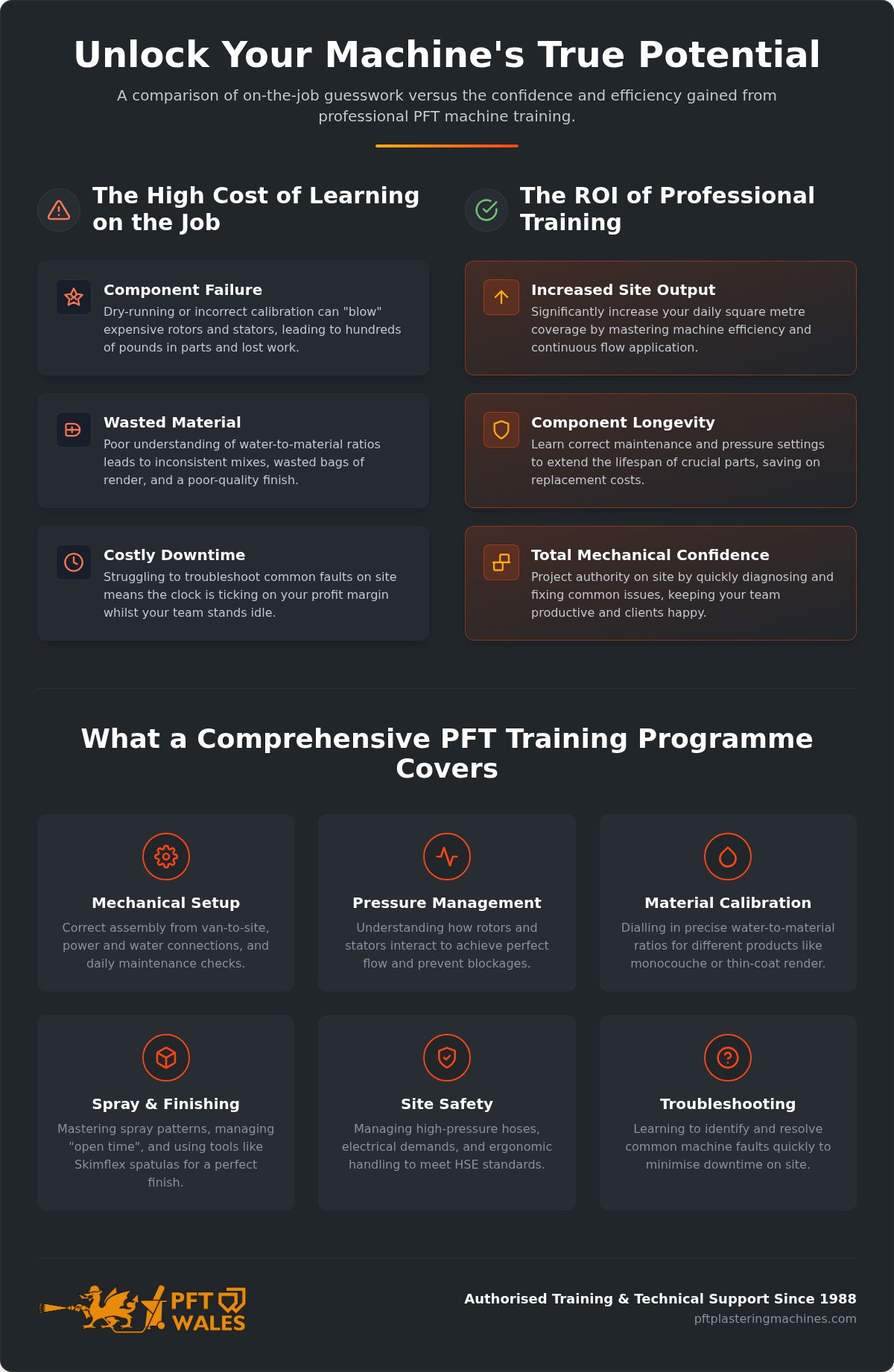
Learning on the job is a risky strategy that often leads to expensive mistakes. A single error in water calibration or a dry-run can instantly damage your rotors and stators, leading to hundreds of pounds in replacement parts and lost hours. Wasted render and machine downtime don't just eat your profit; they damage your reputation with developers who expect strict deadlines to be met. Professional operators project authority on site. They know exactly how to dial in a machine for a perfect flow, ensuring a high-quality finish that keeps the phone ringing with new contracts.
Bridging the Skills Gap in Plastering
Traditional site skills are the foundation, but they need to be augmented with mechanical knowledge to handle modern volumes. PFT training shifts your focus from the physical labour of mixing to the technical management of continuous flow technology. You'll learn how to handle the transition from small-scale domestic jobs to large commercial projects where speed is everything. It's about mastering the "wet-on-wet" technique at a pace that keeps your crew productive and your margins healthy.
Safety and Compliance on the 2026 Construction Site
HSE standards on modern sites are uncompromising. Operating pressurised machinery involves specific risks that aren't present with a bucket and whisk. Training ensures your team understands how to safely manage high-pressure hoses and electrical requirements. It also focuses on ergonomics; a machine should take the strain off your body, not add to it. By proving your team is competent, you satisfy site insurance requirements and demonstrate the professional standards required by major UK housebuilders.
What a Comprehensive PFT Training Programme Covers
PFT training isn't just about learning which buttons to press. It's a deep dive into the mechanical soul of your machine. A comprehensive course takes you from the initial van-to-site assembly right through to advanced pressure management. You'll learn the precise water-to-material ratios for major render brands, ensuring you never waste a bag due to poor calibration. One of the most critical areas we cover is the rotor and stator mechanism. Understanding how these components interact under pressure is the difference between a part that lasts months and one that blows in a week.
Following official safety guidelines is non-negotiable on a modern site. Training covers how to manage high-pressure hoses and the electrical demands of various power systems safely. We focus on the practical realities of a busy site, ensuring you can troubleshoot a blockage or a pump failure without losing your head. By the end of the programme, the machine feels like an extension of your own hands, rather than a temperamental piece of equipment you're afraid to push.
Mechanical Setup and Daily Maintenance
Your day starts with a correct connection. We guide you through the sequence of linking water pumps and power supplies to avoid surging or dry-running the pump. A major focus is the mixing tube; if this isn't cleaned properly at the end of a shift, you're asking for trouble the next morning. We show you how to spot early signs of wear in hoses and couplings before they fail under load. Keeping a stock of genuine PFT rotors and stators is wise, but knowing how to extend their lifespan through proper lubrication and pressure settings is even better.
Material Science and Spray Patterns
Every material behaves differently. Whether you're spraying monocouche, thin-coat, or traditional sand and cement, the machine needs to be dialled in specifically for that product. We teach you how to manage "open time" whilst covering large elevations, ensuring the material remains workable for finishing. You'll also master the art of the spray pattern. Using the right spraying guns and hoses, you'll learn how to achieve a consistent, flat finish every time, regardless of the substrate. If you have questions about specific material flow rates for your next job, feel free to get in touch for technical advice.
Professional Training vs. Self-Taught: The ROI Breakdown
Is the cost of professional instruction worth it? It's a question we hear often. Many contractors try to "wing it" by watching videos online, but there's a world of difference between seeing someone spray and managing the mechanical variables yourself. When you're self-taught, you're essentially paying for your education through broken parts and wasted materials. A single "blown" rotor and stator caused by an incorrect dry-start or poor water calibration can cost you hundreds of pounds in parts alone. Add in the lost labour for a four-man crew standing around on site, and the "free" DIY route suddenly looks incredibly expensive.
Investing in pft training changes the maths of your business. A trained operator doesn't just avoid mistakes; they work faster. We've seen that a crew with a properly calibrated machine can cover significantly more square footage per day compared to one struggling with a temperamental setup. It's not just about spraying; it's about the rhythm of the job. When you trust your equipment, you can push the pace. This efficiency is what allows you to take on larger commercial contracts and outsmart competitors who are still stuck with a bucket and whisk.
Reducing Material Waste and Downtime
Calibration is where the money is won or lost. If your mix is too wet, you're wasting expensive render; too dry, and you're risking a blockage that could shut down the site for hours. Professional training gives you the "feel" for the material that you just can't get from a screen. You'll also learn to avoid those tempting "cowboy" fixes. Using non-genuine components or bypassing safety sensors might get you through the afternoon, but it often voids your warranty and leads to catastrophic failure later. Confidence on site isn't just a psychological win; it's a financial one.
Long-term Machine Health
Your PFT G4 or Ritmo is a significant investment. Trained operators consistently report that their wear parts last up to twice as long as those used by untrained staff. This is because they understand the relationship between hose length, material density, and operating pressure. Beyond daily care, having a relationship with an authorised partner like PFT Wales means you get access to expert technical support when things get tricky. Keeping your machine in top condition doesn't just ensure daily profit; it maintains a high resale value if you ever decide to upgrade your fleet.
Essential Preparation: Getting Ready for Your PFT Course
Turning up for your pft training with a "see how it goes" attitude is a wasted opportunity. To get the maximum ROI from your session, you need to arrive with a clear understanding of your current setup and the specific challenges you face on site. We aren't just teaching you how to turn a machine on; we're helping you integrate it into your business. Start by identifying the exact materials you plan to spray. Whether it's a specific monocouche brand or a thin-coat system, knowing your material helps the instructor tailor the calibration advice to your needs. This is about practical application, not just theory.
Think about the jobs you usually handle. Are you often struggling with poor water pressure or limited power access? Formulate these into specific questions. Our team has been in the trade since 1988, so we've seen every site nightmare imaginable. We can help you find practical solutions before you're standing in front of a live hopper on a high-stakes job. Being prepared means you spend less time on the basics and more time mastering the advanced spray techniques that actually make you money.
The Professional Tool Kit
Machine plastering requires a different finishing approach than traditional hand-skimming. You'll need to assess your tool kit to ensure you have the right gear to keep up with the machine's output. We highly recommend the Skimflex tool range, especially their spatulas and finishing trowels. These are specifically designed to flatten machine-applied material quickly and efficiently. Don't forget the basics; you'll need a dedicated set of cleaning tools and high-quality machine accessories like the correct hoses and couplings. Arriving with the right gear shows you're ready to transition into a high-production mindset.
Technical Readiness
Understanding your power requirements is non-negotiable. Before your course, check if your machine is 110v, 240v, or 415v. Each has different site demands and transformer needs. Electrical safety is paramount; we'll cover this in depth, but having a basic grasp of your machine's requirements prevents delays on the day. Water supply is the other half of the equation. You need to know how to check site pressure and ensure a consistent flow to the pump. Finally, think about your team. Machine plastering moves fast. You need to organise your crew so the spray professional is never waiting for the guys on the spatulas. If you're unsure which power setup suits your typical workload, contact our technical team for a chat before you book.
PFT Wales: Authorised Training and Technical Support
Since 1988, we've been at the heart of the UK plastering industry. We started on the tools ourselves, so we understand the daily grind and the pressure of a ticking clock on site. Our pft training isn't delivered by generic instructors; it's led by experts who know these machines inside out. At our dedicated facility, we use the latest PFT models to give you hands-on experience in a controlled environment. This isn't just about reading a manual. It's about getting your hands dirty and feeling how the material flows through the hose under real-world conditions.
We also bring the Skimflex advantage to every session. As a brand developed by plasterers, for plasterers, Skimflex tools are designed to work in perfect harmony with machine-applied renders. We show you how to use these specialist spatulas and trowels to achieve that mirror-flat finish with half the effort. It's this combination of mechanical mastery and refined tool skills that sets our trainees apart. You won't just be a machine operator; you'll be a more efficient, more profitable craftsman.
Why Learn with an Authorised Dealer?
Choosing an authorised dealer for your pft training ensures you're getting the most accurate technical data available. We have direct links to the manufacturer, which is vital for troubleshooting complex mechanical issues that might stump a generalist. You also get guaranteed access to genuine PFT rotors and stators. Using non-genuine parts can compromise your machine's performance and potentially void your warranty. When you train with us, you're learning the "PFT way," meeting the high standards expected by major construction firms and developers across the UK.
Beyond the Training Day
Our support doesn't end when you leave the training centre. We pride ourselves on being a long-term partner for your business. Whether you need a quick technical tip over the phone or a full parts drawing to identify a specific component, we're here to help. We offer professional servicing and repairs to keep your fleet running at peak efficiency year-round. Join the PFT Wales community and elevate your trade today. By staying connected with our national network, you ensure your business remains at the cutting edge of the industry, backed by the best tools and technical wisdom in the trade.
Future-proof Your Plastering Business
Mastering your machine is the only way to stay ahead in a competitive market that demands speed without compromising on quality. We've seen how the right technical knowledge prevents the frustration of mid-job breakdowns and the high cost of ruined components. By investing in professional pft training, you aren't just learning a new skill; you're protecting your profit margins and extending the life of your equipment.
At PFT Wales, we've been supporting the trade since 1988. As an authorised PFT dealer, we provide more than just a course. We offer a partnership that includes specialist UK-wide technical support, genuine parts, and expert servicing. Whether you're operating a G4 or a Ritmo, our goal is to ensure you leave our facility with total site confidence. Don't let mechanical guesswork slow you down.
Book Your Professional PFT Training Session Today and take control of your output. We're ready to help you reach the next level of site efficiency.
Frequently Asked Questions
How long does a PFT training course typically take?
A standard pft training session is usually a full-day intensive course. This duration allows us to cover everything from initial van-to-site assembly and material calibration to advanced spray techniques and cleaning procedures. We keep the schedule focused on practical application to ensure you gain hands-on experience with the machinery. For specific upcoming dates and durations, please contact our Swansea-based team directly for the latest schedule.
Do I need my own machine to attend a PFT training session?
No, you don't need to bring your own equipment to our specialist training facility. We provide the latest PFT models, including the G4 and Ritmo, for you to use throughout the session. This allows you to get comfortable with the machinery in a controlled environment before taking it onto a live job. If you have already purchased a machine, the course is the perfect time to ask specific technical questions.
Is PFT training suitable for beginners or just experienced plasterers?
Professional pft training is designed for both experienced hand-plasterers looking to transition to machine application and existing operators wanting to refine their technical skills. We tailor the instruction to suit your current experience level. Beginners focus on the fundamentals of setup and material flow, while seasoned professionals often use the time to master troubleshooting and material science for complex commercial render systems.
Will I receive a certificate of competence after the training?
Yes, we provide a certificate of attendance and competence upon successful completion of the pft training course. This document proves you've received instruction from an authorised dealer and understand the safe operation of the machinery. Many UK construction sites and insurance providers now require proof of professional training for operators to ensure compliance with health and safety standards and site-specific competency requirements.
Can PFT training help me reduce the wear on my rotors and stators?
Absolutely. One of the main financial benefits of professional pft training is learning how to extend the life of your wear parts. We teach you how to manage operating pressures and material consistency to prevent the unnecessary friction that causes premature failure. Understanding the relationship between hose length and pump speed can often double the lifespan of your rotors and stators compared to untrained operation.
Does the training cover both internal plastering and external rendering?
Yes, our courses cover a wide range of applications. We provide instruction on spraying internal gypsums as well as external monocouche and thin-coat render systems. Because the machine setup varies depending on the material's density and weight, we show you how to adjust the water-to-material ratio and choose the correct rotor and stator combination for each specific job type you handle.
What happens if my machine breaks down after I have been trained?
We provide ongoing technical support to all our trainees. If you encounter a problem on site that you can't solve using the troubleshooting skills learned during your course, you can contact our specialist team for advice. As an authorised service centre, we also offer professional repairs and a full range of genuine PFT parts and accessories to get your machine back up and running quickly.
Is there a specific training module for the PFT G4 and PFT Ritmo?
Yes, we offer training tailored to the specific machine you intend to use. While the principles of continuous mixing are similar, the PFT G4 and the Ritmo have different power requirements, assembly sequences, and maintenance needs. We ensure your training focuses on the mechanical nuances of your specific model so you can operate it with total confidence and efficiency on your own job sites.