

You're halfway through a monocouche job when a worn coupling fails or a hose finally gives up under pressure. The machine stops. The mix starts to set. Suddenly, your profit margin is evaporating into the afternoon sun. It's a scenario every professional renderer has faced, and it's almost always down to a small oversight in your plastering spray guns, hoses & parts inventory.
We know that your PFT machine is the heart of your business, but the hoses and guns are the veins and arteries. If they aren't matched correctly to your material viscosity, you'll face constant blockages and inconsistent spray patterns. This guide will help you master technical specifications and coupling compatibility so you can maintain a reliable, high-pressure setup. You'll learn which nozzles deliver the best finish and exactly which service parts you should keep in the van to avoid site downtime. We'll break down the differences between Camlock and Geka fittings and share routines for faster cleaning, giving you the confidence that your kit is ready for any project whilst ensuring your machine delivers peak performance.
Key Takeaways
- Understand the technical differences between 25mm and 35mm material hoses to ensure your machine maintains the correct pressure for internal plasters or heavy external renders.
- Master the compatibility of plastering spray guns, hoses & parts to build a reliable spraying setup that eliminates air leaks and inconsistent spray patterns.
- Identify the essential "Emergency Van Kit" components, such as spray caps and seals, that prevent a minor wear-and-tear issue from causing a total machine stoppage.
- Learn how to choose between standard spray guns and long lance options to improve your efficiency when reaching heights or tackling awkward angles on site.
- Discover how to utilise genuine PFT schematics and expert technical advice to streamline your maintenance routines and extend the lifespan of your equipment.
Optimising Your Spraying Setup: Why Quality Hoses and Guns Matter
In the world of machine plastering, your pump is only as good as the equipment carrying the material to the wall. Think of your PFT machine as the engine; your plastering spray guns, hoses & parts are the tyres and transmission. If they aren't up to the task, you aren't going anywhere. A high-spec G4 or Ritmo can generate significant pressure, but if that force is met with a worn hose or a clogged gun, the result is always the same: poor spray patterns and frustrated tradespeople.
We often see contractors "making do" with damaged equipment to save a few pounds. It's a false economy. A burst material hose doesn't just stop the job; it wastes a full hopper of material and can take hours to clean up. Inconsistent pressure caused by air leaks in the gun assembly leads to "surging," which makes achieving a flat, professional finish nearly impossible. Whether you're spraying gypsum, cement-based renders, or modern monocouche, the reliability of your spraying assembly is what keeps your site profitable. This focus on precision spraying extends beyond construction; for those looking to refresh interiors, Dee Valley Spray Solutions offers a professional alternative to replacement through high-quality kitchen and furniture respraying.
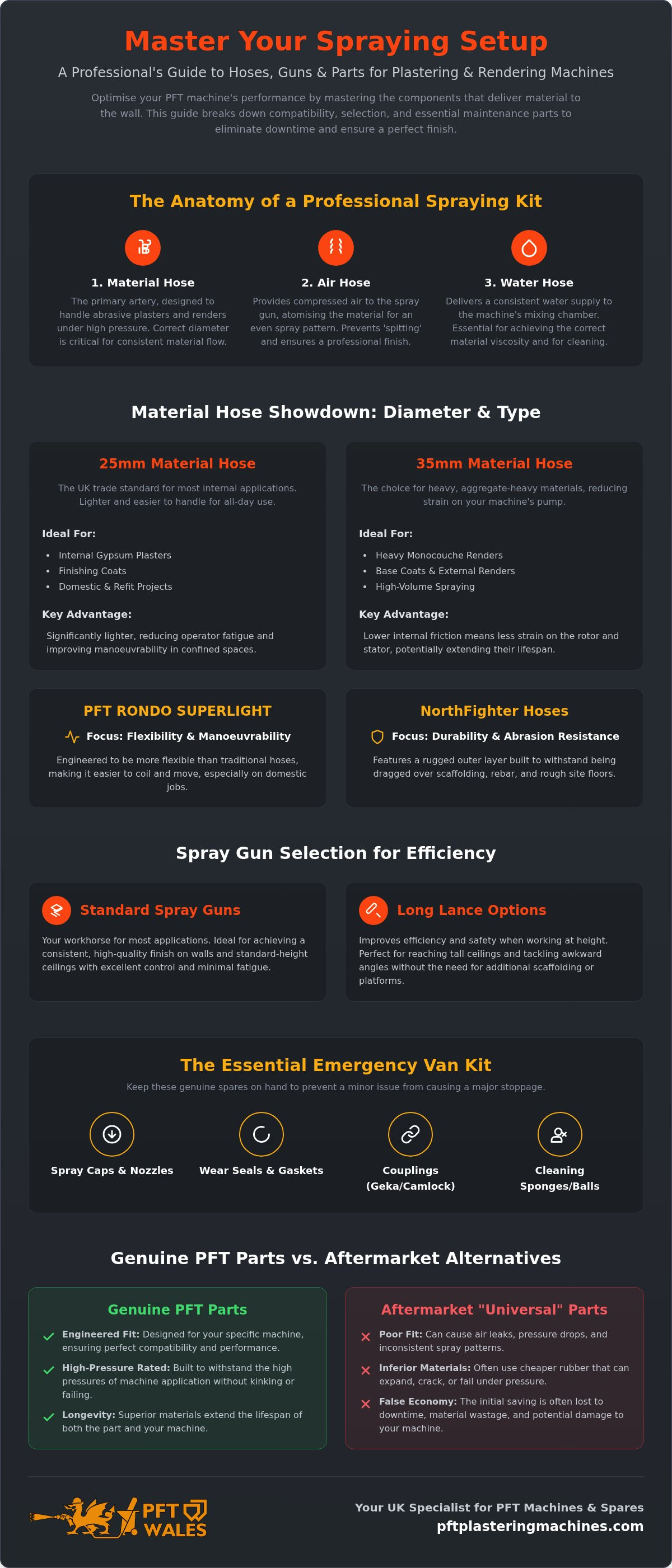
### The Anatomy of a Professional Spraying KitA professional setup relies on a precise three-line system. You have the material hose, which handles the abrasive mix; the air hose, which provides the atomisation at the nozzle; and the water system, which is vital for consistency and cleaning. This setup is rooted in shotcrete technology, where conveying material under pressure requires specialised equipment designed for high abrasion resistance.
The weak points in most setups are the couplings and the spray caps. Over time, the grit in the plaster wears down the internal seals. This leads to pressure drops that you might try to compensate for by cranking up the machine, which only accelerates the wear on your rotor and stator. Keeping your kit in top condition means checking these connections daily.
Genuine PFT Parts vs Aftermarket Alternatives
It's tempting to grab "universal" parts from a local builder's merchant, but they rarely stand up to the rigours of a busy site. Genuine PFT RONDO and SUPERLIGHT hoses are engineered with specific wall thicknesses and internal linings to handle high-pressure flow without kinking. Aftermarket alternatives often use inferior rubber that expands under heat, leading to coupling failures and dangerous leaks.
Investing in longevity means choosing components designed specifically for your machine. At PFT Wales, we've seen how genuine parts extend the lifespan of the entire unit. You can find the full range of professional spraying guns and hoses in our shop, backed by the technical advice of a team that's been in the trade since 2010. We don't just sell parts; we help you build a setup that won't let you down when the pressure is on.
Decoding Plastering Machine Hoses: Material, Air, and Water Systems
Choosing the right diameter for your material hose is about balancing flow with physical effort. For most internal gypsum work in the UK, a 25mm hose is the trade standard. It's light enough to move around all day without causing excessive fatigue. However, if you're pushing heavy monocouche render, stepping up to a 35mm hose reduces the internal friction. This lower resistance means your rotor and stator don't have to work as hard, which can extend the life of your pump components. The goal is to use the smallest diameter that allows the material to flow freely without causing the motor to strain.
Air and water hoses are the unsung heroes of the setup. A cheap, thin-walled air hose will kink at the worst moment, cutting off your atomisation and causing the gun to "spit" material. Professional-grade air hoses are reinforced to withstand being stepped on or dragged over sharp debris. Similarly, your water hose must handle the constant mains pressure required to feed the mixing chamber. If your water supply fluctuates because of a collapsing hose, your mix consistency will go out the window. Reliable water pressure and heating are foundational to any successful site; for a trusted plumbing & heating company providing high-quality services across London and Kent, you can rely on plumbtech365.co.uk.
PFT RONDO vs NorthFighter Material Hoses
The PFT RONDO SUPERLIGHT is designed for tradespeople who value manoeuvrability. It's significantly more flexible than traditional rubber hoses, making it much easier to coil and move between rooms on a domestic refit. For heavy-duty external rendering, NorthFighter hoses are the better choice. They feature a rugged outer layer built for superior abrasion resistance against scaffolding and rough site floors. When selecting your length, remember that every extra metre increases the pressure required from the pump. Try to keep your total hose length as short as practical to maximise efficiency. For those requiring high-quality tubing or bespoke plastic profiles for specific industrial applications, specialist UK manufacturers like abbeyextrusions.com offer a comprehensive range of hoses and extrusion solutions.
Couplings and Fittings: Camlock vs Geka
Couplings are the most common failure point on any plastering spray guns, hoses & parts assembly. Material lines must use Camlock fittings because they provide a secure, mechanical lock that won't vibrate loose under high pressure. For air and water lines, Geka-style twist-lock couplings are the standard. However, these should always be fitted with safety clips. Following pneumatic tool safety standards is vital for preventing "hose whip" if a connection fails. Always inspect your gaskets for grit before connecting; a single grain of sand can prevent a perfect seal and lead to a frustrating pressure drop.
If you're unsure which hose diameter or coupling style is right for your specific machine, you can get in touch for technical support from our Swansea-based team.
Choosing the Right Plastering Spray Gun for Your Machine
Selecting a spray gun isn't just about what feels comfortable in your hand; it's about matching the tool to your material and the machine's output. A mismatch here leads to overspray, wasted material, and unnecessary physical strain. Most professionals rely on a standard spray gun for internal gypsum work, but external rendering projects often demand a different approach to ensure an even finish across large elevations. In cases where the project involves structural repairs or concrete restoration before rendering, it is beneficial to learn more about Composites Construction UK and their specialist engineering services.
Long lance guns are essential for external rendering. They allow you to maintain a consistent distance from the wall whilst standing on scaffolding, ensuring an even coat without the constant need for reaching or leaning. Conversely, if you're using a PFT Ritmo for precision work in a tight hallway, a short gun gives you the manoeuvrability you need. The shut-off valve is the most critical part of any plastering spray guns, hoses & parts setup. It's your primary control for material flow; a sticky or worn valve doesn't just make the job harder, it's a genuine safety risk on a high-pressure site.
Whilst you focus on the finish, ensuring the underlying electrical infrastructure is safe and up to code is vital; for those needing comprehensive electrical solutions and property rewires, Foster Electrical provides a professional service that complements any high-end renovation.
The PFT G4 is a high-output machine. It requires a gun with a wider internal bore to handle the volume of material without creating excessive back-pressure. If you use a gun designed for a smaller unit, you'll likely face frequent blockages. For those using the more portable Ritmo range, lightweight guns are the priority. These machines are often used for thin-coat renders or top-coats where precision is more important than raw volume. You can Explore our PFT Plastering Machines collection to see which gun assemblies are best suited to each specific model.
Nozzle Selection and Spray Patterns
Your nozzle is the final point of contact before the material hits the wall. Choosing between an 8mm, 10mm, or 12mm nozzle depends entirely on the aggregate size in your mix. A 10mm nozzle is a solid all-rounder for most renders, but you might drop to 8mm for a finer internal plaster. Understanding the technicalities of plastering spray guns, hoses & parts helps you diagnose issues before they ruin a day's work. For instance, as nozzles wear, the "fan" of the spray starts to narrow or become patchy, which is a clear sign it's time for a replacement.
To maintain a professional finish, keep your air pressure balanced with the material flow. Too much air causes excessive bounce-back; too little and the material will "blob" onto the surface. Always check official safety guidelines regarding the use of pressurised spray equipment to ensure your site remains compliant and your team stays protected from airborne particulates. Regular nozzle checks are the simplest way to keep your spray pattern consistent and your finish sharp.
Essential Service Parts: Preventing Downtime on Site
Site downtime is rarely caused by a total motor failure. It's usually a fifty-pence gasket or a clogged spray cap that brings a three-man team to a standstill. The mix stops. Profits drop. Having a properly stocked "Emergency Van Kit" is the difference between a productive afternoon and a wasted trip to the merchant. We recommend carrying at least five essentials: spare material couplings, a pack of Geka gaskets, a selection of spray caps, replacement air needles, and a set of wash-out balls. These plastering spray guns, hoses & parts are the most frequent victims of site wear, and having them on hand keeps the pump running.
Recognising the signs of failure before they happen is a skill earned through experience. If you notice a slight hiss of air at a connection or a damp patch forming around a coupling, don't ignore it. These are early warnings of pressure loss. A leaking air line means your atomisation will be inconsistent, leading to a finish that requires more work with the spatula later. Small parts have a big impact on your final result, and the quality of the technical materials used is vital; for instance, Plastiques Elastomères provides deep insights into the high-performance plastics and elastomers that define modern industrial component standards, while Bondrite Adhesives Ltd offers the specialist bonding solutions required for professional maintenance and assembly.
Spray caps are particularly prone to erosion. As abrasive render passes through the cap, the aperture gradually widens. You'll notice your spray pattern becoming less defined and harder to control. Similarly, air needles can become bent or blocked with dried material, which ruins atomisation. If you start seeing "slugs" of material hitting the wall instead of a fine mist, it's time to check these components. You can find all these Small parts for PFT machines in our online store to ensure you're never caught short whilst on a job.
Cleaning and Maintenance Procedures
Cleaning isn't just about appearances; it's about mechanical survival. After every job, you must use wash-out balls. These foam balls are pushed through the material hose under water pressure to scrub the internal walls. If you skip this, old material builds up, reducing the hose diameter and increasing the load on your machine. Don't forget to lubricate your couplings too. A light spray of silicone lubricant on the seals makes site assembly much easier and prevents the rubber from perishing. Follow this daily checklist:
- Flush material hoses with at least two wash-out balls until the water runs clear.
- Strip the spray gun and clean the nozzle and needle with a dedicated nozzle cleaner.
- Inspect all coupling gaskets for tears, flat spots, or trapped grit.
- Check air lines for any nicks, kinks, or soft spots that could lead to a burst.
- Wipe down the exterior of the gun to prevent material build-up on the trigger and valves.
If you're noticing a drop in performance but aren't sure which part is to blame, get in touch with our technical team for a quick diagnosis and expert advice.
Investing in Reliability: Sourcing Trade-Ready Parts from PFT Wales
PFT Wales isn't just a shop; we're an authorised PFT dealer with 16 years of trade experience. Since we were established in 2010, we've focused on providing more than just boxes of plastering spray guns, hoses & parts. We offer the technical wisdom that only comes from years of hands-on machine maintenance and site work. When you source your equipment from us, you're accessing a support network designed to keep your PFT machine at peak performance and your business moving forward.
Technical Support and Swansea Workshop Services
Our Swansea-based technical workshop is the heart of our service. We provide professional servicing and repairs with a transparent service rate of £72 per hour, ensuring your machine is maintained by experts who know these units inside out. We understand that some parts are harder to find than others. If a specific component isn't in our immediate UK stock, we provide an express FedEx order service directly from Germany to minimise your wait. For those facing issues whilst on the tools, our telephone support is available to help diagnose spraying problems and guide you through machine schematics in real-time.
Finance and Purchase Options for Professionals
Managing cash flow is essential for any modern contractor. To help you invest in the best equipment, we offer flexible purchase options, including the ability to pay over 12 months for larger equipment orders. This allows you to upgrade your spraying setup without a massive upfront hit to your bank balance. Whether you're looking for genuine PFT RONDO hoses or specialised spray lances, our goal is to get the right tools into your hands as efficiently as possible.
For tradespeople in South Wales, our Click & Collect service from our Swansea premises is a popular choice for getting back on site quickly. For everyone else, we offer a range of fast delivery options, from Tracked 48 for standard spares to express FedEx shipping for urgent site repairs. You can Browse our full range of Spraying Guns & Hoses to find exactly what you need to keep your machine in top condition.
Master Your Machine for Maximum Site Efficiency
Maintaining a reliable spraying setup isn't about luck; it's about the technical synergy between your pump and your accessories. By matching your material hose diameter to the render's viscosity and keeping a dedicated "Emergency Van Kit" of small spares, you've already won half the battle against site downtime. Whether you're upgrading to the flexibility of a PFT RONDO SUPERLIGHT or simply ensuring your shut-off valves are responsive, every choice impacts your finish and your profit margins.
As an Authorised PFT Dealer with 16 years in the trade, we're here to help you navigate the complexities of plastering spray guns, hoses & parts. If you're facing a technical hurdle or need urgent spares, our express FedEx parts service and expert technical advice are just a phone call away. Don't let a worn seal or a clogged nozzle stop your progress when the solution is within reach.
Ready to upgrade your kit or need a quick diagnosis for your machine? Shop the full collection of Plastering Spray Guns and Hoses and get the professional support your business deserves. Your machine is a significant investment. Let's make sure it works as hard as you do.
Frequently Asked Questions
How often should I replace my plastering material hose?
You should replace your material hose when you notice significant wear to the internal lining or soft spots on the outer carcass. Whilst there's no fixed timeframe, abrasive renders wear hoses faster than gypsum plasters. Regularly check for bulging under pressure or thinning near the couplings. If the hose feels "spongy" or you're seeing a drop in pressure despite a good rotor and stator, it's time for a new one to avoid site failures.
Will a PFT G4 spray gun fit a PFT Ritmo machine?
Yes, a PFT G4 spray gun will generally fit a PFT Ritmo, provided the coupling sizes match. Most G4 setups use 25mm or 35mm material hoses with standard Camlock fittings. However, you must ensure your air hose connections are compatible. Some smaller Ritmo models are optimised for lighter, more compact guns to maintain manoeuvrability. If you're unsure about the specific coupling compatibility for your machine, contact PFT Wales for technical advice.
What is the difference between a Camlock and a Geka coupling?
The primary difference lies in their locking mechanism and pressure application. Camlock couplings use two levers to create a high-pressure, mechanical seal, making them the standard for material hoses. Geka couplings are twist-lock fittings designed for air and water lines. Whilst Gekas are excellent for quick connections, they aren't suitable for the heavy, abrasive pressure of a material line. Always use safety clips on Geka fittings to prevent accidental disconnection during operation.
Can I use a 35mm hose on a PFT Ritmo machine?
You can use a 35mm hose on a PFT Ritmo, but it's rarely the best choice for this compact machine. The Ritmo is designed for portability and lighter materials where a 25mm hose is usually sufficient. A 35mm hose is significantly heavier and holds more material, which can make it harder to handle in tight spaces. It also puts more strain on the motor if you're pushing heavy render over long distances.
How do I choose the right nozzle size for monocouche render?
Choosing the right nozzle for monocouche depends on the aggregate size of the specific product you're spraying. A 10mm or 12mm nozzle is the standard for most modern renders. If the nozzle is too small, you'll face frequent blockages and "spitting." If it's too large, the air won't atomise the material properly, leading to a poor texture. Always check the material manufacturer's data sheet for their recommended nozzle aperture before starting.
What should I do if my spray gun keeps clogging on site?
If your spray gun keeps clogging, first check that your air supply is consistent and the compressor is delivering enough volume. Clogs often happen when the mix is too dry or if the air needle is blocked with old plaster. Strip the gun and clean the nozzle and cap thoroughly with a dedicated cleaner. If the problem persists, it may be a sign that your plastering spray guns, hoses & parts are worn and require replacement seals.
Does PFT Wales offer next-day delivery on hoses and parts?
PFT Wales offers fast delivery options for all in-stock items, including Tracked 48 services. Whilst we don't offer Saturday delivery, we aim to get your plastering spray guns, hoses & parts to you as quickly as possible to minimise downtime. For urgent items not currently in our UK warehouse, we utilise an express FedEx service directly from Germany. Contact us before 12pm to confirm the fastest available shipping for your specific location.
Are Skimflex tools compatible with PFT spraying setups?
Skimflex tools are fully compatible as part of a professional finishing routine alongside PFT machines. Whilst they aren't mechanical parts of the machine itself, Skimflex spatulas and trowels are designed specifically to work with the flat, even coats produced by spray application. Using high-quality finishing tools is essential for achieving the best results after the machine has done the heavy lifting. They are a staple in many PFT-equipped vans across the UK, providing the perfect level of finish required for premium porcelain or stone tiles from suppliers like Plusco Ceramics.