

The rotor and stator are the beating heart of your plastering machine. If you want to keep your pump running at its peak, you need to understand how rotors and stators work together as a matched pair rather than just individual spares. We've all been there. You're halfway through a spray and the pressure suddenly drops, or a nasty material blockage brings the whole site to a standstill whilst you're left waiting for spares. It's frustrating, expensive, and often completely avoidable.
This guide will help you master the selection, installation, and maintenance of your pump parts to ensure you achieve a perfect spray pattern every time with zero unexpected downtime. We'll dive into decoding PFT part numbers, understanding workshop pressure benchmarks, and the specific maintenance routines that extend the life of your expensive pump components. By the end, you'll have the confidence to troubleshoot on-site and keep your gear running as smoothly as the day you bought it.
Key Takeaways
- Learn how to match the shore hardness of your pump components to specific materials like monocouche or thin-coat systems to avoid frustrating blockages.
- Discover the specific pressure benchmarks and visual cues, such as rotor scoring or material surging, that signal exactly when a replacement is required.
- Follow a professional priming checklist to prevent dry-starting and ensure your rotors and stators achieve their maximum operational lifespan.
- Understand the mechanical risks of using non-genuine spares and how to access expert technical support for your PFT machinery.
- Master the troubleshooting techniques needed to maintain a consistent spray pattern and eliminate expensive downtime on the job.
Understanding the Role of Rotors and Stators in PFT Machinery
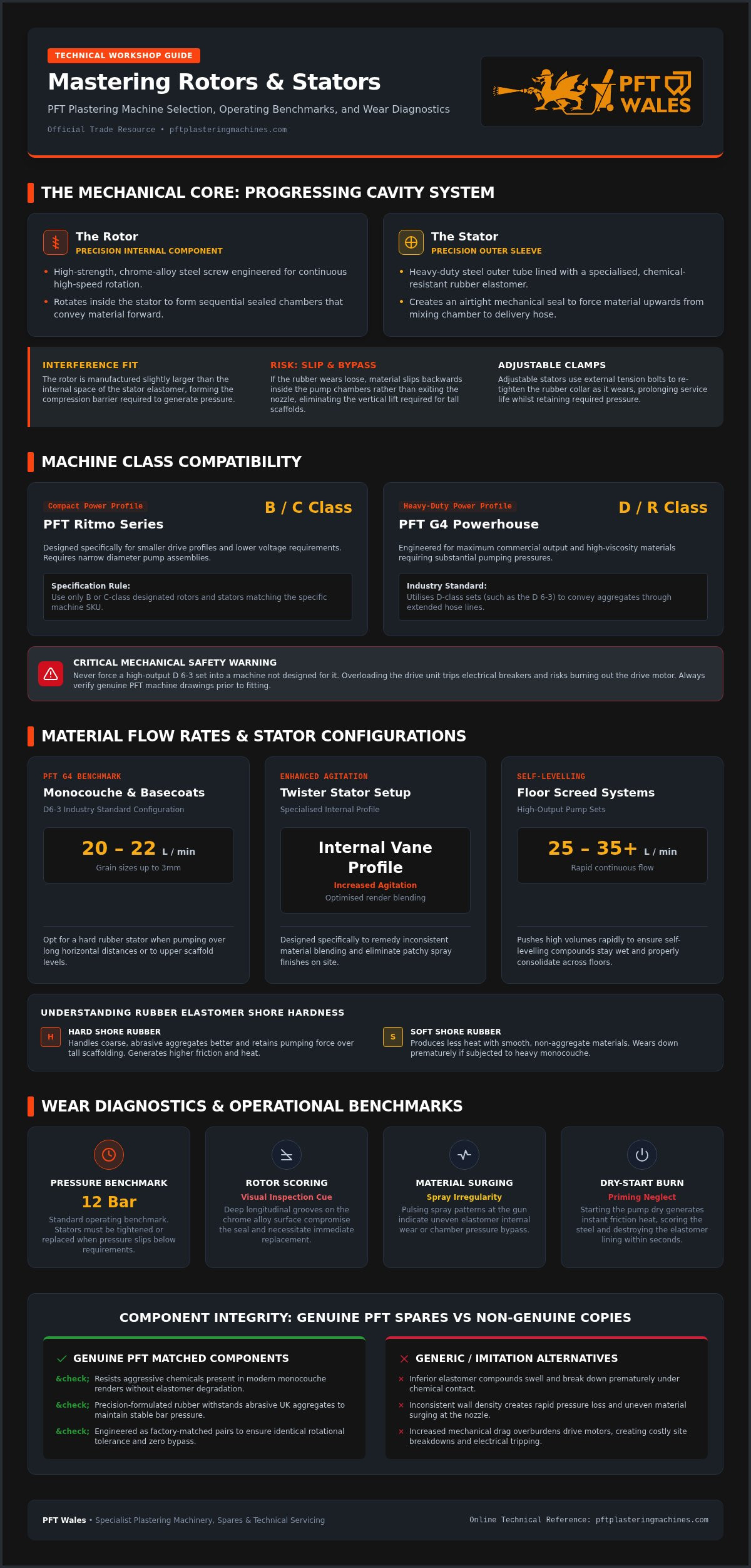
To the untrained eye, these components look like simple hardware. But for anyone running a PFT G4 or Ritmo, rotors and stators are the precision-engineered core of the entire operation. The rotor is a high-strength, chrome-alloy steel screw that spins at high speeds. It sits inside the stator, which is a tube lined with a specialised rubber elastomer. Together, they create a sequence of sealed chambers that move material from the mixing zone to the hose.
Using genuine PFT components is vital for site reliability. Generic alternatives often use inferior rubber compounds that swell or degrade when they meet the chemicals in modern monocouche renders. This leads to premature wear and inconsistent flow. Genuine parts are designed to handle the abrasive nature of UK aggregates, ensuring your pump maintains the correct bar pressure throughout a long shift.
To better understand how these components interact within the pump manifold, watch this helpful video:
The Mechanical Heart: How Pump Pressure is Generated
The pumping action relies on the progressing cavity pump mechanism. This system uses an "interference fit," where the rotor is slightly larger than the internal space of the stator. This tightness creates the seal needed to generate high pressure. If the fit is too loose, you get "slip" or "bypass," where material flows backwards inside the pump instead of out through the nozzle. This is why a worn stator can't pump material to the upper floors of a scaffold; it simply hasn't got the grip to fight gravity.
Identifying Your Machine: Ritmo vs G4 Requirements
You can't just grab any part off the shelf. Different machines have vastly different power profiles and chamber sizes. A PFT Ritmo, for example, typically uses smaller B or C-class rotors and stators, whilst the G4 powerhouse relies on the larger D or R-class sets. Attempting to force a high-output D 6-3 into a machine not designed for it will trip your breakers or, worse, burn out your motor. Before ordering, always check the PFT machine parts drawings to match the exact SKU to your specific model and voltage.
Selecting the Right Rotor and Stator Pair for Your Material
Choosing the right setup isn't just about what fits the machine; it's about matching the "shore hardness"—the density of the rubber lining—to the specific material you're pumping. Harder rubber handles abrasive aggregates better but generates more friction and heat. Softer rubber is excellent for smoother materials but wears down rapidly if you're spraying heavy monocouche. It's a constant balancing act between achieving a high-pressure output and protecting the lifespan of your components.
Safety is paramount when dealing with high-pressure pumping systems. Adhering to OSHA standards for pumping equipment ensures your site remains safe, especially when pushing material through long hose lengths. For professional results on larger projects, you might consider an adjustable stator. These feature an external clamp that allows you to tighten the fit as the rubber wears, helping you maintain that vital 12-bar pressure benchmark for longer before needing a full replacement.
Best Options for Monocouche and Basecoat Renders
For the PFT G4, the D6-3 remains the industry standard. It typically delivers around 20 to 22 litres per minute, which is ideal for standard grain sizes up to 3mm. If you're finding the material consistency isn't quite right, a "Twister" stator can improve the mix. These have an internal profile designed to increase material agitation as it passes through the pump. For long-distance pumping or working on tall scaffolds, always opt for a "hard" stator to ensure the material doesn't lose momentum before it reaches the nozzle.
Specialised Setups for Floor Screeds and Thin-Coats
If you're shifting large volumes of self-levelling compound, you need high-flow rotors and stators. These sets are designed to push 25 to 35+ litres per minute, ensuring the screed stays wet and levels properly across the floor. Conversely, for thin-coat renders or skimming with a PFT Ritmo, you'll want a smaller diameter set, such as a B 4-2 or C 4-2. These provide a more delicate, controlled flow that's easier to manage when applying fine finishes.
Choosing the wrong set can lead to motor strain or a patchy, "thick-thin" spray pattern. If you're unsure which setup fits your next job, get in touch with our technical team for expert advice. You can also browse our full rotors and stators collection to see specific material compatibility for every PFT model.
Step-by-Step Installation and Priming Checklist
Safety is your first priority. Before you pick up a tool, ensure the machine is fully isolated from the mains. This isn't just common sense; it's a key part of meeting statutory work equipment maintenance requirements. Once the power is off, clean the mixing tube until it's spotless. Any grit left behind will score your new rotors and stators, leading to a drop in pressure before you've even finished the first wall. It's a simple step, but skipping it is the fastest way to waste money on spares.
Fitting the Stator to the Rotor
Seating the stator correctly takes a bit of graft. You might use a stator puller or the machine's own drive to pull the part into place, but don't rush it. Alignment is everything. If the slots aren't lined up, the material flow gets restricted, causing unnecessary heat. When you're tightening the tie-bolts, work in a cross-pattern. Tighten them evenly. Warping the rubber lining by over-tightening one side is a rookie mistake that leads to 'hot spots' and internal tearing. It's about balance, not just brute force.
The Crucial First Start: Priming and Lubrication
A dry start is the fastest way to kill a pump. The friction between dry steel and dry rubber generates enough heat to melt the stator lining in seconds. While industrial machinery and heavy plant often rely on high-grade formulations from specialists like Rida Lubricants to combat friction, your plastering pump requires dedicated care during setup. Always use a silicone-free assembly spray to lubricate the parts during assembly. We stock these in 100ml, 250ml, and 400ml cans for easy site use. Never reach for the washing-up liquid. It contains salts and chemicals that strip the plasticisers from the rubber, making it brittle and prone to pitting.
Professional renderers always use a priming slurry. A simple mixture of water and cellulose paste or a very thin mortar mix coats the internal cavities and provides a 'slip' layer for the material to follow. Once the machine is running, keep a close eye on your pressure gauge. On a PFT G4, you should see a steady reading of at least 12 bar. If you're running a Ritmo, don't let it drop below 6 bar. If the pressure is lower, or if it fluctuates wildly, stop and check your seals. Proper lubrication and priming are the difference between a set that lasts months and one that fails by lunchtime.
Identifying Wear: When to Replace Your Rotor and Stator
Knowing exactly when to swap out your pump parts is the difference between a productive day and a costly site breakdown. You shouldn't wait for the machine to stop pumping entirely. Instead, keep a close eye on the physical condition of your components during your daily wash-down. Look for deep scoring or "rifling" on the steel rotor surface. Inside the stator, check for pitting, tears, or chunks of rubber missing from the lining. If the internal surface looks smooth but the material is still underperforming, you need a more objective measure.
The most reliable method is the dead-head pressure test using a mortar pressure gauge. On a PFT G4, a standard set should hold a minimum of 12 bar pressure. For the PFT Ritmo, the threshold is 6 bar. If your rotors and stators can't maintain these levels during a workshop or site test, the internal seal has failed. Attempting to "squeeze" more life out of worn parts by over-tightening adjustable clamps only puts massive strain on your motor and drive system, risking a much more expensive repair later.
The 'surging' Effect: A Tell-Tale Sign of Wear
Have you noticed the material pulsing or "surging" at the nozzle? This inconsistent flow is a classic sign of a failing pump. As the rubber lining wears, the interference fit loosens, allowing material to slip back into the previous chamber. This doesn't just slow you down; it ruins the finish. Poor pressure leads to inadequate material aeration, resulting in a "splattery" spray pattern that's difficult to level. If you're constantly adjusting the water flow to compensate for a patchy spray, it's time to stop work and inspect the pump before you face a total blockage.
Rotor vs Stator: Which One is the Culprit?
Tradespeople often try to save money by replacing only the stator. This is almost always a false economy. A worn rotor will have a reduced diameter and a rougher surface finish. If you drop a brand-new stator onto a worn rotor, the rough steel will act like a file, chewing through the fresh rubber in a fraction of its normal lifespan. Always check for "egg-shaping" at the stator entry point, which indicates the rotor is no longer spinning true. For a clear look at what "end-of-life" components actually look like, check out our PFT Wales training and help videos for visual wear guides.
Identifying these issues early keeps your site running smoothly and protects your machine's motor. If you're seeing performance drops but aren't sure which part to order, contact our Swansea workshop for a professional diagnosis and technical support.
Sourcing Genuine PFT Spares and Technical Support
Choosing where you buy your rotors and stators is just as important as how you maintain them. It's tempting to look for cheaper, non-genuine alternatives, but knock-off parts are a massive gamble. These components often lack the precision engineering found in genuine PFT equipment. A rotor that's even a fraction of a millimetre off can cause excessive motor strain or fail to fit the pump manifold correctly. You end up spending more on electricity and motor repairs than you ever saved on the part itself.
PFT Wales is an authorised PFT dealer with 16 years of industry experience. We don't just sell boxes; we understand the mechanics of the machines we supply. If you're on a job and a pump fails, you need an expert who can talk you through the fix. For urgent requirements where UK stock might be low, we offer an express-order service directly from Germany via FedEx. It ensures you get the genuine parts you need without the weeks of waiting that can kill a project's timeline.
Why Genuine PFT Parts Save Money in the Long Run
Genuine parts are designed to work in perfect harmony with your machine's power profile. This precision means less friction, which translates to a longer life for your motor and more consistent material flow. When the shore hardness of the rubber is exactly as specified, you don't get the unexpected pressure drops that ruin a spray pattern. You can find specific diagrams for every machine model on our plastering machine parts drawings page to ensure you're ordering the correct components for your specific pump class.
Getting Expert Help from PFT Wales
Sometimes you need more than just a new part. If your machine is struggling, our Swansea workshop offers professional servicing and repairs. We even provide service-while-you-wait options by appointment, so you can get back to the site as quickly as possible. If you're troubleshooting on-site, our technical telephone support is available on 01792 677057 to help you diagnose faults before you commit to a purchase. It's always better to speak to a specialist to ensure you're ordering the right kit for the job.
We understand that downtime costs money. That's why we offer next-working-day delivery for larger in-stock items for £9.99 across the UK mainland. Please remember that all our delivery schedules operate on working days only, so there's no Saturday delivery. Whether you need a single D6-3 stator or a complete overhaul kit from our rotors and stators range, we're here to keep your business moving.
Maximise Your Machine's Potential on Site
Mastering the maintenance of your rotors and stators is the best way to protect your machine's motor and ensure a flawless finish. By matching your pump parts to the material density and sticking to a strict priming routine, you'll avoid the common site headaches of blockages and surging. Regular pressure testing gives you the foresight to replace components before they fail, keeping your crew productive and your spray patterns consistent. Work smarter, not harder.
As an authorised PFT dealer with 16 years of trade experience, PFT Wales is here to support your business with technical wisdom and genuine spares. If you're facing an urgent breakdown, our express parts service from Germany ensures you're back in action fast. Don't let a worn stator bring your project to a standstill. Speak with our technical team today for expert advice on choosing the right components for your next job. Let's keep the material flowing.
Frequently Asked Questions
How long should a PFT rotor and stator last on average?
A rotor and stator set typically lasts between 1,000 and 3,000 square metres, but this varies based on the abrasiveness of your material. Sand-heavy renders wear components much faster than smooth gypsum plasters. You'll know it's time for a change when your pressure gauge drops below 12 bar on a G4 or 6 bar on a Ritmo. Regular cleaning and proper lubrication are the only ways to reach the upper end of that lifespan.
Can I use a D6-3 rotor with a D6-3 Twister stator?
Yes, you can use a standard D6-3 rotor with a D6-3 Twister stator as they share the same geometry. The "Twister" designation refers to the internal profile of the stator lining, which is designed to improve material agitation and mixing. Since the external dimensions and screw pitch remain the same, they're fully interchangeable. This setup is a popular choice for contractors looking to improve the consistency of their monocouche render spray.
Why is my new stator getting hot during the first use?
Excessive heat in a new stator is almost always caused by a lack of lubrication or a "dry start." If you haven't used enough assembly spray or a proper priming slurry, the friction between the steel rotor and the rubber lining generates intense heat immediately. This can cause the rubber to swell or even melt, leading to a premature failure. Always ensure the pump is fully lubricated and primed before you engage the motor.
Do I need to replace both parts at the same time?
It's highly recommended to replace both rotors and stators as a matched pair to ensure consistent pressure. Whilst the stator rubber often shows the most obvious signs of wear, the steel rotor also loses diameter over time. Fitting a new stator to a worn rotor creates a loose fit that lacks the necessary bar pressure. Conversely, a worn rotor's rough surface will quickly tear through a brand-new stator lining, which is a false economy.
What is the difference between a maintenance-free and an adjustable stator?
A maintenance-free stator has a fixed internal diameter and is simply replaced once the pressure drops below the required threshold. An adjustable stator features an external clamping system that allows you to tighten the fit as the rubber wears down. This can extend the component's life, especially when spraying abrasive renders. However, you must be careful not to over-tighten them, as this increases starting torque and can trip your machine's breakers.
Will using non-genuine rotors and stators void my PFT warranty?
Using non-genuine parts can compromise your 1-year warranty on new PFT machines if the component causes a mechanical failure. PFT machines are precision-tuned to the torque requirements of genuine parts. Third-party spares often have inconsistent shore hardness or poor fitment, leading to unnecessary strain on the drive motor. To protect your investment, it's always safest to stick with genuine PFT components sourced from an authorised dealer like PFT Wales.
How do I know if my stator is 'blown'?
You'll know a stator is "blown" when it can no longer maintain the required pumping pressure, even with the water flow correctly adjusted. Visual cues include "egg-shaping" at the entry point or chunks of rubber appearing in your material. On-site, you'll notice the material surging at the nozzle or a significant reduction in spray distance. The definitive test is using a pressure gauge; if a G4 pump can't hold 12 bar, it's spent.
What lubricant should I use when fitting a new rotor and stator?
You should only use a dedicated, silicone-free assembly spray or a cellulose-based priming paste when fitting new parts. We stock genuine PFT assembly spray in 100ml, 250ml, and 400ml cans specifically for this purpose. Never use washing-up liquid or petroleum-based greases. These household items contain salts and chemicals that break down the elastomer compounds in the stator rubber, causing it to swell and fail much earlier than it should.