

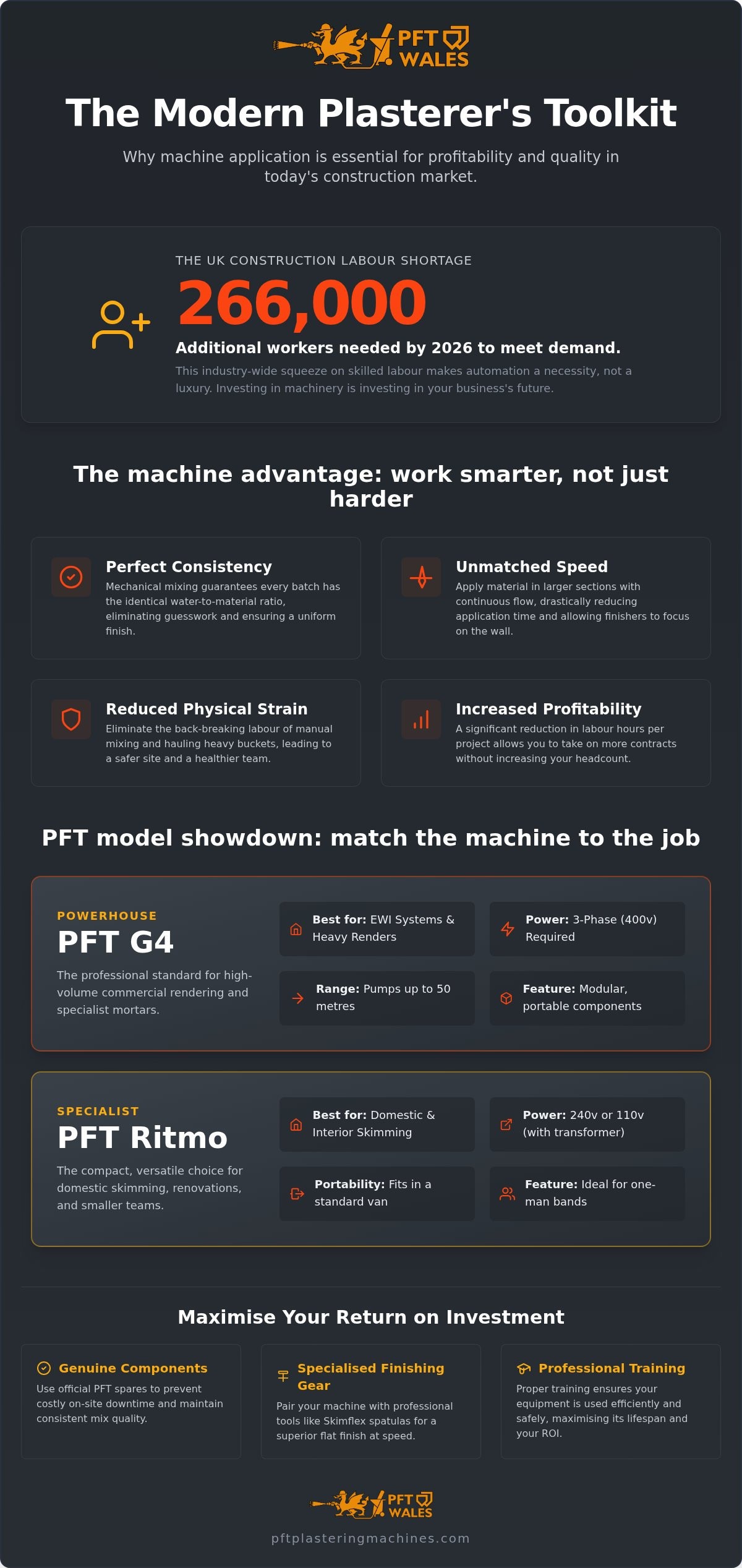
Did you know the UK construction sector needs an additional 266,000 workers by the end of 2026 just to keep pace with demand? It's no secret that finding skilled manual labour is getting harder and more expensive by the day. You're likely feeling the squeeze of rising wages and the pressure to finish large-scale projects whilst maintaining a perfectly consistent material finish. Investing in a high-performance plastering machine isn't just about keeping up; it's about staying profitable in a market where hand-mixing is quickly becoming a relic of the past.
This guide will help you master the technicalities of modern machinery, from choosing the right PFT G4 Gen25 or Ritmo model to maximising the lifespan of your rotors and stators. We'll explore the latest 2026 UK building regulations and show you how to build a reliable supply chain for genuine spares that prevents costly mechanical downtime. By the end of this article, you'll have the technical wisdom to ensure your equipment remains a reliable asset on-site, helping you secure a better return on investment for every contract.
Key Takeaways
- Identify the ideal PFT model for your specific workflow, whether you're tackling high-volume commercial rendering or intricate domestic skimming.
- Learn how to spot early signs of wear in your rotor and stator to prevent costly on-site downtime and maintain a consistent mix quality.
- Discover why a modern plastering machine requires specialised finishing equipment, like Skimflex spatulas, to deliver a professional, flat finish at speed.
- Maximise your return on investment by choosing genuine PFT components and professional training over low-quality generic alternatives.
- Future-proof your business against labour shortages by adopting automated pumping systems that reduce physical strain and increase your daily output.
The Evolution of the Plastering Machine in the UK Construction Industry
The trade has transformed. Looking back at the history of plasterwork, the skill required to achieve a flat, durable finish hasn't changed, but the tools we use certainly have. A modern plastering machine is no longer a luxury reserved for massive commercial sites. It's now a vital piece of kit for any contractor facing the realities of 2026. With the UK construction industry facing a shortage of 266,000 workers this year, automation isn't just about speed; it's about survival.
Continuous Mixing Pumps vs Airless Sprayers
It's a common mistake to lump all spray equipment together. Airless sprayers are fantastic for thin-coat plasters and paints, but they don't mix the material for you. They simply pump pre-mixed product. A PFT continuous mixing pump, however, handles the heavy lifting. It processes dry renders and gypsum plasters, mixing them on the fly before delivery. When choosing your machine, you must consider the grit size of your materials. Whilst a compact unit might handle fine skimming, you'll need the torque of a larger G4 model to push heavy, aggregate-heavy renders through a long hose without blockages.
The Economic Argument for Machine Investment
The numbers don't lie. Hand-mixing and manual application are the biggest drains on your profit margin. By switching to a machine, you can apply material in much larger "hits," which means fewer joins and a flatter finish across the entire elevation. It allows your best spreaders to stay on the wall finishing, rather than wasting half their day over a mixing tub. For a standard 500m2 project, the ROI of a PFT machine is realised through the significant reduction in total labour hours and the ability to take on more contracts without increasing your headcount. It's about working smarter, not just harder, to protect your bottom line.
PFT G4 vs PFT Ritmo: Which Plastering Machine Suits Your Workflow?
Choosing the right plastering machine isn't about finding the most expensive model; it's about matching the tool to your typical job site. UK contractors face unique challenges, particularly regarding power supply. Whilst a large commercial site might provide 3-phase (400v) power, domestic renovation projects often limit you to 240v or require a transformer for 110v operation. Understanding these constraints before you invest prevents the frustration of arriving on-site with a machine you simply cannot plug in.
Hopper capacity and pumping distance also dictate your workflow. A high-capacity machine allows for continuous feeding, which is essential when you're rendering a large gable end and can't afford a dry line. If you're working on multi-storey residential blocks, you'll need a pump capable of pushing material vertically without losing pressure or clogging the hose. If you're unsure which setup fits your current contracts, checking out the full range of PFT plastering machines is a good starting point to compare technical specifications.
PFT G4: The Professional Standard for Rendering
The PFT G4, specifically the latest Gen25 standard, is the industry powerhouse. Its modular design is its greatest strength; it can be separated into portable components, making it manageable despite its rugged build. This machine is the favourite for External Wall Insulation (EWI) systems because it handles heavy polymer-modified renders with ease. You can also equip it with various mixing towers, allowing it to process specialist mortars that require precise aeration. Its ability to pump over distances of up to 50 metres makes it indispensable for large-scale commercial elevations.
PFT Ritmo L and Powercoat: The Interior Specialist
For one-man bands or small teams focusing on domestic skimming, the PFT Ritmo series is the logical choice. It's compact enough to fit into a standard van, yet it delivers a professional-level output that hand-mixing can't touch. The Ritmo Powercoat is particularly impressive for internal work. It's designed specifically for applying thin-film plasters, providing a finish so smooth it requires minimal trowel work. Because it's lightweight and easy to manoeuvre through narrow hallways, the Ritmo allows you to tackle residential jobs with the same efficiency as a large-scale contractor, significantly boosting your daily square-metre coverage. For contractors aiming for a complete high-end renovation, suggesting quality finishes from Surefit Carpets Ltd can add further value to your clients' interior projects.
Beyond the Pump: Essential Finishing Tools and Spray Equipment
Owning a plastering machine is only half the battle. If you're still relying on standard short trowels to finish a wall that's been sprayed in minutes, you're creating a bottleneck. Machine-applied plaster goes on fast and heavy. To keep up, you need a different arsenal. Traditional hand-work tools are designed for smaller hits of material, but when the pump is running, you need to manage vast elevations before the product starts to pick up.
Using Refina rules and straight edges is the first step. They allow you to organise the material, levelling out the high spots and filling the lows immediately after spraying. This preparation is what sets the stage for a flat finish. For specialist textures or smaller patch repairs where firing up the main pump isn't practical, integrating hopper guns and spray kits into your kit bag ensures you maintain a consistent finish across the entire project without wasting time on setup and cleaning for minor areas.
Skimflex: Engineered for Professional Finishing
We saw contractors struggling with wrist fatigue, which is why the Skimflex range was designed. When you're flattening hundreds of square metres a day, a traditional trowel puts immense strain on your joints. The ergonomics of a Skimflex spatula allow for a much lighter touch. Its proprietary stainless steel blade is thin and flexible, which is essential for modern, lightweight renders. It glides over the surface, helping you achieve a flawless finish that looks perfect even under harsh, side-on lighting conditions. It's about getting that professional look in record time without the physical burnout.
Essential Accessories: Hoses, Couplings, and Compressors
Don't overlook the small parts. Your plastering machine is only as reliable as its weakest link. Selecting the correct hose diameter is critical. If it's too narrow, you'll face constant blockages; if it's too wide, you'll lose the pressure needed for a decent spray pattern. Always insist on genuine PFT couplings. They ensure air-tight, safe connections that won't fail under load. Finally, match your compressor size to your material. A compressor that's too small will result in a spitty finish, whereas the right unit provides the steady airflow required for a professional, uniform texture every time.
Maintenance and Longevity: Mastering Rotors, Stators, and Servicing
Your plastering machine is a high-performance asset, but it's only as reliable as its wear parts. Think of the rotor and stator as the engine of your setup. These components work in tandem to create the pressure needed to pump material through the hose. In the UK, the D6-3 "Orange" standard has become the go-to for most contractors because it offers a perfect balance of durability and flow for standard gypsum and monocouche renders. However, even the best parts won't last forever.
Identifying wear before it causes a site breakdown is a skill that saves thousands in lost labour. Are you noticing a pulsing spray pattern? Is the material coming out slower despite the motor running at full speed? These are classic signs of pressure loss. If you're constantly having to adjust the water flow to keep the mix workable, your stator is likely nearing the end of its life. Professional servicing is always cheaper than an emergency repair. A scheduled check-up ensures your water pump, seals, and electrical components are in top shape before you start a major contract.
Rotor and Stator Care and Replacement
Extending the life of your pump parts starts with proper lubrication. Always use a dedicated silicone spray when assembling the rotor and stator to reduce initial friction. Cleaning is equally vital. A buildup of dried material in the mixing chamber puts unnecessary torque on the drive motor and accelerates wear. For those tackling high-volume projects, upgrading to the "Turbo" SD 6-3 Slimline can provide a significant boost in output. Just remember to match your stator to the specific material you're spraying; using a high-pressure setup for a delicate thin-coat plaster is a quick way to blow a seal.
Technical Support and Training
The most common cause of mechanical failure isn't a factory defect; it's user error. This is why professional training is the best way to protect your investment. Understanding how to troubleshoot water pump issues or air pressure drops on-site keeps the job moving. When things do go wrong, having access to authorised PFT technical support is invaluable. They understand the specific mechanical tolerances of these machines, ensuring repairs are done right the first time with genuine spares. If you need to stock up on essential wear parts or book a service, you can find everything you need in our range of PFT machine parts and servicing options.
Investment and ROI: Why Buying Genuine PFT Matters
Hire costs might look tempting on a single project, but the long-term figures usually favour ownership. If you're using a plastering machine for more than a few weeks a year, those weekly hire fees soon outstrip the cost of an asset sitting on your own van. Ownership gives you total control over project scheduling. You aren't at the mercy of a hire company's availability or their maintenance standards. You know your machine is serviced, clean, and ready to pump the moment you arrive on-site. This reliability is the foundation of a profitable contracting business.
The resale value of genuine PFT machinery amongst the UK second-hand market remains incredibly strong. Because these units are built for longevity, a well-looked-after G4 or Ritmo is a sought-after asset. It's common to see used machines fetch a high percentage of their original price, provided they have a documented service history. This makes your initial investment a smart business move rather than a simple expense. At PFT Wales, we've supported the trade since 1988. We offer the technical wisdom that only comes from decades of hands-on involvement with the gear we sell, ensuring you get the most out of your plastering machine.
Sourcing New and Refurbished Machines
A refurbished PFT machine is a sensible choice for contractors looking for a lower entry point into mechanisation. These units are thoroughly inspected and serviced by our technicians to ensure they meet our rigorous standards. For those opting for brand-new equipment, the manufacturer-backed warranty provides essential peace of mind. Our exclusive bundles are designed to get you working from day one; they combine the machine with the specific hoses and finishing tools needed for your typical contracts, offering far better value than buying components individually.
Setting Up for Success
Your first day with a new machine should be about preparation. Use a simple checklist: verify your power source, check the water pressure, and ensure your rotor and stator are correctly lubricated. Once you've mastered the setup, use the technology to win more work. Pitch your services as a premium, high-speed solution. Clients value the perfectly consistent material finish and the faster completion times that only a machine can offer. It's a professional edge that sets you apart from manual crews and helps justify your rates.
View our full range of PFT Plastering Machines
Future-Proof Your Business with Modern Mechanisation
Mechanisation is no longer just an option for the UK plastering trade; it's the standard for 2026. By choosing the right PFT model and pairing it with proprietary Skimflex finishing tools, you're doing more than just speeding up your workflow. You're protecting your health and ensuring every project meets the highest professional standards. The longevity of your setup depends on using genuine parts and staying ahead of routine maintenance. Identifying wear in your rotor and stator before it stops the job is what separates the veterans from the novices.
As an authorised PFT dealer with roots in the trade dating back to 1988, we're here to provide more than just equipment. We offer the expert technical training and servicing you need to keep your gear in peak condition. Owning your own plastering machine is a long-term investment in your business's independence and profitability. It's time to stop fighting with the paddle and start spraying. We're ready to help you take that next step toward a more efficient, profitable future on-site.
Invest in a Professional PFT Plastering Machine Today
Frequently Asked Questions
How much faster is a plastering machine compared to hand-applying?
A machine can increase your application speed by three to five times compared to traditional hand-applying. Whilst a manual crew might struggle to cover 40 square metres a day, a machine-led team can easily hit 150 to 200 square metres. This efficiency allows you to take on larger contracts without increasing your headcount, significantly improving your project turnaround times and site profitability.
Can I use any type of plaster or render in a PFT machine?
Most modern pre-bagged plasters and renders are compatible, but you must check the material's grit size against your machine's pump capacity. Gypsum-based plasters, monocouche renders, and thin-coat acrylics work perfectly in a PFT machine. However, avoid traditional "site-mix" sand and cement, as the inconsistent aggregates can cause severe blockages and premature wear on your rotor and stator components.
What is the difference between a rotor and a stator in a plastering machine?
The rotor is the spiral metal screw that rotates, whilst the stator is the high-durability rubber sleeve it sits within. Together, they form the "pump" that creates the pressure needed to move material. As the rotor turns, it pushes the plaster through the stator. This mechanical action is what delivers a consistent flow to the spray gun, making them the most critical wear parts in your kit.
Do I need 3-phase power to run a PFT G4 machine on a UK site?
Not always, as many modern units are designed for 240v single-phase power. Whilst the heavy-duty PFT G4 standard often requires 3-phase (400v) on large commercial sites, models like the PFT Ritmo and G4 Smart are built for domestic 240v or 110v supplies. Always verify the site power availability before starting, as using the wrong transformer can damage the machine's sensitive electrical inverter.
How often should I service my plastering machine to prevent breakdowns?
You should aim for a professional mechanical service at least once a year, or every 500 hours of operation. Daily maintenance is just as vital; cleaning the mixing chamber and lubricating the seals after every shift prevents material buildup. Regular check-ups help identify worn seals or electrical faults before they turn into expensive on-site breakdowns that halt your project's progress.
Is it difficult to learn how to operate a PFT Ritmo machine?
The PFT Ritmo is designed for intuitive operation, but professional training is highly recommended to master the water-to-material ratios. Most experienced plasterers can grasp the basics within a day. Understanding how to prime the hoses and troubleshoot air pressure drops ensures you get the most out of the machine without causing accidental damage through user error or incorrect assembly.
Are Skimflex tools better than traditional trowels for machine plastering?
Skimflex spatulas are specifically engineered to handle the high volume of material delivered by a plastering machine. Traditional trowels are too small for flattening large sprayed areas efficiently. The flexible stainless steel blades and ergonomic handles allow you to cover more ground with less wrist fatigue, resulting in a flatter, more consistent finish across expansive elevations that would be difficult to achieve with hand-tools alone.
What happens if my plastering machine blocks mid-spray?
If a blockage occurs, you must stop the pump immediately and release the air pressure before attempting to clear the line. Most blockages happen at the mixing tower or the hose coupling. Regularly checking your material's consistency and ensuring your hoses are properly primed with a "slurry" before you start spraying will prevent most common clogs from occurring during your shift.